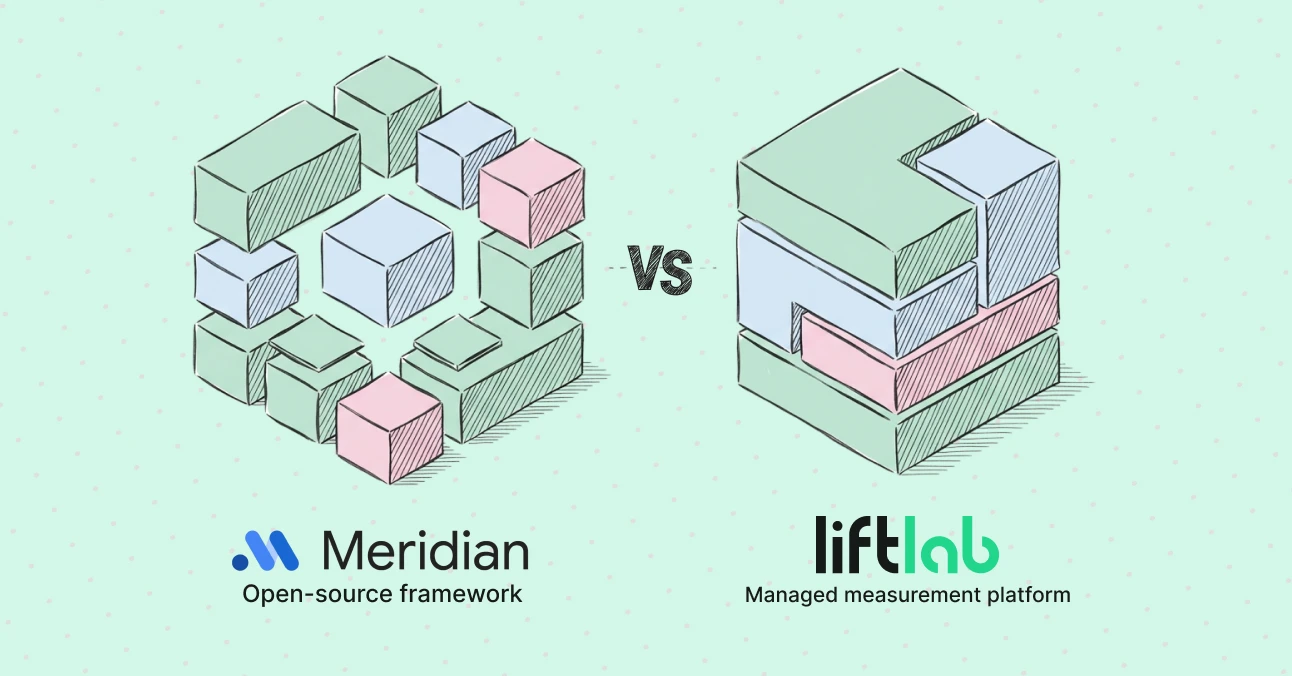
Meridian brings Bayesian marketing mix modeling to teams willing to build and run it. LiftLab takes a managed-platform approach, combining measurement with the ongoing monitoring and decision-making needed to use MMM across the full marketing mix.
Executive Summary
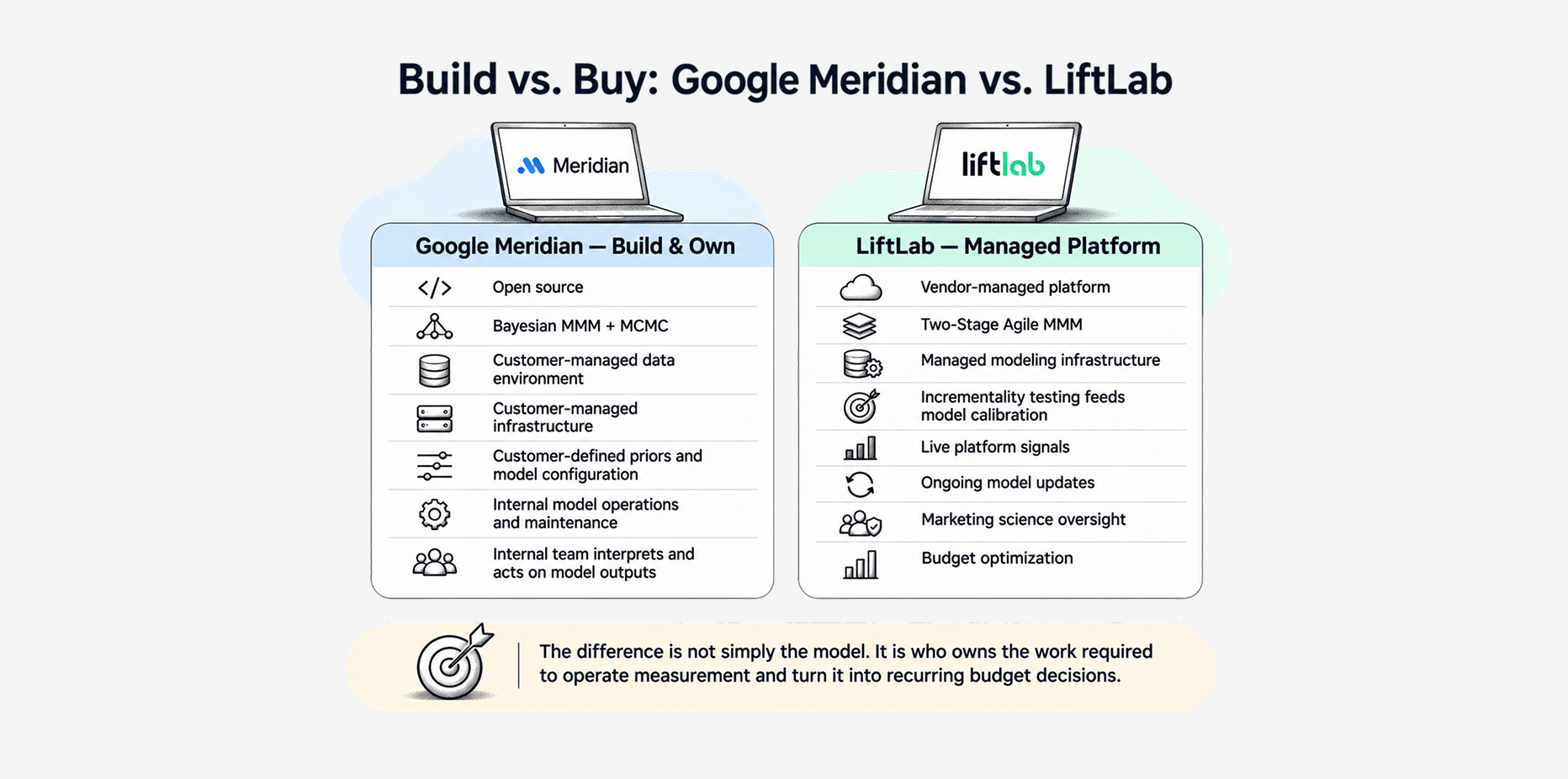
Google Meridian and LiftLab take different approaches to marketing mix modeling. Meridian is an open-source framework that gives analytics teams direct control over the model, data, priors and infrastructure. LiftLab is a managed platform that connects MMM with incrementality testing, live platform signals and ongoing budget optimization.
The choice is less about whether one approach can produce an MMM and more about who operates the measurement capability. Meridian can suit teams with the technical expertise and infrastructure to build and maintain their own modeling workflow. LiftLab shifts that operational responsibility to a managed platform, with ongoing model updates, experimentation and marketing science oversight built into the process.
For teams weighing build versus buy, the key consideration is whether they want to own the modeling stack or use measurement as an ongoing operating capability.
Same question, two different delivery models
Both Google Meridian and LiftLab address the same fundamental marketing measurement questions: which channels are driving incremental results, what is the return from each channel, and how should the next marketing dollar be allocated?
Google Meridian is an open-source Bayesian Marketing Mix Modeling (MMM) framework. It uses Bayesian causal inference and Markov Chain Monte Carlo (MCMC) methods to estimate channel effects, quantify uncertainty, model response curves, and support budget allocation. Google Meridian MMM gives analytics teams direct control over model configuration, priors, diagnostics, and the underlying modeling environment.
Teams working with Meridian are responsible for the model environment, data preparation, priors, diagnostics, and ongoing model operation.
LiftLab takes a managed-platform approach to marketing measurement. Its Agile MMM connects measurement with incrementality testing and ongoing optimization. The distinction here is the delivery model: who builds, operates, maintains, and turns the measurement system into an ongoing input to marketing decisions.
How they compare, feature by feature
| Dimension | Google Meridian | LiftLab |
|---|---|---|
| Cost model | Free, open source | Subscription, vendor-managed |
| Stack | Python, TensorFlow Probability; GPU recommended for MCMC sampling | Managed platform; no customer-managed modeling infrastructure |
| Methodology | Bayesian causal inference using MCMC; default priors provided, customization expected | Bayesian causal inference using MCMC, compounded with a two-Stage Agile MMM, separating auction dynamics from consumer response, with experimental evidence used to calibrate response estimates |
| Native data signals | Google Ads, Search query volume, YouTube reach/frequency | First-party transaction data plus third-party platform data like paid, brand, and offline marketing signals |
| Update cadence | Python-driven batch runs; Scenario Planner supports budget planning | Customizable up to daily model refreshes |
| Causality | Experiment results can calibrate ROI priors through Meridian’s calibration tooling | Incrementality experiments feed into the Trust Engine to validate and calibrate response curves |
| Brand + performance | Channel-level Bayesian decomposition | Separates immediate performance effects from longer-term brand effects |
| Support | Community + certified partner network | Vendor-managed support |
| Compute requirement | Analyst-managed Python environment; GPU recommended | Managed infrastructure |
Where Meridian is the right call
Google Meridian makes sense for teams that want direct control over their marketing mix model and have the technical resources to operate it.
Its biggest advantage is the combination of open-source access and Bayesian methodology. Analysts can work directly with the model, specify priors, inspect diagnostics, and control how the analysis is implemented rather than relying on a managed abstraction.
Meridian also has a meaningful advantage for teams with substantial Google media investment. Its native integrations include Google Ads data, Search query volume, and YouTube reach and frequency signals, giving those inputs a direct place in the modeling workflow.
Google continues to develop the platform, including the Scenario Planner, which supports interactive budget optimization and future budget scenarios.
For an analytics team with the Python expertise, data engineering capacity, and ongoing model-operations bandwidth to support it, Google Meridian can be a powerful way to build an in-house MMM capability. Teams that need implementation or operational support can also work with a Google Meridian partner.
The cost that doesn’t show up on a license page
Meridian is free to download. Running an MMM capability around it is not necessarily free.
Bayesian expertise is a hiring problem
Meridian gives analysts direct control over the model, but that control comes with overheads. Running it effectively requires Python proficiency, data engineering skills, an understanding of Bayesian priors, model diagnostics, and ongoing capacity to refresh and interpret the model. In other words, you need a data engineer, a data scientist and a marketing scientist to effectively use Meridian.
Infrastructure you now own
Meridian runs in a Python environment, and Google recommends a minimum of one GPU for the compute-intensive MCMC sampling used by the model.
Someone still needs to provision and maintain the environment, manage data pipelines, run the models, troubleshoot failures, and keep the output available.
The software is open source. The infrastructure still has to be provisioned, maintained, and operated.
Priors are judgment calls
Bayesian modeling allows analysts to incorporate prior knowledge into the model. It also means someone has to decide what those priors should be, assess whether they’re appropriate, and understand how they affect the resulting estimates.
That’s not a weakness of Bayesian MMM. It’s part of having direct control over the model. The operational question is whether your organization wants to keep that expertise in-house.
Connecting measurement across the funnel
Meridian can incorporate a broad range of media and non-media variables, but teams with broader full-funnel measurement requirements may need additional signals and approaches alongside the core model.
That’s relevant when the question isn’t just which performance channel generated sales this quarter, but how performance media and longer-term brand investment contribute to the same business outcome.
Key-person risk
An internally operated model can become dependent on the people who understand its data pipelines, model specification, assumptions, diagnostics, and history.
The code leaves when the analyst does. The context goes with it. Knowledge transfer and continuity therefore become part of the operating cost of an in-house MMM capability.
What changes with LiftLab
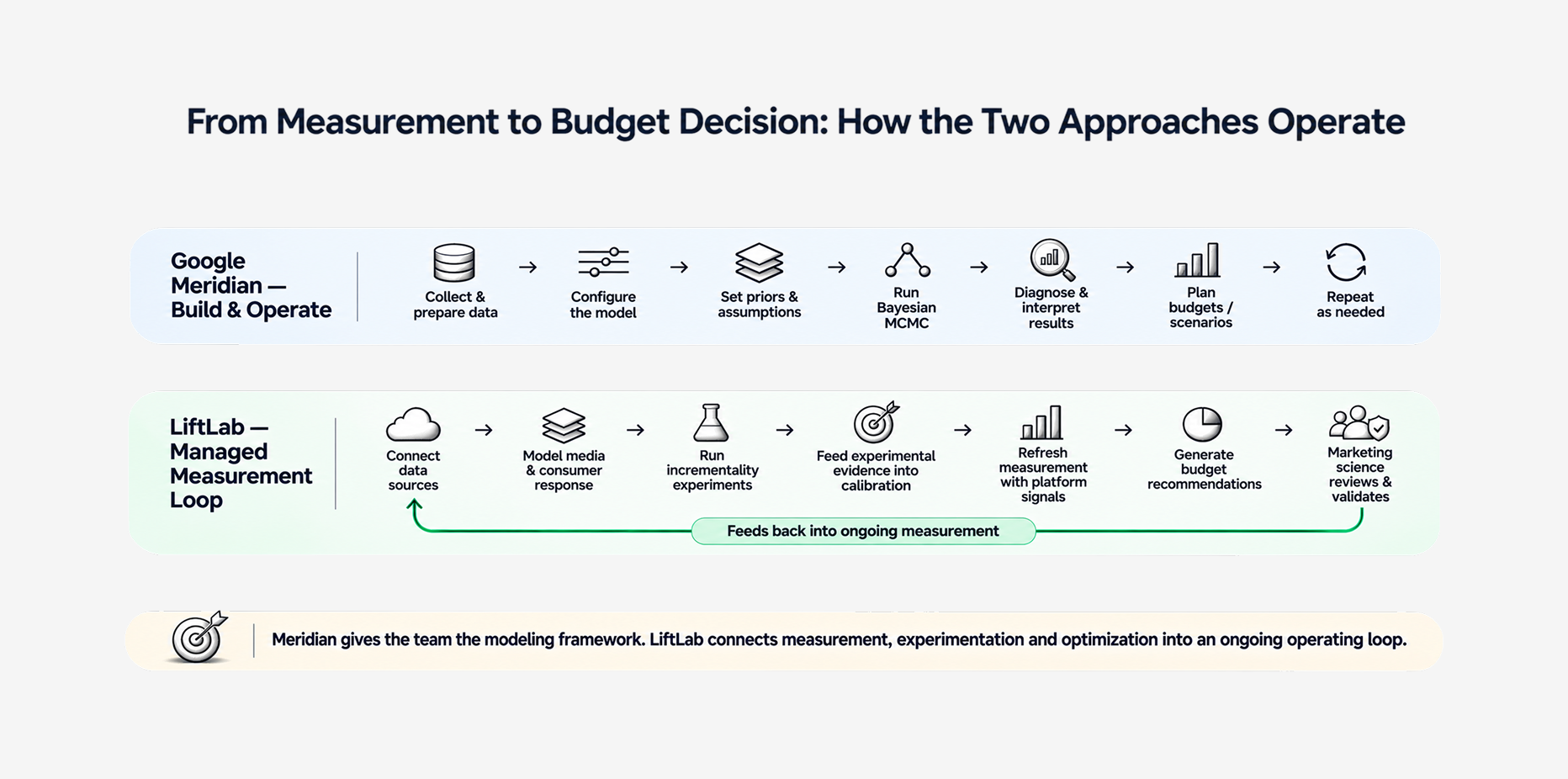
A managed platform like LiftLab shifts the operational work from the internal analytics team to the measurement platform. LiftLab continuously refreshed MMM with incrementality testing, live platform signals and budget optimization, so measurement can function as an ongoing operating system rather than a model the team runs periodically.
Daily platform-shift detection
Marketing platforms can change faster than a traditional MMM cycle. LiftLab’s PlatformSense layer ingests live platform signals, while its Agile MMM refreshes models daily. As a result, teams can detect changes in channel performance without waiting for a quarterly or annual model refresh.
The distinction is between a model that reports on what happened and a measurement system that keeps updating as the market changes.
Managed infrastructure, zero GPU ops
With LiftLab, the modeling environment is managed rather than maintained by the customer’s analytics team. LiftLab’s marketing science team handles model configuration, calibration and ongoing validation, so customers don’t need to build or maintain the modeling infrastructure themselves.
Built-in incrementality
LiftLab treats incrementality experiments and MMM as complementary. Geo holdouts, conversion lift studies and matched-market experiments provide causal evidence for specific channel or campaign questions, while MMM provides the continuous cross-channel view. Experiment results feed into the modeling layer as calibration inputs, sharpening the model’s estimates over time.
That creates a feedback loop between observational measurement and experimental evidence, rather than treating the MMM as a closed system.
Blended brand + performance
LiftLab’s full-funnel architecture measures both short-term performance effects and the longer-term contribution of brand investment. Its Long-Term Multiplier framework quantifies the compounding value of brand investment alongside immediate channel returns, giving marketing and finance a common view of marketing’s contribution to the P&L.
Agile optimization with expert oversight
LiftLab’s agile optimization strategy ingests spend data, refreshes model coefficients, and generates budget reallocation recommendations. Marketing scientists review the outputs, validate assumptions, flag anomalies, and account for business contexts such as pricing changes, product launches, and market shifts.
The result is a human-in-the-loop optimization system where models adapt to real-time changes in demand and performance, becoming sharper and more accurate.
How the LiftLab model works
LiftLab’s Agile MMM uses a two-stage approach that separates auction dynamics from consumer response. The first stage accounts for changes in media costs and auction conditions. The second models how exposure translates into immediate business outcomes and longer-term brand effects.
The model combines observational data with experimental evidence. LiftLab uses incrementality experiments like geo holdouts (also called matched-market tests) to provide additional causal evidence that can be used to calibrate the model’s response estimates.
The platform also incorporates live platform signals and refreshes the model daily. Its optimization layer uses the resulting estimates to generate budget recommendations, while LiftLab’s marketing science team reviews the outputs, validates assumptions and accounts for business context.
Does it matter that Google built the tool measuring Google’s channels?
Meridian’s Google-native data integrations are a genuine advantage for teams with substantial Google media investment. Meridian can incorporate Google Ads data, search query volume, and YouTube reach and frequency signals directly into its modeling workflow.
When Google’s channels represent only part of the media mix, teams investing significantly in non-Google channels may need additional measurement inputs or independent validation to understand those channels with the same level of confidence.
That is not evidence that Meridian intentionally favors Google’s channels. It is a question of measurement coverage: whether the data and validation available within the tool adequately represent the marketing mix a business operates.
Which one fits where you are right now?
The right approach depends on what your team wants to own.
Meridian may be enough if you have the data science and engineering resources to build and maintain an MMM workflow, want direct control over model specifications and priors, and are comfortable managing the infrastructure and ongoing analysis yourself.
A managed platform may make more sense if you want measurement to operate as an ongoing capability rather than an internal modeling project. This goes double if you need recurring measurement across a broad channel mix, integrated incrementality testing, and a platform that connects measurement to budget decisions.
Started with Meridian? Here’s what teams hit at scale
Starting with Meridian to build an internal MMM system can be quite simple. It even works well for smaller operations with a limited marketing footprint. However, as the organization grows and measurement matures, teams need continuous model updates, broader data integration, experiment-based calibration, and more internal effort to maintain the modeling environment. It’s easy to see how this can get both time-consuming and expensive, especially when teams are trying to scale fast and don’t have the bandwidth to focus on non-essential functions.
Moving to LiftLab? Here’s what it looks like in practice
If you have been running Google Meridian but are ready to make the shift to a managed solution like LiftLab, you’ll be surprised at how easy the process is.
For one thing, none of your Meridian output is wasted. All of it, including prior data, iROAS etc are fed into the LiftLab MMM. LiftLab integrates with all leading key platforms, data warehouses, and marketing ecosystems, and the onboarding team helps make that process smooth. Depending on how your data lives, this can take as little as two weeks only, after which a dedicated LiftLab marketing scientist configures your baseline Agile MMM while others in the team design and launch your first experiments.
Usually by the fourth week, the system is live and you begin to receive budgeting recommendations while the LiftLab team constantly refines and calibrates your model to make it more effective and accurate.
To see how LiftLab customers use these recommendations to make more from each marketing dollar, check out the examples below.
Pandora used LiftLab’s scenario planning, geo tests and marginal-return analysis to make weekly budget adjustments. A 2% reallocation of its media budget from brand to generic search and shopping was followed by a 9.5% increase in revenue and 12.4% increase in profit. Read the Pandora case study
Cinemark expanded its measured channel mix from 7 to 13 channels over three years and used MMM alongside incrementality testing to inform ongoing budget allocation. Read the Cinemark case study
These examples illustrate the operating model: measurement becomes an input into recurring budget decisions, with experimentation providing additional evidence.
See your own data run through both approaches
Curious what the difference looks like in your own marketing mix?
Already running Meridian? Talk to LiftLab about what it would take to operationalize your measurement beyond the model.
Building your first MMM capability? See how LiftLab approaches measurement, experimentation and optimization as a managed platform.
Key takeaway
Meridian gives teams control over building their own MMM capability. LiftLab gives teams a managed measurement system that connects MMM, experimentation and optimization. The meaningful difference is not simply the model. It is who owns the work required to keep measurement running and turn it into recurring budget decisions.
Frequently asked questions about LiftLab vs. Google Meridian
Isn’t Meridian free and Bayesian, so why would we need anything else?
Google Meridian can be a strong choice for teams that want to build and operate their own Bayesian marketing mix modeling capability. The software is free, but the data engineering, infrastructure, statistical expertise, diagnostics, maintenance, experimentation, and ongoing operation are not.
Does Google favor its own channels in Meridian’s results?
Google’s ownership of Meridian is not evidence that the model intentionally favors Google channels. The relevant question is whether the data and validation methods adequately represent every channel in your marketing mix, particularly when significant investment sits outside Google’s ecosystem.
How is LiftLab’s model different from Meridian’s Bayesian MCMC approach?
Google Meridian is a Bayesian marketing mix model that uses MCMC to estimate channel effects and uncertainty, with analysts specifying priors. LiftLab also uses Bayesian with MCMC, but compounds that with a two-stage architecture separating auction dynamics from consumer response and incorporates incrementality experiments into model calibration.
We already have a Meridian pipeline. What does switching involve?
Switching primarily changes who operates the measurement capability rather than making your existing work irrelevant. LiftLab’s onboarding connects data sources, ingests historical data, configures the model, and launches an incrementality experiment before ongoing measurement moves to the managed platform. Depending on the condition of customer data, this is a process that can be completed in as little as 2 weeks.