Liftlab - Logo
Request a Demo

Trusted by the Category Leaders Who've Outgrown Their Dashboards

From global consumer brands to high-growth DTC, LiftLab is the measurement system for CMOs and CFOs. They choose LiftLab when platform attribution no longer suffices. 

Retail jewelry — global

+9.5% revenue

from a 2% budget shift

Entertainment — enterprise

7 → 13 channels

weekly mROAS reallocation

Financial software

+19% gross revenue

year-end window

DTC apparel

3.4x TikTok spend

at max profit

Ecommerce grocery

13 channels optimised

weekly CAC forecasts

2–2.5×

Long-term vs. short-term brand advertising returns across 1,000+ brands

Dr. Koen Pauwels, Northeastern University
60–90

Days before brand effects begin surfacing in measurable revenue data

LiftLab webinar, February 2026
30+

Years of peer-reviewed marketing science underlying LiftLab’s LT multiplier framework

Dr. Koen Pauwels, Northeastern University

Your Model Rewards Short-Term Efficiency. Your Brand Pays the Price.

If your MMM does not account for long-term brand effects, each optimization cycle can gradually erode the brand equity that supports organic growth, lowers CAC, and maintains price elasticity, even as dashboards indicate positive results.

Your Model Rewards Short-Term Efficiency. Your Brand Pays the Price.

If your MMM does not account for long-term brand effects, each optimization cycle can gradually erode the brand equity that supports organic growth, lowers CAC, and maintains price elasticity, even as dashboards indicate positive results.

01 — MODEL BIAS

Standard MMMs run weekly. Brand compounds quarterly.

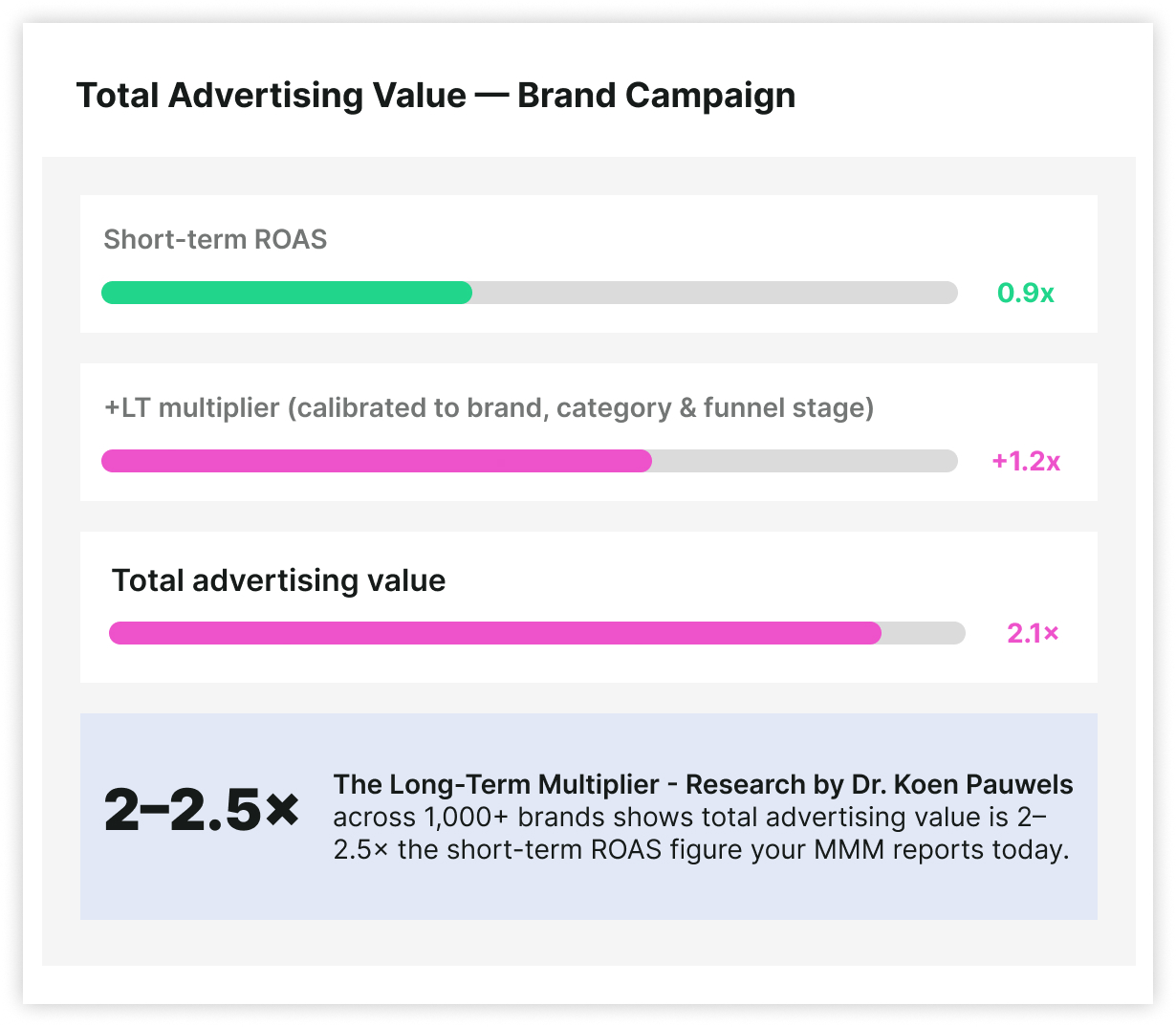
Standard MMMs focus on outcomes that are immediately attributable, such as short-term conversions and clicks. However, brand advertising delivers compounding value over time, resulting in lower future CAC, higher LTV, and increased organic demand. Without calibrating the long-term multiplier—the ratio of total to short-term advertising value—the model consistently undervalues brand campaigns and overlooks the 2 to 2.5 times long-term uplift observed across more than 1,000 brands.

02 — MISATTRIBUTION

Halo lift gets stolen by performance channels — inflating their ROAS

Attribution systems assign credit to the channel present at the time of conversion, while brand advertising that generated purchase intent earlier receives none. This inflates performance ROAS and makes brand investments appear inefficient, often leading to reduced brand spend. CAC then rises 6 to 18 months later, but the delay prevents clear attribution, and models focused only on short-term effects cannot reveal this connection.

03 — LANGUAGE GAP

Finance sees brand as a cost, not a compounding asset

Metrics such as awareness, consideration, NPS, and share of voice are valid leading indicators, but they operate on a different timescale than the CFO's reporting cycle. Unless brand equity is quantified in terms of reduced future CAC and higher LTV, with a net present value that Finance can audit, brand spend is typically the first to be reduced during a downturn.

04 — DEMAND DECAY

Over-indexing on performance creates long-term demand decay

Performance channels convert demand generated by brand investment. When brand spending decreases, performance efficiency declines over time, but the lag often obscures the connection until negative effects are evident. Conversion rates decrease, organic traffic declines, and CAC rises, yet the model fails to capture these changes.

Four Layers That Make Every Brand
Dollar Visible on the P&L

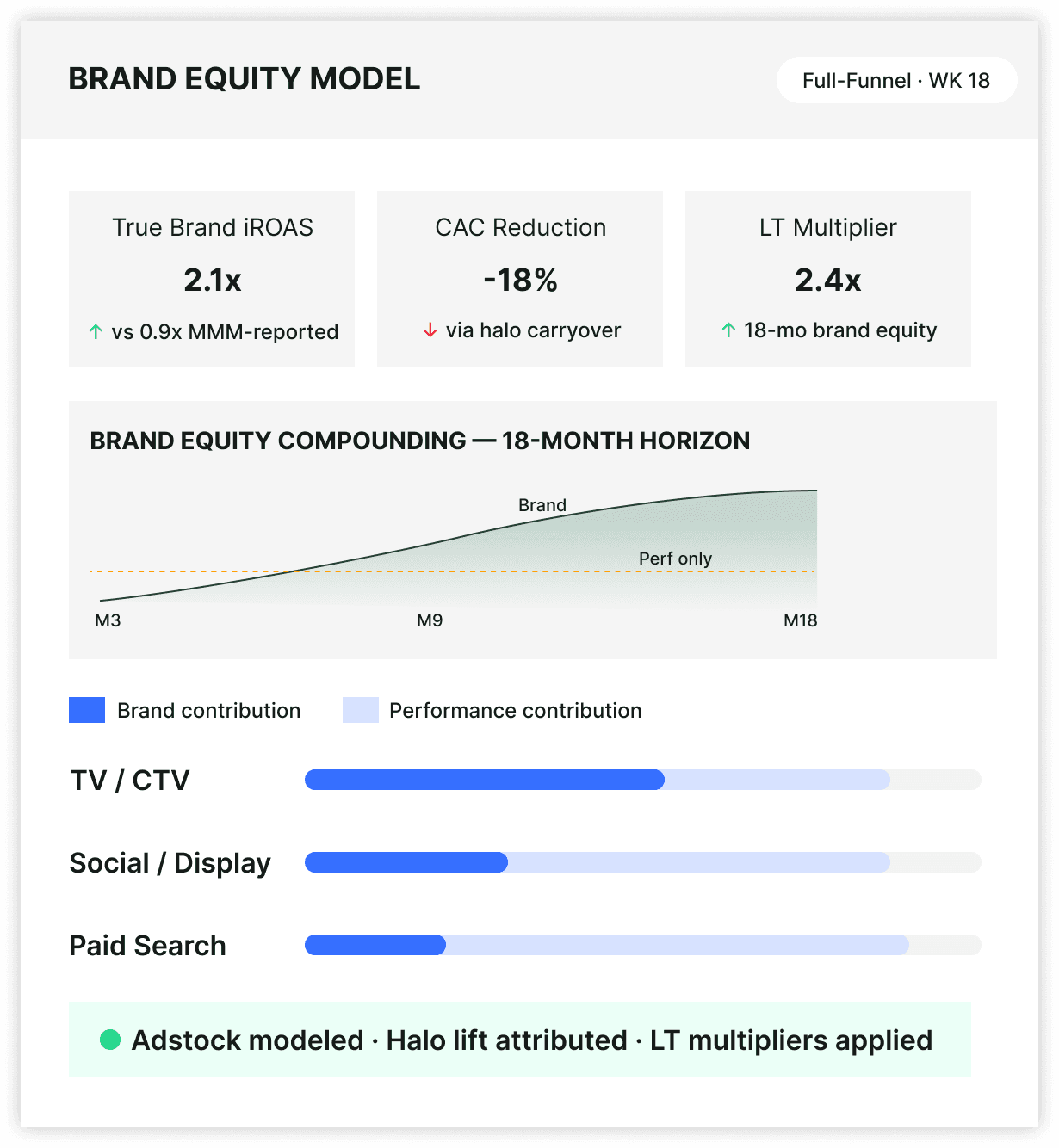
LiftLab’s Agile MMM extends beyond short-term ROAS by calibrating long-term advertising multipliers. These research-backed ratios, tailored to your brand, category, and channel mix, are integrated into scenario planning to ensure brand and performance investments are evaluated on equal, evidence-based terms.

SHORT TERM LAYERFoundation

Measure short-term advertising effects with precision

LiftLab’s two-stage Agile MMM separates ad-auction dynamics (CPM/CPC costs) from true consumer response, producing accurate short-term iROAS and mROAS curves at the channel, tactic, and campaign level — without any platform self-reporting bias distorting the baseline.

Explore Agile MMM
HALO & CARRYOVER LAYERBrand Recovery

Calibrate the LT: ST ratio to your brand, category, funnel position, and channel mix

LiftLab leverages over 30 years of peer-reviewed marketing science, based on Dr. Koen Pauwels’ research with more than 1,000 brands, to determine your brand’s specific long-term to short-term advertising value ratio. This LT:ST ratio is influenced by brand lifecycle, product category, funnel position, and channel mix.

See Trust Engine Calibration
LT MULTIPLIER LAYERP&L Proof

Apply LT multipliers to establish brand’s NPV on the P&L

Long-term advertising multipliers, calibrated to your brand lifecycle, product category, funnel position, and market context, translate compounding brand value into a net present value that Finance can review, challenge, and approve. This approach is supported by over 30 years of peer-reviewed marketing science from Dr. Koen Pauwels at Northeastern University.

Watch the Dr. Pauwels Webinar
PORTFOLIO OPTIMIZATIONTotal Advertising Value

Optimize the full-funnel portfolio against total advertising value

Budget scenarios use total advertising value, calculated by scaling short-term ROAS with the LT:ST multiplier, as the objective function. This allows brand and performance spending to be evaluated consistently. As a result, scenarios often recommend allocating more budget to top-of-funnel investments, since the compounding multiplier clarifies the financial case for brand. Brand investment then achieves the same level of defensibility as your best-performing performance channel.

See Scenario Planner

Six Decision-Grade Outputs That
Make the Brand Investment Case

This approach provides robust econometric evidence that replaces survey data and intuition.
The results are clear for marketers, defensible in the boardroom, and approvable by Finance.
  • Long-Term Advertising Multiplier by Channel

    Long-Term Advertising Multiplier by Channel

    Per-channel LT multipliers are calibrated to your brand lifecycle, product category, and funnel stage. This approach converts short-term ROAS into total advertising value, enabling accurate budget comparisons across brand and performance channels.
  • Long-Term to Short-Term Multiplier by Channel

    Long-Term to Short-Term Multiplier by Channel

    The research-calibrated ratio of total to short-term advertising value is broken down by channel and funnel position. This reveals which channels most efficiently build brand equity over time and which primarily convert existing demand.
  • Top-of-Funnel Reallocation Recommendation

    Top-of-Funnel Reallocation Recommendation

    Applying the LT:ST multiplier to the full portfolio consistently shifts budget toward top-of-funnel brand investment. This output quantifies the warranted increase in brand spend and projects the P&L impact at 6, 12, and 18 months.
  • Brand Equity NPV on the P&L

    Brand Equity NPV on the P&L

    LiftLab models brand equity as a stock variable, expressing long-term brand contributions in net present value terms. This allows Finance teams to validate, challenge, and approve these figures, rather than relying on brand health scores that are not included in financial reviews.
  • Short + Long-Term Budget Scenarios

    Short + Long-Term Budget Scenarios

    Constraint-aware scenarios balance short-term performance ROAS with long-term brand equity growth. These scenarios show the revenue risk of reducing brand investment at 6, 12, and 18 months, as well as the equity cost of over-investing in performance at each budget level.
  • Board-Ready Brand Investment Narrative

    Board-Ready Brand Investment Narrative

    One-click outputs translate LT multipliers and brand NPV into a CFO-ready financial narrative. This ensures brand spend is defended with the same rigor as any capital investment, without requiring a data scientist to interpret the results.

Every Tool to Turn Brand from a Cost Center Into a Compounding Asset

LiftLab's brand measurement integrates with all platform capabilities. Brand does not operate separately from performance, and your measurement system should reflect this connection.

Long-Term Brand Value Measurement

Your MMM reports a 0.9x ROAS on brand, while the actual figure is 2.1x. LiftLab calibrates the long-term-to-short-term advertising value ratio, based on over 30 years of Dr. Koen Pauwels' research with more than 1,000 brands, and integrates it into Scenario Planning. This ensures brand investment is evaluated on equal financial terms with all performance channels.

Explore Long-Term Brand Value Measurement →

Full-Funnel Budget Planning

Brand and performance are modeled together, making their interdependence clear. When upper-funnel investment decreases, lower-funnel efficiency declines as well. LiftLab demonstrates this causal link before the impact appears in CAC, allowing proactive action.

Explore Full-Funnel Budget Planning →

Scenario Planning & Forecasting

"What happens to blended CAC in 12 months if brand spend is cut by 30%?" LiftLab provides P&L-linked outcome ranges to answer this, offering the Head of Branding a powerful budget defense tool that most measurement systems cannot deliver.

Explore Scenario Planning & Forecasting →

Incrementality & Calibration

Demonstrate brand lift causally using geo holdouts rather than survey correlations. Each test informs the AMM through the Trust Engine™, continuously refining brand response curves and calibrating LT multipliers with real-world causal data.

Explore Incrementality & Calibration →

Diminishing Returns & Marginal ROI

Identify where performance channels are saturating to make the need for brand investment clear. Declining performance efficiency often indicates a depletion of brand demand. Only upper-funnel investment can address this, and LiftLab highlights these trends before budget adjustments occur.

FiExplore Diminishing Returns →

Real-Time Budget Optimization

A weekly modeling cadence ensures the brand’s contribution to performance efficiency is visible within the quarter. Establish guardrails to protect brand investment before optimization, so brand spend is not the first item reallocated if monthly targets are missed.

Explore Real-Time Budget Optimization →

DIAGNOSTIC

Signs Your MMM Is Missing Long-Term Brand Value

Six warning signals that your measurement framework is systematically undervaluing brand — and the readiness checklist to fix it with LiftLab.

WARNING SIGNALS — ACT NOW

  • CAC keeps rising, even as ROAS holds steady. Performance is masking brand demand decay that will fully surface in 6–9 months.
  • Geo tests show brand lift, but your MMM cannot confirm or quantify it. Your model is structurally blind to effects you already know exist.
  • Conversion rates softened 60–90 days after a brand budget cut and no one connected the two events. The lag is the model’s blind spot.
  • Finance is treating brand spend as discretionary cost with no measurable ROI, because you haven’t yet given them an NPV number they can audit.
  • Brand advertising never appears in your MMM’s top-performing channels even though awareness scores and brand health metrics are strong.
  • Performance efficiency drops 6–12 months after brand investment is cut, but no one in the room connects the two decisions because the model can’t show the link.

READINESS CHECKLIST — GET STARTED

  • Minimum required : 12–18 months of weekly spend by channel, a primary revenue or conversion KPI, and calendar metrics for brand campaign flights.
  • Helpful additions : Branded vs. non-branded search split, organic traffic data, brand health or awareness survey scores, and any past geo-holdout or brand lift study results.
  • Accelerates calibration : Any existing incrementality test results even partial, that can be used as prior inputs to LT multiplier calibration through the Trust Engine™.
  • No data science team required : LiftLab’s marketing scientist handles model configuration, calibration, and interpretation end to end.
  • First outputs in 48 hours after data connection. Short-term iROAS and mROAS signals live within the first 48 hours; LT multipliers calibrated within the first planning cycle.
  • Brand NPV on the P&L established within the first planning cycle, typically before the next quarterly budget review after onboarding.

Frequently Asked Questions

Standard MMMs measure only immediate results such as conversions, clicks, and short-term revenue lift. In contrast, brand advertising generates compounding value over time, reflected in lower future CAC, higher LTV, and increased organic demand. Dr. Koen Pauwels’ research across more than 1,000 brands shows that long-term effects typically add 2 to 2.5 times to the apparent short-term ROAS. Without calibrating the LT:ST multiplier, brand budget reviews are based on structurally inaccurate figures.

Quantify Your Brand's Long-Term Value Before the Next Budget Cycle.

Book a 30-minute session with a LiftLab marketing scientist. We'll show you how halo effects, ad-stock carryover, and LT multipliers apply to your specific channel mix, and what the total advertising value gap looks like with your real numbers.

No data science team required
First signals in 48 hours
Marketing scientist included
SOC 2 & ISO 27001 certified
Quantify Your Brand's Long-Term Value Before the Next Budget Cycle.