// Head of Analytics · Buyer Group Evaluator · Omnichannel, eCommerce & CPG
You are evaluating a measurement system that will influence multi-million dollar budget decisions, shape the CMO’s narrative to the board, and reflect on your professional reputation. The stakes are significant, and potential pitfalls are real.
You’ve Been Asked to Evaluate LiftLab.Here’s Why That’s a Harder Job Than It Looks.
You are evaluating a measurement system that will influence multi-million dollar budget decisions, shape the CMO’s narrative to the board, and reflect on your professional reputation. The stakes are significant, and potential pitfalls are real.
01 — THE VENDOR BLACK BOX
If you cannot review how a model reaches its conclusions, you should not approve its recommendations. A vendor unwilling to explain their approach to adstock decay, uncertainty quantification, and calibration methodology is not protecting intellectual property; rather, they are avoiding scrutiny. You are responsible to your CMO and CIO for only endorsing what you can verify.
02 — THE BUILD OPTION IS ON THE TABLE
Open-source MMM frameworks are technically capable, and your data science team is qualified to use them. The key consideration is whether the team that builds the system will still be available to maintain it in 18 months, given potential changes in media mix, staff turnover, and evolving business needs. The build-versus-buy decision is significant, and your recommendation should address both options transparently.
03 — THE ORGANIZATION HAS MOMENTUM
Your value in this buyer group lies in your willingness to challenge results that do not withstand scrutiny. Apply the same rigor to evaluation as you would to any measurement claim: request methodology documentation, seek validation evidence, and compare model outputs to known experimental results. Your recommendation should be defensible, including both your conclusion and the process that led to it.
04 — A DEMO IS NOT AN EVALUATION
Most MMM vendor evaluations consist of a 45-minute demo with illustrative outputs. The analytics team sees clean channel attribution charts and is expected to form a view. A rigorous evaluation looks different: methodology documentation reviewed before the demo, sample outputs from comparable brands compared against known holdout results, and a technical Q&A where your team can interrogate assumptions directly. That’s the evaluation your CMO and CIO expect you to have conducted before you say “yes.”
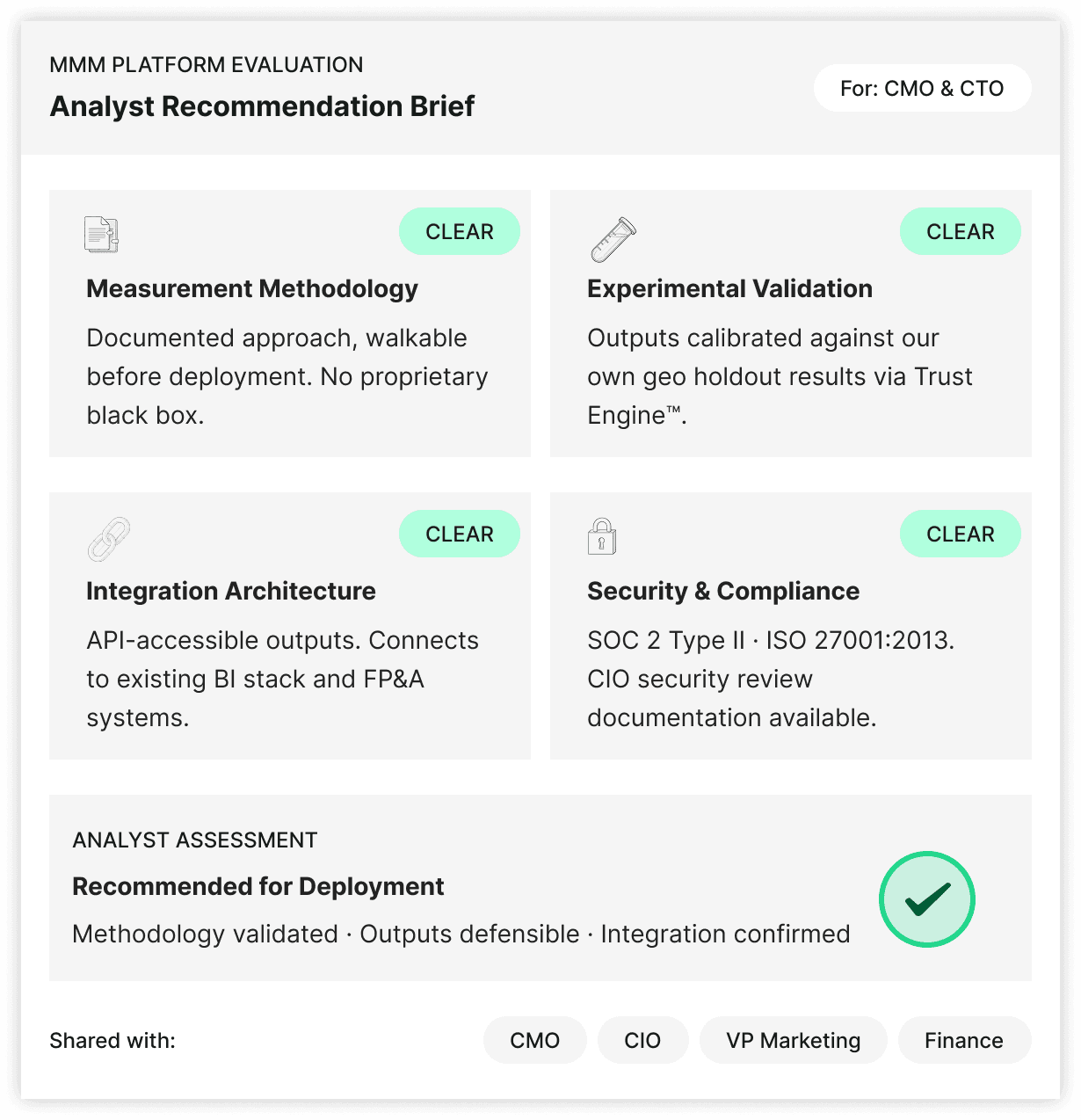
LiftLab’s measurement system consists of four connected layers. Each layer addresses a specific failure mode of standard MMM and is fully documented for review with your analytics team before any output is used for budget decisions.
The first layer separates daily CPM and auction fluctuations from actual consumer demand signals. This prevents the model from misinterpreting cost events, such as competitive CPM spikes or inventory constraints, as performance changes. Most single-layer MMMs conflate these factors, resulting in channel coefficient estimates influenced by auction dynamics rather than consumer behavior. LiftLab addresses this issue before estimating response curves.
Explore Agile MMM →The second layer fits channel-level response curves with explicit, per-channel adstock decay and saturation parameterization. Uncertainty is quantified for every iROAS and mROAS estimate, providing confidence intervals rather than misleading point estimates. Each channel’s adstock and saturation methodology is documented and available for analytics review. These outputs are reliable for presentation to Finance.
See Model Architecture →The Trust Engine™ incorporates geo holdout results and incrementality test outcomes directly into the model as calibration inputs, updating channel incrementality estimates based on experimental evidence. This mechanism enables the Head of Analytics to answer “how does the model compare to our holdout results?” with a specific, documented alignment report rather than a verbal reassurance. When the model and experiment disagree, both teams know where to focus their review.
See the Trust Engine™ →Budget scenarios are constructed with real-world constraints, such as channel caps, CAC ceilings, and committed contracts, as explicit model inputs. All outputs are version-controlled and accessible via API, allowing the analytics team to integrate them into internal BI, financial planning, and proprietary scenario frameworks. Out-of-sample backtesting is conducted before any output is used for budget decisions, providing a validation baseline for the analytics team.
See Scenario Planner →You have likely already considered the open-source path. Google Meridian is well-designed, Meta Robyn is widely used, and your team has the technical capability to deploy either. Below is an honest assessment of the true costs of each option and the reasons analytics teams at similarly sophisticated brands selected LiftLab after evaluating all three.
The Recommendation Frame
The strongest recommendation to your CMO and CIO is not to choose LiftLab instead of building internally, but to use LiftLab as the production measurement infrastructure. This allows your analytics team to focus on experimental design, model interrogation, and the generation of strategic insights. Such a recommendation respects your team’s capabilities and accelerates business value.
These are the three measurement options most analytics teams are weighing. Here is an honest assessment of what each offers — and what each costs at production scale.
Meridian is a robust framework with a Bayesian architecture, thorough documentation, and support from Google’s research team. It provides a solid technical foundation for an in-house MMM. The key evaluation question is not whether Meridian works, but who on your team will manage the data pipeline, calibration cycle, model configuration, and ongoing maintenance as the media mix evolves. Google built the framework; your team operates the system.
Robyn is the most widely deployed open-source MMM framework and benefits from a strong practitioner community. It is approachable and well-documented. However, its main limitation for the Head of Analytics is the lack of native uncertainty quantification; outputs are point estimates without credible intervals, making it difficult to communicate model confidence to Finance. Extensions are available but require additional engineering investment. Robyn is a solid starting point, but not a production measurement platform by default.
LiftLab is a production measurement system or a framework that requires an assembled team. It offers weekly model refreshes, Trust Engine™ calibration against geo holdouts, uncertainty quantification on every output, and full API access for downstream integration. Your analytics team benefits from a robust MMM without having to manage the supporting infrastructure. While the model is a commercial system and not fully under your team's control, the advantage is that maintenance is handled externally, allowing your team to focus on generating insights.
The Recommendation Frame
The strongest recommendation to your CMO and CIO is not to choose LiftLab instead of building internally, but to use LiftLab as the production measurement infrastructure. This enables your analytics team to focus on experimental design, model interrogation, and the generation of strategic insights. Such a recommendation respects your team’s capabilities and accelerates business value.
These are the six platform capabilities the analytics team will use, interrogate, and integrate with existing systems. Each is designed to complement analytical rigor — not replace it.
Two-stage MMM architecture with documented per-channel adstock and saturation curves, uncertainty quantified on all outputs, and weekly recalibration cadence. Methodology documentation is available for analytics review before onboarding. The model the analytics team can interrogate, not just consume.
Explore Agile MMM →
Geo holdout results and incrementality tests are incorporated into the MMM as calibration inputs, closing the loop between model estimates and experimental evidence. The analytics team can clearly assess the alignment between model outputs and holdout results and use this alignment report to validate the model before approving any budget recommendation.
Explore Trust Engine →
Daily ad-platform efficiency signals are applied to stable econometric response curves, rather than raw dashboard data. When CPMs spike, PlatformSense classifies this as a cost event, not a performance signal, and adjusts accordingly. Anomaly detection reduces the manual monitoring burden on the analytics team while maintaining oversight of model inputs.
Explore PlatformSense →
We develop constraint-aware budget scenarios based on documented response curves, providing outcome ranges that accurately reflect the model’s confidence. All scenario outputs are versioned and accessible via API, allowing seamless integration with internal FP&A and BI systems. This ensures the analytics team maintains control over how recommendations are presented within the business.
Explore Scenario Planner →
Long-term advertising multipliers are calibrated to your brand lifecycle and product category, using a documented methodology available for analytics team review. This capability prevents brand investment from being under-credited in standard MMMs and provides the CMO with a P&L-defensible case to protect brand budgets during Finance reviews.
Explore Long-Term Brand Value Measurement →
Channel saturation curves derived from documented response function estimates — not interpolated averages. Marginal return at the last dollar of spend, with confidence ranges that honestly communicate when evidence is thin versus when a channel’s ceiling is clear. The number the analytics team can present to Finance and actually defend when challenged.
Explore Diminishing Returns →