24 hrs 

from platform shift to updated budget recommendation, not 7–90 days.

±20%

bounded modifier range, responsive to real signals, not reactive to daily noise.

70+

ad platforms ingested, including Meta, Google, TikTok, Pinterest, and Amazon Ads.

Your Budget Plan Was Right When You Built It. Markets Moved Without Telling Your Model

Most teams can plan well at the start of a quarter. The problem is what happens when conditions change mid-flight, and your measurement system can't keep up.

Problem

  • CPMs spike mid-campaign with no model visibility
  • Creative fatigue erodes performance gradually and invisibly 
  • Platform algorithms shift, your coefficients don't 
  • Budget decisions rely on last month's mROAS scores 
  • Teams can see the dashboard signal but can't trust it causally 

Fix

  • Daily platform signals update effective elasticity in real time
  • CTR and CVR trends at the tactic level surface fatigue before revenue drops
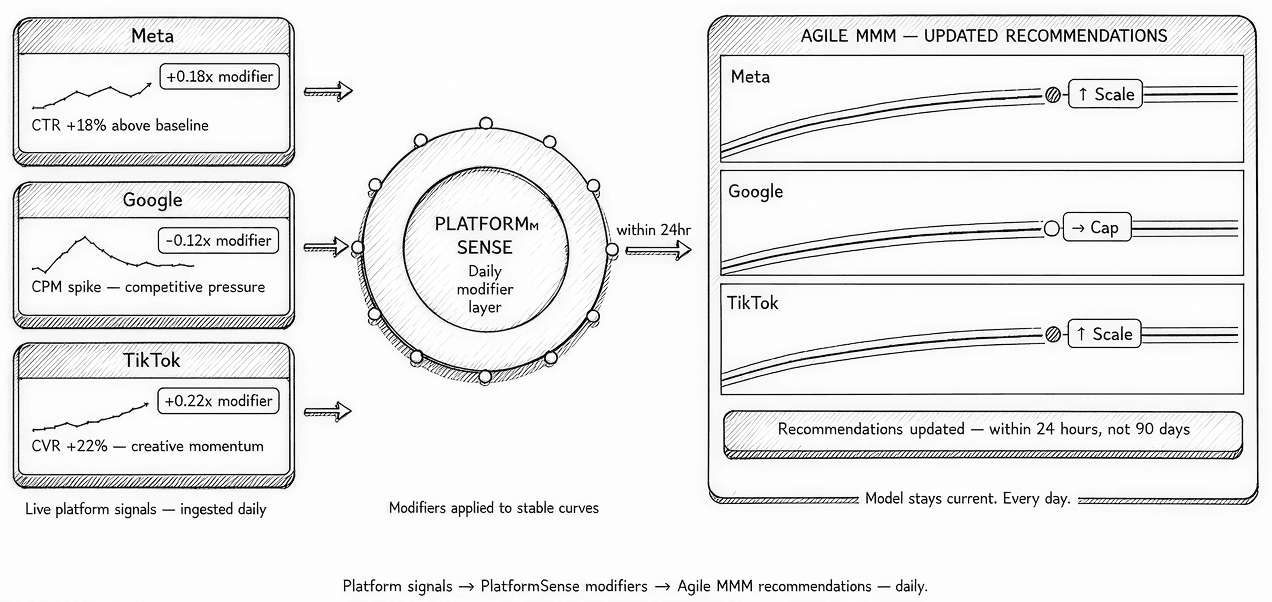
  • Time-varying modifiers reflect algorithm shifts within 24 hours
  • mROAS scores and curve outputs reflect today, not last quarter
  • Platform signals are calibrated against causal MMM, no black box 
  • Every fix feeds back into the Agile MMM, so the next quarter starts sharper than the last.

Consequence

  • Overfunding channels that already peaked for the cycle 
  • Flash sale windows close before you scaled the winner
  • Finance loses confidence in marketing's numbers mid-quarter 
  • Teams override the model with gut instinct,  undermining the MMM 
  • CAC rises faster than your reporting can explain it 

From Daily Platform Shift To Actionable Budget Move — In Three Steps 

LiftLab's PlatformSense layer continuously monitors ad platform effectiveness and feeds those signals into your live marketing mix model, turning daily noise into decision-grade intelligence. 

Detect the shift

LiftLab continuously ingests effectiveness signals from your ad platforms, CTR, CVR, impression share, CPC, and platform-attributed revenue. When a channel drifts meaningfully from its historical baseline, the system flags it. Not as a raw dashboard metric, but as a calibrated efficiency signal indexed against your modeled baseline. 

Powered by PlatformSense

Quantify the impact

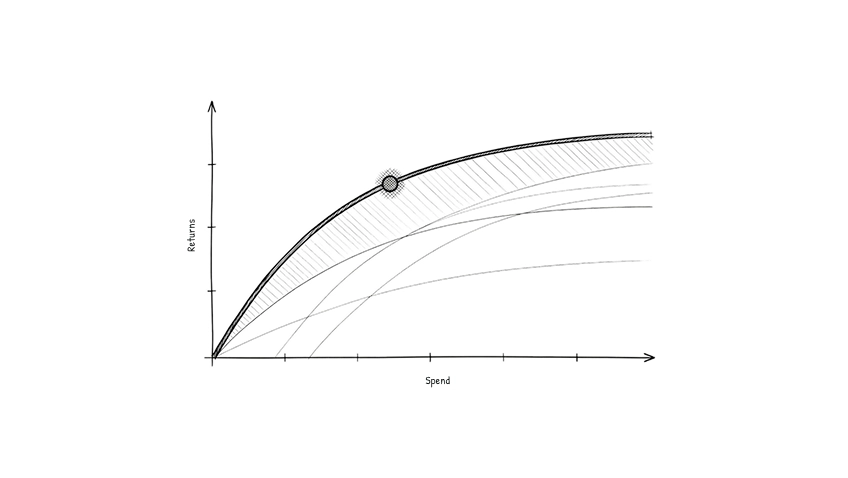
The shift is translated into a time-varying modifier on your channel's effective elasticity — bounded at ±20% to filter noise from the genuine signal. Your mROAS scores, diminishing returns curves, and budget recommendations all update to reflect current channel efficiency rather than a 90-day average. You see exactly how much that shift is worth in revenue terms. 

Flows into Marginal ROI & Diminishing Returns

Move spend with confidence 

With updated marginal ROI signals in hand, your team can reallocate spend with the same causal confidence as a full model recommendation, not a gut call based on a platform dashboard. Run a quick scenario, confirm the constraint guardrails hold, and move. The model validates the decision; your team executes it. 

Connects to Scenario Planner

Outputs That Change What Your Team Does on Monday Morning

In-flight optimization isn't about more dashboards. It's about actionable decisions that are defensible to finance and executable by your media buyers. 

Daily channel efficiency signals  

Daily channel efficiency signals  

A ranked view of which channels and tactics are above or below the efficiency baseline today, with the modifier delta shown alongside the core elasticity.

Know by Monday morning which channel needs attention before the week's budget is committed.

Updated mROAS and reallocation brief 

Updated mROAS and reallocation brief 

Revised marginal ROI scores that reflect today's effective elasticity, with a spend reallocation summary showing where to add and where to pull back.

Walk into your media planning call with a number Finance can interrogate, not a gut call. 
Constraint-aware in-flight scenario  

Constraint-aware in-flight scenario  

A budget shift scenario that respects your locked commitments and guardrails, so your reallocation is executable, not just theoretical. 
 
Reallocate with confidence; the model validates the move before your team executes it.

When Your Team Needs This

Triggers: You need this if

  • Finance is asking why CAC is rising when ROAS looks fine.
  • You've increased spend on a channel that stopped working and found out weeks later.
  • A flash sale or seasonal event ended before your measurement reflected what worked.
  • Creative performance is degrading, and you're catching it in the quarterly MMM, not real time.
  • Your team manually overrides model recommendations because they feel stale.

Data Readiness

Minimum to start:

  • Most updated LiftLab AMM model.
  • API-connected ad platforms (Meta, Google, or TikTok).  
  • 12+ months of historical spend and sales data already modeled. 

Nice to have: 

  • Post-purchase survey data for brand signal cross-validation. 
  • Creative-level performance data for tactic-level fatigue tracking. 
  • Existing CAC or ROAS guardrails set in the Constraint-Aware Optimizer. 

Next Steps: What happens after you engage

  • Map your ad platforms and confirm API-connected data coverage (1 day). 
  • Configure PlatformSense metrics and alpha values per tactic with your Marketing Science team (3–5 days). 
  • Run the first modifier report and review daily elasticity shifts against recent platform history (1 week). 
  • Execute first in-flight reallocation scenario against current guardrails (week 2). 
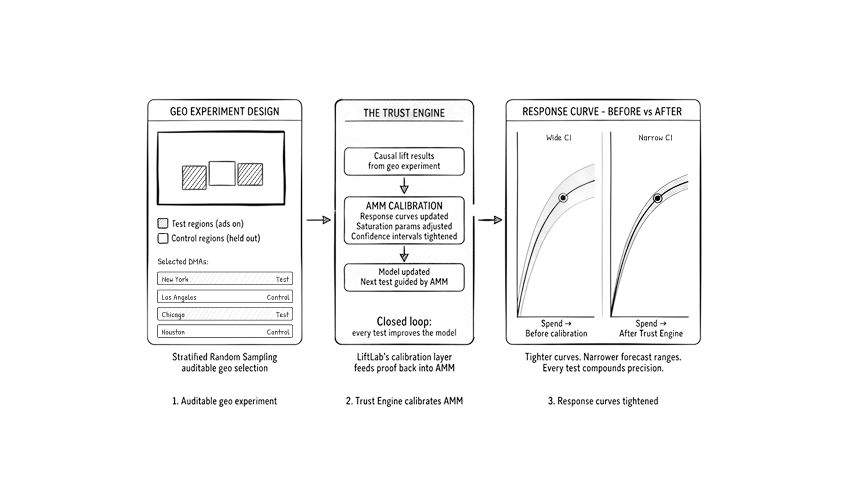
  • Identify 1–2 channels for closed-loop validation with Trust Engine experiments (30–60 days).

Frequently Asked Questions

Platform dashboards show CTR, CPC, and conversion data in real time, but they can’t tell you whether those signals represent genuine efficiency shifts or daily noise. LiftLab’s PlatformSense calibrates every platform signal against your Agile MMM baseline, so you know whether the shift is real and how much it’s worth in revenue terms before moving budget.

Go Deeper