These aren't reporting bugs. They're architectural conflicts of interest built into the measurement systems eCommerce brands rely on every day — and they compound silently until CAC inflation makes them impossible to ignore.
Seven Reasons Your DTC Budget Decisions Are Based on Numbers You Can't Fully Trust
These aren't reporting bugs. They're architectural conflicts of interest built into the measurement systems eCommerce brands rely on every day — and they compound silently until CAC inflation makes them impossible to ignore.
01 — Attribution Bias
Last-click and most MTA implementations are structurally biased toward trackable, bottom-funnel channels — paid search, retargeting, brand search. They over-credit demand-capture and under-credit demand-creation. DTC brands that optimize on last-click inevitably overinvest in retargeting and underinvest in awareness, harvesting existing demand without replenishing it. The result: CAC inflation 18–24 months later that is not caused by the market — it is caused by the measurement system.
LiftLab: True iROAS from 1P transaction data, not pixels
02 — Platform ROAS Conflict of Interest
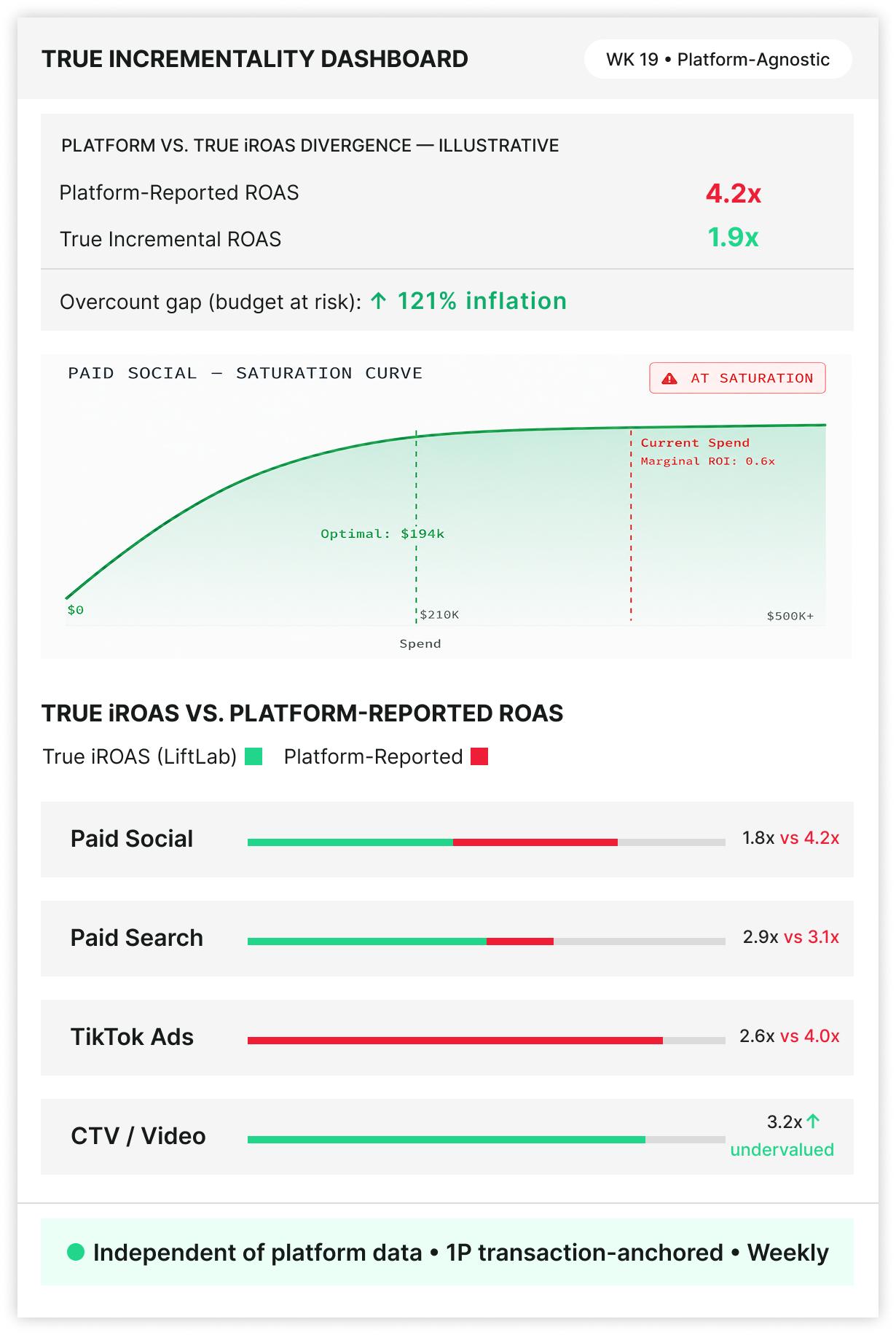
Each platform uses different attribution windows, different identity resolution methodologies, and different definitions of what constitutes a conversion — all optimized to make their platform appear essential. The same user conversion gets claimed by three platforms simultaneously. For DTC brands spending across 8–12 channels, the sum of platform-reported ROAS bears no mathematical relationship to actual revenue. Meta measuring Meta is not an independent audit. It never was.
LiftLab: One iROAS per channel, independent of platform self-reporting
03 — iOS Signal Loss
Apple's App Tracking Transparency (ATT) framework, introduced with iOS 14.5, eliminated the mobile IDFA, disrupting cross-device attribution for DTC brands. AppsFlyer, which tracks over 15 billion installs annually, reported that advertisers lost visibility into about 65% of iOS installs after ATT. According to an independent Harvard Business Review analysis, eCommerce customer acquisition costs increased by approximately 38% in the 12 months following ATT, with DTC brands among the most affected. DTC brands using pixel-based attribution now operate with incomplete data, often unaware of how these gaps distort their channel mix decisions.
LiftLab: MMM is privacy-native — no user-level tracking required
04 — Measurement Cadence Mismatch
A DTC brand spending $2–5 million per month makes weekly budget decisions, including creative rotation, channel rebalancing, bid strategy adjustments, and promotional timing. Traditional MMM updates occur quarterly or semi-annually. By the time results are available, the media mix has shifted, campaigns have ended, and budgets have already been reallocated based on intuition. These models address last quarter's questions, not current needs.
LiftLab: Weekly MMM + daily PlatformSense signals
05 — Invisible Saturation
The most costly mistake in DTC marketing is not funding a poor channel, but continuing to invest in a good channel after marginal returns have diminished. Average ROAS may appear strong because it combines efficient early spend with less effective saturated spend. By the time average ROAS declines, significant budget has already been spent with minimal incremental return.
LiftLab: Saturation curves at current spend, flagged before CAC spikes
06 — Exploding Channel Mix
In the past three years, channels such as TikTok, CTV, podcasts, influencer marketing, SMS, streaming audio, and retail media have become significant DTC spend categories. Traditional MMM vendors, built for a TV, search, and social mix, are not equipped to handle a 13-channel media mix that evolves monthly. DTC brands are adopting new channels more quickly than vendors can update their models or pricing.
LiftLab: 70+ platforms ingested, model updates continuously
07 — Short-Term Optimization Trap
DTC brands with frequent repurchase cycles (e.g. supplements, beauty, apparel) tend to optimize aggressively on short-term conversion metrics, systematically undervaluing the brand investment that builds long-term LTV and reduces future CAC. The measurement challenge is that the value of brand advertising compounds over months, not days, and most DTC models aren't designed to capture it. Without a framework that connects short-term performance to long-term brand contribution, budgets cut the brand first when a quarter is soft. CAC rises 6–18 months later. The cycle is predictable, and it almost always goes unnoticed until the damage is already visible in the performance data.
LiftLab: Long-term multipliers and adstock carryover in the same model as performance ROAS · Brand budget protected with P&L evidence
Most eCommerce brands are running all three simultaneously and getting three different answers. None account for true incrementality. None are built for the speed of DTC decision-making.
Legacy MMM Providers
(Nielsen, Analytic Partners, Ipsos MMA)
Open-Source Build Options
(Robyn, PyMC-Marketing, LightweightMMM, Meridian)
Platform Attribution Tools
(Meta Advantage+, Google DDA, TikTok Attribution, Northbeam, Triple Whale)
Our model uses first-party data to deliver true incrementality. Each geo holdout your team conducts improves model accuracy. Weekly refreshes ensure more precise budget decisions. This solution is designed for the fast pace of DTC, rather than the slower, quarterly approach of traditional MMM.
LiftLab's Two-Stage Agile MMM separates ad-marketplace dynamics (CPM fluctuations, auction volatility, creative fatigue) from true consumer response — building response curves anchored to your actual revenue data, not platform-reported conversions. The model explicitly parameterizes saturation for each channel, so long-term brand effects and diminishing returns are visible alongside weekly performance ROAS in the same output.
Explore Agile MMM →The Trust Engine™ feeds causal proof from transparent geo holdouts and switchback tests directly back into the Agile MMM as calibration inputs — permanently sharpening channel response curves with every experiment. For DTC brands, this means your TikTok holdout result doesn't produce a one-time lift number; it updates the model's TikTok coefficient for all future budget decisions. The closed loop that standalone incrementality vendors can't provide.
See Incrementality & Calibration →PlatformSense ingests data from over 70 ad platforms daily, including Meta, Google, TikTok, Pinterest, Amazon Ads, Snapchat, and CTV networks, and applies live signals to stable econometric response curves. PlatformSense identifies reallocation signals from CPM spikes, creative fatigue, and algorithm changes before they appear in weekly revenue. The model updates continuously, delivering both speed and stability.
Explore PlatformSense →The Scenario Planner creates constraint-aware Conserve, Maintain, and Accelerate scenarios with CAC delta and payback period outputs, using the financial language your CFO and board expect. Enter your real-world constraints, such as channel caps, pre-committed spend, and CAC ceilings, to receive a range of defensible options before any funds are allocated. The budget meeting becomes a decision, not a negotiation between competing dashboards.
See Scenario Planner →Six purpose-built capabilities that address each structural failure DTC brands face — connected into one continuously compounding system, not six separate workstreams.
LiftLab builds platform-agnostic channel response curves using your first-party transaction data. This approach separates ad-marketplace cost dynamics from actual consumer demand. You gain clear insight into each channel’s true revenue contribution, rather than relying on platform-attributed results.
Explore Agile MMM →
Stop optimizing for average ROAS. LiftLab pinpoints where each channel’s incremental returns flatten at your current spend, updated weekly. For DTC brands scaling quickly, this reveals the difference between maximizing profit and overspending, up to three months before changes appear in your CAC data.
Explore Diminishing Returns →
Geo holdouts and switchback tests designed to prove causal lift — not just report it. Every result feeds back into the Agile MMM through the Trust Engine™.Your TikTok geo test doesn't just produce a number for a deck; it permanently calibrates response curves and updates the model that guides next quarter’s budget.
Explore Incrementality & Calibration →
Answers questions like "What happens to CAC payback if we cut Meta 20% and move it to CTV?" using constraint-aware Conserve, Maintain, and Accelerate scenarios.Outputs revenue ranges and CAC delta, aligned to the financial language your board and CFO use to evaluate growth investments.
Explore Scenario Planning & Forecasting →
Receive actionable reallocation recommendations within 24 hours of a platform shift, based on stable econometric response curves rather than raw dashboard data. For brands running weekly promotions or seasonal campaigns, this enables you to address creative fatigue before revenue declines, instead of reacting to a CAC spike after it occurs.
Explore Real-Time Budget Optimization →
For DTC brands with repurchase cycles, the compounding effect of brand advertising on LTV and future CAC is often the most undervalued asset in the marketing P&L. LiftLab calibrates long-term advertising multipliers alongside weekly performance ROAS, ensuring the model provides clear justification for brand spend during budget reviews.
Explore Long-Term Brand Value Measurement →