

Meta Robyn suits teams that can staff a full MMM practice in-house: data collection, quality control, model design, interpretation, and ongoing maintenance. LiftLab suits teams that would rather hand that work to specialists and plan against a model that is updated regularly, calibrated with experiments, and built for finance-approved budget decisions. Robyn is free software that estimates the model. LiftLab is a managed platform that runs the practice around it. This guide compares both on cost, cadence, causality, brand, and support.
Executive Summary
Model estimation, the part Robyn performs, is a small share of an MMM practice. Around it sits the larger workload: data collection, quality control, model design grounded in marketing science, interpretation, and ongoing maintenance. The real decision is whether to staff all of that in-house or hand it to specialists. Meta’s An Analyst’s Guide to MMM notes that in-house MMM demands the most internal time and resources of the options it describes, with a first study taking three to five months.
A model alone also offers limited planning support, and building that capability in-house is financially viable only for the largest marketers. LiftLab covers both layers: a Marketing Science team that runs the practice, and a platform that adds daily signal updates, experiment calibration, combined brand and performance modeling, and constraint-aware scenario planning.
Core Differences
The primary distinction is how much of the MMM practice your team owns. Meta Robyn is a reliable, free, open-source estimation tool and a practical starting point for in-house modeling, but everything around the estimation, from data preparation to interpretation and planning, stays with your team. LiftLab takes on that work, which matters most when the model needs frequent updates, has to absorb daily platform changes, and must hold up in budget discussions with Finance.
Same question, two different delivery models
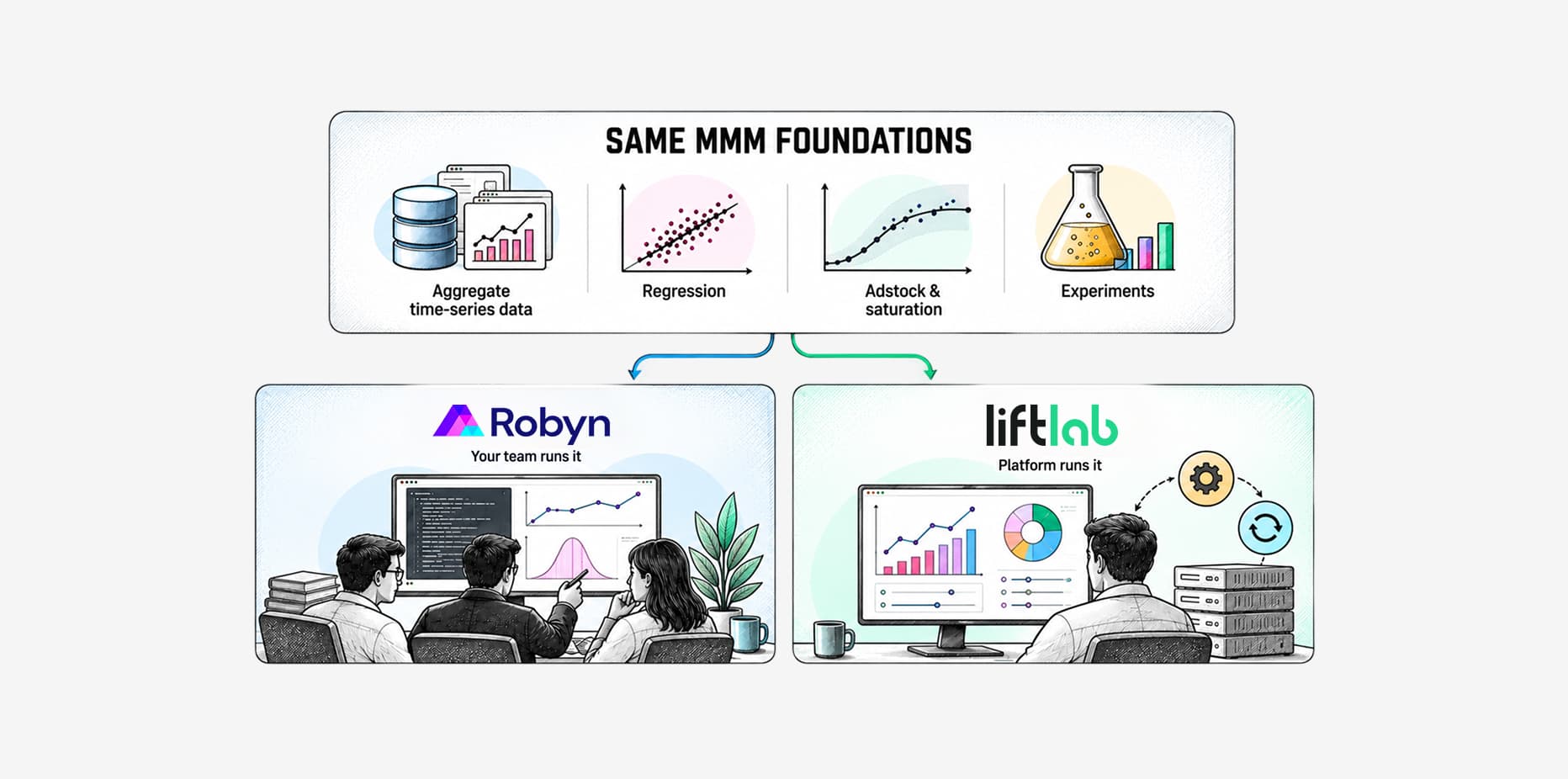
Robyn and LiftLab address the same core question: how much revenue each channel generates and where to allocate the next dollar. Both rely on aggregate time-series data instead of user-level tracking, use regression to isolate media impact from baseline demand, seasonality, and price, and apply adstock and saturation adjustments. Both can incorporate geo experiments to validate and calibrate model estimates.
Meta Robyn is an open-source marketing mix modeling package developed in R by Meta’s Marketing Science team and released under the MIT license. Teams are responsible for building and operating it. In contrast, LiftLab is a managed full-funnel platform that handles modeling, experimentation, and reallocation for the customer. Ultimately, the distinction lies in who manages the process.
How they compare, feature by feature
| Dimension | Meta Robyn | LiftLab |
|---|---|---|
| Cost model | Free, MIT license | Subscription, vendor-operated |
| Stack and access | Open-source packages in R and Python; third-party no-code interfaces exist, but your team still owns the data, model choices, and interpretation | SaaS platform accessed through a web login; no code, R, or Python required |
| Update cadence | Refresh function (robyn_refresh) supports monthly, weekly, or daily refreshes per Meta; your team schedules, runs, and validates each one | Daily signal updates from 70+ ad platforms (PlatformSense) |
| Causality | Your team runs geo tests and enters results as point estimates; Meta’s separate open-source GeoLift package helps design and analyze tests | Geo tests run in-platform and calibrate the model automatically (Trust Engine) |
| Brand and performance | Adstock and saturation per channel; no dedicated long-term brand layer in the documentation | Short-term performance and long-term brand modeled together (Agile MMM) |
| Budget planning | Allocator in R with per-channel spend bounds and ROAS or CPA targets; output is charts and tables, not a live interface | Locked commitments, platform minimums, channel caps, and CAC ceilings set before the optimizer runs, in a shared interface (Scenario Planner) |
| Support | Public community group and GitHub issues | Vendor support and an embedded Marketing Science team |
| Data minimum | Per Meta’s guide: at least two years of weekly data and about ten observations per variable | 12 to 24 months of weekly spend by channel, one primary outcome KPI, and a promotional or seasonality calendar |
* Robyn entries are drawn from Meta’s An Analyst’s Guide to MMM, the Robyn documentation, and CRAN, reviewed in October 2026. Confirm current details with each vendor before deciding.
Where Robyn is the right call?
Running Robyn well takes more than statistical skill. The people operating it need to be equally strong in analytics and data management and in marketing itself: how ad platforms price and deliver media, and how consumers respond to it. That combination rarely sits in one person, which is why specialist providers surround the model with a multidisciplinary team. With that in mind, Robyn is best suited to three scenarios: piloting MMM to test whether your data is ready; teams that already combine statistical, data, and marketing expertise, with a stable channel mix and quarterly reporting; and independent validation alongside a vendor model, since results confirmed by two methods are easier to act on.
Continuity beyond one analyst
The vendor operates the model. LiftLab’s Marketing Science team configures and calibrates it, reviews outputs, and validates assumptions before the planning meeting, so continuity does not depend on any one person’s schedule.
The cost that does not show up on a license page
Teams often plan for model development but underestimate the challenges of ongoing operation. According to EMARKETER’s Media Mix Modeling Trends 2026 report (May 2026), only 28 percent of marketers consider their organizations very effective at turning MMM insights into action.
Analyst hours are the real license fee
Meta’s Analyst’s Guide to MMM clearly outlines the trade-offs. In-house development avoids ongoing costs beyond headcount and time, but demands strong analytical and data science capabilities and the highest internal resource investment among Meta’s options. Users are responsible for reviewing hyperparameter bounds, selecting the model window, and choosing the final model from the Pareto-optimal set. Robyn intentionally leaves this final decision to the user.
Time to first insight
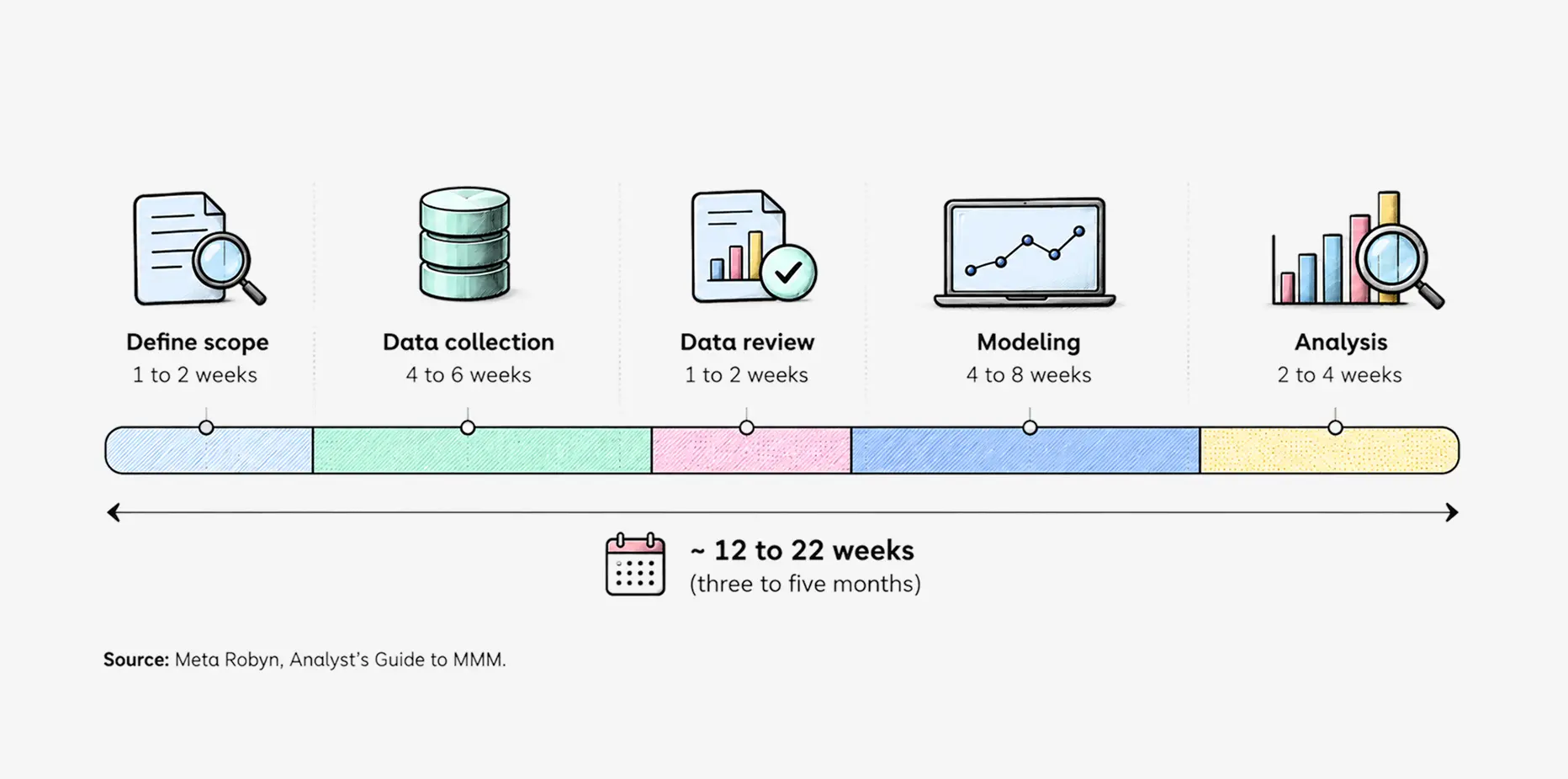
Meta’s guide estimates a first MMM study requires one to two weeks for scoping, four to six weeks for data collection, one to two weeks for data review, four to eight weeks for modeling, and two to four weeks for analysis. This totals approximately 12 to 22 weeks, or three to five months, before a recommendation is available. Timelines may be shorter for refresh models and vary based on whether the work is in-house or with a partner. While this wait is reasonable for a first model, recommendations may arrive after planning decisions have already changed.
Causality is opt-in work
Robyn supports calibration, which Meta recommends. When enabled, calibration incorporates error against experimental results into Nevergrad as a third objective, alongside prediction error and decomposition distance. Robyn does not conduct experiments; Meta provides GeoLift for designing and analyzing geo tests. However, tests must be funded, executed, and results manually entered into Robyn as point estimates with start and end dates and incremental response. Meta advises running incrementality studies regularly to keep calibration current. This requires an ongoing program, not just a configuration change.
No native brand layer
Robyn attributes contributions to the specified KPI. Each media channel receives adstock and saturation transformations, with effects estimated within the modeling window. Robyn’s documentation does not address long-term brand effects that develop over months or quarters. As a result, brand investments can be difficult to justify in financial reviews without long-term estimates, often relying on conviction rather than data.
Key-person risk
Because the skills Robyn depends on rarely sit together, the work often ends up concentrated in one person. The pipeline, hyperparameter rationale, and model justification are often documented in a single repository and primarily understood by one analyst. Support is available through a public community group and GitHub issue queue, but these offer no service-level guarantees. If the analyst is unavailable and paid social performance declines, the model may not be updated, and discussions proceed without its input.
What changes when the platform owns this instead?
The platform takes on the operating load: scenario planning, daily signal updates, experiment calibration, brand valuation, and continuity.
Scenario planning in an interface
The Scenario Planner incorporates commercial constraints before optimization begins. Locked TV upfronts, platform minimums, channel caps, and CAC ceilings are established first. Scenarios are then developed within these parameters at three levels: Conserve, Maintain, and Accelerate. Each scenario provides a forecast range with quantified marginal ROAS trade-offs, enabling planners to act directly without translating allocator results. Robyn’s allocator accepts per-channel spend limits and ROAS or CPA targets, while the Scenario Planner adds business guardrails and a collaborative planning interface.
Daily platform-shift detection instead of a quarterly rerun
PlatformSense collects daily signals from over 70 ad platforms, such as click-through rate, conversion rate, impression share, and cost per click. These signals are applied as time-varying modifiers to stable, long-term response curves, which are based on one to three years of data and are not recalculated daily. Only the modifier layer adjusts, and it is bounded to ensure the model responds to real efficiency changes rather than daily fluctuations. When CPMs rise due to competition, Agile MMM interprets this as a cost event, not a decline in consumer demand. Efficiency changes are reflected in recommendations within 24 hours, eliminating the need to wait for the next model refresh.
Incrementality built into the model loop
The Incrementality Testing Suite selects test geographies using stratified random sampling or synthetic controls. It supports switchback tests for high-volatility environments, strategy experiments for campaign-level changes, and go-dark tests with pacing to assess saturation. Results are integrated into the model through the Trust Engine, while Agile MMM prioritizes tests in channels with the greatest uncertainty. Calibration is maintained continuously by the platform, eliminating the need for manual repetition.
Brand and performance in one economic view
Agile MMM operates in two stages. The first stage models auction dynamics and costs, including CPM and competitive pressure. The second stage models consumer response, distinguishing short-term performance from long-term brand contribution. Long-Term Multipliers convert short-term lift into compounding value over a 6 to 52 week period, calibrated to the brand’s category, lifecycle stage, and each tactic’s funnel position. Results are presented as net present value on the P&L, providing Finance with an auditable dollar figure for brand investment.
Continuity beyond one analyst
The vendor operates the model. LiftLab’s Marketing Science team configures and calibrates it, reviews outputs, and validates assumptions before the planning meeting. This process ensures continuity is not dependent on any one person’s schedule.
How LiftLab’s model actually works?
LiftLab’s Agile MMM uses a two-stage structure. The first stage isolates auction dynamics and media cost, ensuring that increases in CPM are not misinterpreted as reduced effectiveness. The second stage models consumer response based on cost-adjusted inputs, distinguishing short-term performance from long-term brand contribution. Response curves are estimated using one to three years of historical data. PlatformSense applies daily signals as modifiers, rather than re-estimating the model each day.
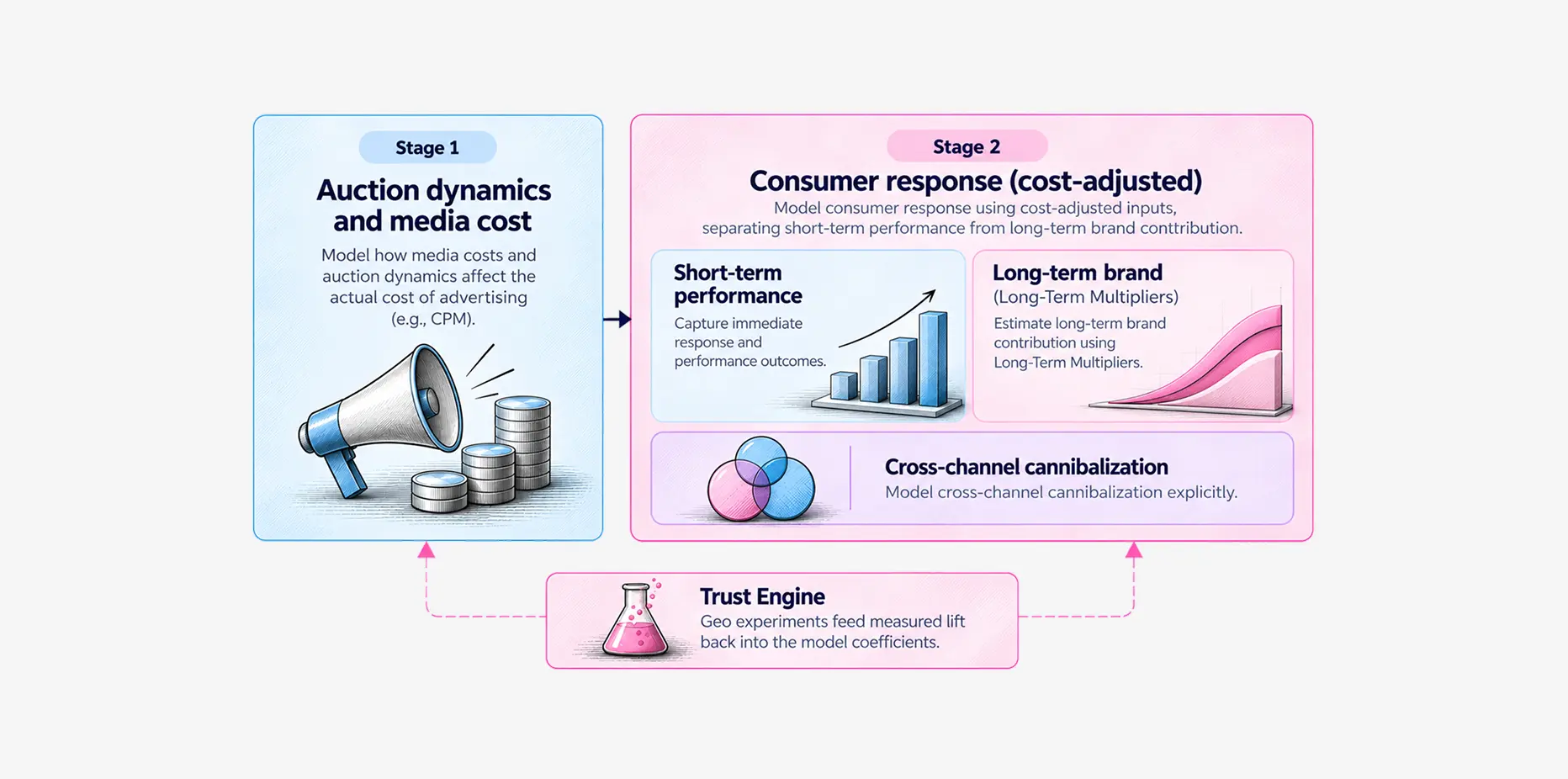
Adstock effects are modeled over days. Long-Term Multipliers are applied separately to short-term lift, so long-term brand value does not rely on long decay assumptions. The model uses aggregate spend and outcome data, eliminating the need for user-level tracking. Geo experiments continuously calibrate the model by feeding measured lift back through the Trust Engine.
Which one fits where you are right now
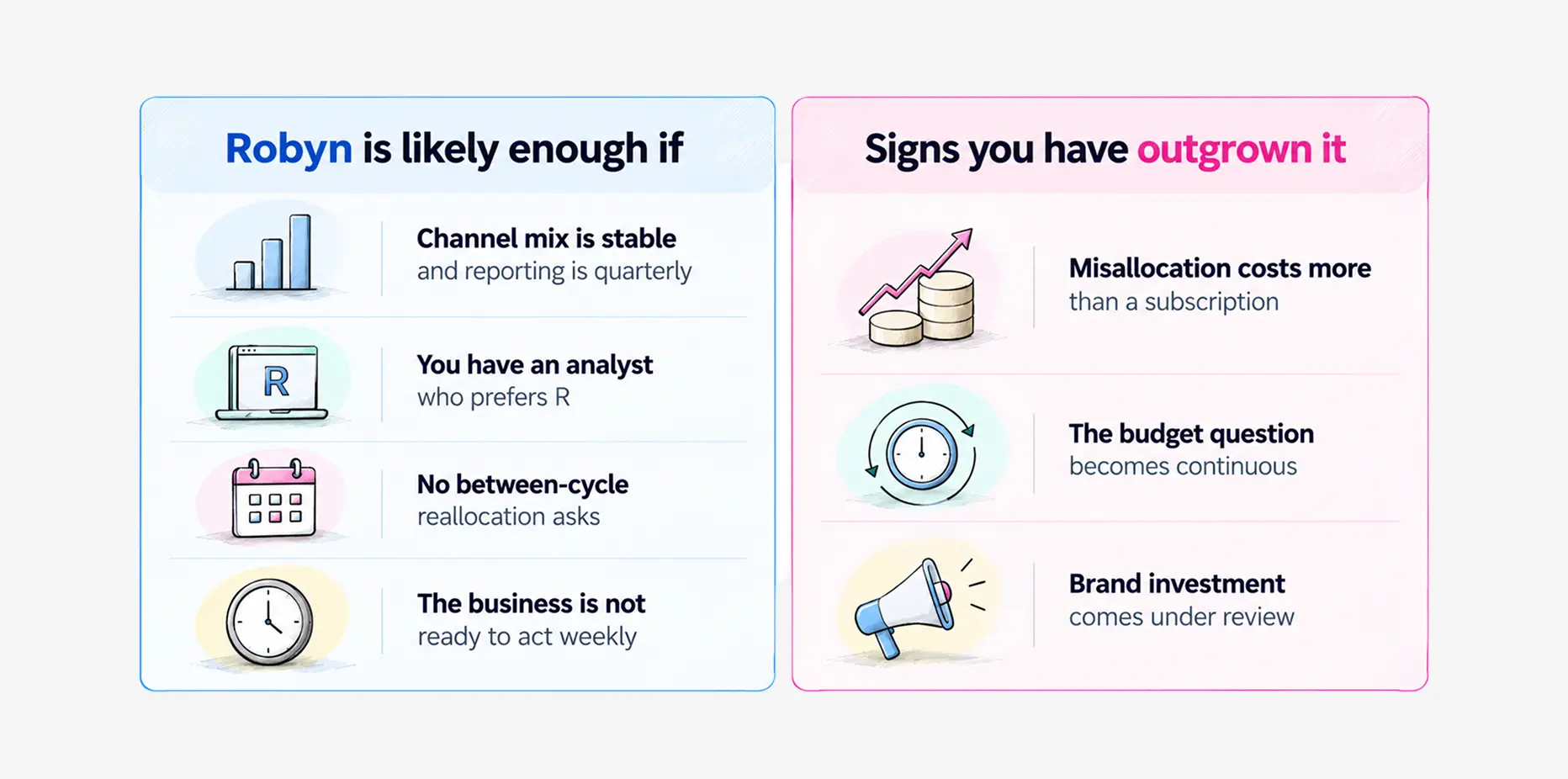
Robyn is likely enough if the channel mix is stable, the reporting cadence is quarterly, the team has people who combine statistical, data, and marketing expertise with time to run the model alongside their other work, and no one is currently asking for a reallocation decision between planning cycles.
Most teams outgrow it on one of three triggers. Media spend reaches a level where a few points of misallocation cost more than a subscription. The budget question becomes continuous rather than periodic. Or brand investment comes under review and the current model cannot speak to it. If none of those is true yet, staying in-house is a defensible call.
Started with Robyn? Here is what teams hit at scale
Almost nothing about that work is wasted. The hardest part of any MMM program is the data layer, and a team that has already assembled two years of clean weekly spend, exposure and outcome data by channel has done the expensive work. The variable taxonomy carries over. So does the internal case, already made, for aggregate modeling in budget decisions. Prior Robyn results also remain useful as a reference point, because significant differences from a well-established model are worth examining before drawing conclusions.
What changes is who carries the operating load. Onboarding runs concurrently rather than sequentially: a three to four week window connects the data, configures the model and launches the first geo holdout, with first calibrated outputs typically inside ten weeks. Teams that built their own pipeline usually move fastest, because they already know where every number comes from.
See your own data run through both approaches
Two ways in, depending on how much evidence you need first. To see your own data modeled and a first geo test scoped, book a working session with LiftLab’s Marketing Science team. To read the methodology first, download the whitepaper Measurement to Capital Allocation, which explains how MMM and incrementality testing work as a closed loop.
Not sure whether you are at the point of switching? See if LiftLab Right for Your Enterprise?
Key Takeaways
Model estimation is a small part of an MMM practice. Robyn handles estimation, while data collection, quality control, model design, interpretation, and maintenance remain with your team.
Calibration in Robyn is an ongoing process. While Robyn accepts experiment results as point estimates, your team must regularly design, fund, conduct, and input these tests.
Robyn’s documentation does not include a dedicated long-term brand layer, making it more difficult to justify brand value in financial discussions.
Key-person risk is inherent, as responsibility for the pipeline, hyperparameter reasoning, and model selection rationale often rests with a single analyst.
LiftLab takes on the full practice, not just the model. Its Marketing Science team runs data, modeling, and interpretation, while the platform applies daily platform signals to stable response curves, feeds experiment results back through the Trust Engine, and expresses brand value as net present value with Long-Term Multipliers.
Transitioning from Robyn is less complex than it appears. With data preparation complete, onboarding usually takes three to four weeks, and initial calibrated outputs are delivered within approximately ten weeks.
Frequently asked questions about Robyn and Marketing Mix Modeling (MMM) solutions
Robyn is free, so why pay for an MMM platform?
Free software does not mean free operation. Robyn estimates the model, but the rest of the practice, including data collection, quality control, model design, interpretation, and maintenance, stays with your team. Meta’s An Analyst’s Guide to MMM notes that in-house MMM requires the highest investment of internal time and resources among the options it describes. For teams with that capacity and a quarterly decision cycle, Robyn is often the more cost-effective choice. For teams making budget decisions more frequently, it often is not.
How long does it take to build an MMM with Robyn?
Meta’s guide estimates a typical first MMM study takes 12 to 22 weeks: one to two weeks for scoping, four to six for data collection, one to two for data review, four to eight for modeling, and two to four for analysis. Refreshes and partner-led projects may be faster. While Robyn automates much of the modeling, your team remains responsible for data collection and review.
Can an in-house data science team build calibration themselves?
Yes, and some teams manage this effectively. Robyn accepts experimental results for calibration, and Meta’s GeoLift package supports the design and analysis of geo tests. The main challenge is operational: designing comparable geo holdouts, preventing spillover in test geographies, funding foregone spend, and repeating the process frequently enough to keep calibration current. Meta therefore recommends running incrementality studies regularly. The key question is whether your team can maintain this cadence alongside other responsibilities.
How is LiftLab’s model different from Robyn’s Ridge regression approach?
Robyn uses ridge regression and Nevergrad to optimize hyperparameters based on prediction error and decomposition distance, then provides a set of Pareto-optimal candidate models for user selection. In contrast, LiftLab’s Agile MMM divides the process into two stages: one for auction dynamics and media cost, and another for consumer response, which is further separated into short-term performance and long-term brand impact. Estimation details are provided in the section on LiftLab’s model.
What does switching from an existing Robyn pipeline involve?
The primary task is data mapping, as most of the foundational work is complete. Teams using Robyn already have clean, aggregated weekly data by channel, which serves as the required input for the platform. Onboarding usually takes three to four weeks to connect data, configure the model, and launch the initial geo holdout. Existing Robyn results remain valuable for comparison.
Can we run LiftLab alongside our existing Robyn model?
Yes. Existing Robyn results remain valuable as a reference, since significant differences from a well-established model should be reviewed before making decisions. A working session will map your current weekly data to the platform and outline the first geo test.