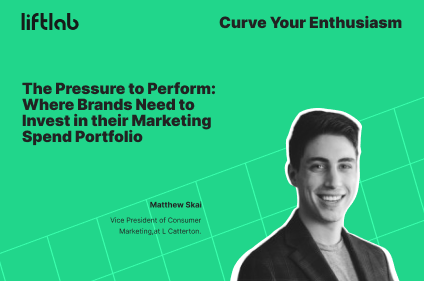
Marketing investment strategy treats media spend as a revenue-generating portfolio, not a cost center. This matters because metrics like CAC and last-click attribution mislead once growth stage and true incrementality aren’t factored in. Without incrementality testing to separate correlation from causation, brands trust media mix models that can be dangerously wrong. This video covers how to build that mindset, from channel evolution to creative quality to the cost of inaction.
Why Marketing Investment Strategy Starts With Treating Spend as a Portfolio
Marketing investment strategy starts with treating spend as a portfolio, because a portfolio mindset asks what each dollar is generating, while a cost-center mindset only asks how to spend less. In this Curve Your Enthusiasm conversation, Jon Lorenzini talks with Matt Skai of L Catterton, who brings both an operator’s and a private equity perspective to the same conclusion: marketing has to be evaluated as a revenue driver, not overhead to be trimmed.
The conversation moves through how channel mix evolves as budgets scale into the $25 to $40 million range, why there’s no single “best” metric independent of a business’s specific blockers, and why commonly worshipped benchmarks like CAC can actively mislead when they ignore growth stage and incrementality. Skai is direct that creative quality and site experience often matter more than media mix optimization itself, and that raw media mix models based on correlation are genuinely risky without incrementality testing to confirm actual causation. The conversation closes on two grounding points: marketing budget conversations with finance go better when framed around the cost of not acting, and no amount of optimization rescues a product that doesn’t deliver real value in the first place.
In this video, you’ll learn:
How to treat marketing as a strategic investment portfolio
The limitations of traditional metrics like customer acquisition cost
Why incrementality testing is essential for accurate media measurement
Strategies for navigating change management and aligning with finance teams
The role of product quality in long-term brand success
TIME STAMPVideo Overview: Marketing Investment Strategy Summarized
+–
[0:00 – 2:05] Introduction and Context
Jon Lorenzini welcomes viewers to the seventh episode of Curve Your Enthusiasm, introducing the theme of marketing performance and the guest, Matt Skai, Vice President of Consumer Marketing at L Catterton.
[2:06 – 3:54] Collaboration and Origins
Matt Skai explains how he met the LiftLab team while trying to solve the challenges of attribution modeling in the L Catterton portfolio.
[3:55 – 5:12] Marketing as an Investment Strategy
Skai emphasizes that marketing should be viewed as a revenue driver, not a cost center, noting that this mindset is consistent across both operator and private equity roles.
[5:13 – 8:07] Evolution of Marketing Channels
Discussion on how the number and mix of channels evolve as a business scales, from early-stage reliance on search to more diversified strategies as budgets reach $25 million to $40 million.
[8:08 – 12:26] Category Building vs. Brand Building
Insights into balancing high-risk category education with brand-specific demand, noting that timing and cash position are critical factors in deciding when to invest in building a new market.
[12:27 – 14:01] Metrics and Business Health
Skai highlights that there is no universal “best” metric; the focus should be on identifying specific business blockers and using the appropriate data to address them.
[14:02 – 16:24] Metrics Brands Cling To (and Should Avoid)
Critique of common industry benchmarks like Customer Acquisition Cost, which can be misleading if not contextualized within a company’s unique growth stage and incrementality.
[16:25 – 19:59] The Importance of Creative and Context
Discussion on why creative quality and site experience often outweigh media mix optimization, and why comparing yourself to competitors’ benchmarks is often ineffective.
[20:00 – 23:23] The Human Element and Market Conditions
Skai notes that the team’s capability and “X factor” are the hardest things to quantify but are the primary predictors of long-term success, alongside macroeconomic factors
[23:24 – 26:53] Future of AI in Marketing
Perspectives on using AI for ideation today, and the future evolution where platforms will likely automate entire video campaigns and A/B testing.
[26:54 – 34:40] Measuring Influencer Success
Skai shares a critical view on influencer programs: many brands fail by picking influencers based on aesthetics rather than the relevance of their audience to the brand’s target demographic.
[34:41 – 37:41] Limitations of Media Mix Models
Discussion on how raw media mix models based on correlation can be dangerous without incrementality testing to validate causation.
[37:42 – 42:09] Change Management and Marketing Realities
Navigating the tendency for organizations to scapegoat media mix models for broader operational or product issues, and the importance of being consumer-first.
[42:10 – 46:13] Navigating Finance Communications
Strategies for having direct, honest conversations with finance teams, using data to replace legacy metrics like last-click attribution with incrementality-based measurements.
[46:14 – 50:42] Incentives and Risk Tolerance
Advice on managing the trade-offs between growth and profitability, and how to argue for increased marketing investment by focusing on the cost of not acting.
[50:43 – 52:56] Final Takeaways and Conclusion
Skai reflects on the importance of product quality, noting that marketing is ultimately irrelevant if the underlying product does not provide real value.
Key Lessons: Building a Marketing Investment Strategy Around Incrementality
Investment strategy: View marketing as a primary revenue generator rather than an arbitrary cost center to optimize long-term growth.
Measurement evolution: Move beyond raw media mix models and last-click attribution by integrating rigorous incrementality testing to validate true performance.
Operational alignment: Facilitate productive discussions with finance departments by presenting data on the cost of inaction versus the benefits of testing.
Creative impact: Prioritize consumer-first messaging and authentic storytelling, as these factors often outweigh the specific media channels selected for a campaign.
Product priority: Recognize that even the most optimized marketing efforts cannot compensate for a product that lacks fundamental consumer value.