Direct mail vs email marketing means matching each channel to the right segment, not the priciest option for top customers. This matters because prospects and dormant customers ignore email from an unfamiliar brand but respond well to physical direct mail. Brands that email strangers and mail loyal customers waste budget on the wrong channel per segment. This video breaks down how one retailer flipped that strategy to cut costs.
Why Direct Mail vs Email Marketing Depends on Customer Segment, Not Customer Value
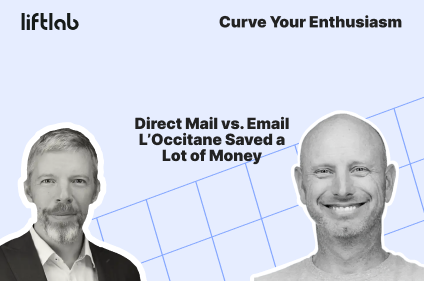
Direct mail vs email marketing should be decided by customer segment, not by how valuable a customer is, since L’Occitane’s original approach of reserving expensive direct mail for its best customers and email for everyone else was, as Dr. Koen Pauwels puts it, exactly backwards. In this conversation, Dr. Koen Pauwels of Northeastern University joins LiftLab’s John Wallace and Jon Lorenzini to unpack marketing experiments run across L’Occitane’s US and European markets, covering hundreds of thousands of customers, prospects, and dormant users.
The data showed that prospects and dormant customers largely ignored email from a brand they didn’t recognize, while a physical, flashy direct mail piece could actually catch their attention. Existing customers, on the other hand, responded well to a simple email reminder. Switching the channel strategy to match, direct mail for prospects, email for existing customers, cut L’Occitane’s costs significantly. The conversation also challenges the common practice of relying solely on CAC-to-lifetime-value metrics to run a marketing P&L, arguing that re-engaging existing customers isn’t free and needs to be accounted for too.
In this video, you’ll learn:
How L’Occitane optimized its marketing spend by re-evaluating traditional CRM segmentation
Why sending emails to prospects who don’t know your brand is often ineffective
How to use direct mail as a strategic tool for customer acquisition and re-engagement
Why marketing opt-out preferences often span across multiple channels, such as email and direct mail
The limitations of relying solely on CAC-to-lifetime-value metrics for running a marketing P&L
TIME STAMPFull Video Transcript: L’Occitane Direct Mail vs Email Case Study
+–
In this video , Dr. Koen Pauwels of Northeastern University joins LiftLab’s John Wallace and Jon Lorenzini to break down how L’Occitane rethought its direct mail and email strategy by customer segment.
[0:00 – 0:38] The CRM Approach and Initial Assumptions
[Dr. Koen Pauwels]: With L’Occitane, it was a much bigger scale, a huge company. We got data on hundreds of thousands of customers, potential customers, and dormants (people who hadn’t bought from the company for over a year) in the US and five European countries. We used the typical CRM approach, classifying consumers by frequency, recency, monetary value, and clumpiness of their purchases: do you do all your purchases right before Christmas for your wife, or do you spread them out over the year? We had about six of these behavioral segments.
[0:38 – 1:29] The Direct Mail vs. Email Strategy Mistake
[Dr. Koen Pauwels]: The big question was, they also sent direct mail to their highest-value customers. It made sense; it’s the most expensive, so we give it to our best customers. They sent emails to their prospects and dormants. Across all of these six countries, we were like, this is exactly wrong. If you look at the responsiveness, prospects and dormants don’t respond to your emails. If you get an email from a company you have not heard about, or you can’t pronounce L’Occitane, you’re probably not going to buy there. Whereas, if you’re a customer that regularly comes inside their wonderful offline stores, an email may be enough to remind you to buy again. These direct mails talk about the product assortment; they’re beautiful and flashy. You can show it to people in your family or at your work. We saw in historical data that it worked very well with prospects and dormants.
[1:29 – 2:19] Experiments and Behavioral Insights
[Dr. Koen Pauwels]: We did the experiment in Italy where we switched it and found that the company could save a lot of money. We also had some really cool things there regarding opt-outs. Some people opt out of direct mail explicitly but not email; others explicitly opt out of email but not direct mail. A side hypothesis we had was, is this people that just really don’t like a certain channel, or don’t want to be bothered by you at all? We figured out it was the latter. If somebody says don’t send me a direct mail, they typically also don’t want your email, and vice versa. That got the practice prize a few years ago. Different customer segments react very differently to what you have to offer.
[2:20 – 4:06] Re-evaluating Marketing Metrics
[Jon Lorenzini]: I think that’s very relevant, the new versus existing. You talked about your fax strategy, your beeper strategy, your phone strategy from before, but the metrics from a finance side is your CAC versus lifetime value, which is very much that new customer focus. From what I hear, the mix of your media depends on your customer segmentation, one being educating your customer, forming a relationship, which might be more costly, higher impact, higher cost ads might grow your business, while emails are more affordable ways of reaching out to existing customers.
[Dr. Koen Pauwels]: I do think that this CAC to lifetime value metric is overvalued for marketers because it does cost money. This is something John and I talk a lot about internally, getting an existing customer to convert again sometimes requires reminders and ads, and they’re not free, unless you’re locking into a Verizon contract or a life insurance policy. Applying them across all industries is a little arbitrary or extreme.
[John Wallace]: What I found is that’s a shortcut that folks have done that I can’t get on board with. If you have a company like L’Occitane, I’m under no obligation to ever buy there again, so they’re going to keep marketing to me. The question was, should they use email or should they use direct mail? But in the finance and counting of this, I’ve seen too many companies ignore that spend and just put all the spend against acquiring new customers. I just don’t think that’s the right finance for running a marketing P&L to say I spend all my money to acquire customers and everyone else comes back for free.
Key Lessons: Matching CRM Channels to Customer Segments
Challenge assumptions: Don’t automatically assume high-value customers need the most expensive marketing channels; responsiveness varies by segment.
Strategic channel matching: Use high-impact, physical media, like direct mail, to build awareness with prospects, and lower-cost digital media, like email, to maintain relationships with existing customers.
Omnichannel behavior: When customers opt out of one channel, they are likely disinterested in all communication; respect their opt-out as a signal to disengage from the relationship broadly, not just from that one channel.
Rethink CAC-to-lifetime-value: Treating CAC-to-lifetime-value as the only metric that matters undervalues the real cost of keeping existing customers engaged. Reminders and ads aimed at repeat customers belong in the marketing P&L, not in a column marked “free.”