


Executive Summary
Your digital campaigns are driving more revenue than your platform will report – and the online-to-offline attribution gap is why. An INFORMS field experiment confirmed that 84% of the total sales impact from online advertising occurs offline, in stores and through retail partners – impact your platform can’t see.
Your online channel might be generating substantially more revenue than your platform reports, especially if customers buy in stores, through retail partners, or on marketplaces like Amazon. That gap isn’t a data issue. It’s how ad platforms are built: they optimize against the conversions they can see, not the full demand system.
This post explains where that gap comes from, how it skews budget decisions, and the only measurement method that gives omnichannel brands a more finance-defensible view of true return. It draws on LiftLab and PMG’s 2026 research report, Escaping the Omnichannel Measurement Trap, developed by practitioners across both organizations. The full report is available to download at the end of this post.
What You Will Learn
Why 84% of your online ad impact remains undetected by all platforms, and why no attribution upgrade can address this structural issue
How incomplete signals accumulate over budget cycles, leading to increased CAC that the model cannot explain
The only measurement method that bridges the online-to-offline gap and supports a continuously improving, finance-auditable system.
What is online-to-offline attribution?
Online-to-offline attribution measures the revenue that online ads generate in physical stores and retail channels that platform dashboards cannot see. Standard attribution tools track digital conversions and have no mechanism for what happens after a consumer leaves the digital ecosystem. This results in brands systematically undercounting the true return on their digital spend. Closing the gap requires geo holdout incrementality testing and MMM that can capture offline sales lift generated by online ads.
Online-to-Offline Attribution: What Each Method Can and Cannot See
| Method | What It Measures | Can It See Offline Sales? | Can It Prove Causation? |
|---|---|---|---|
| Last-click attribution | Final digital touchpoint before conversion | No | No |
| Multi-touch attribution | Credit distribution across digital journey | No | No |
| Server-to-server integration | Improved signal quality within digital ecosystem | No | No |
| Geo holdout incrementality testing | True causal lift across all sales channels including offline | Yes | Yes |
| Media mix modeling calibrated by experiments | Full-funnel causal contribution across all channels | Yes | Yes |
The Number Your Media Plan Is Built Around and Why It’s Wrong
Here’s a finding that should make every CMO pause mid-budget-cycle: A field experiment published in the INFORMS Journal of Marketing Science tracked the online advertising outcomes for a national apparel retailer across more than 3 million users. The result: 84% of the total sales increase generated by the online campaign came from offline purchases. Offline, not online.
The retailer, measuring performance through an online-only attribution lens, was close to cutting out the campaign entirely. Their measurement system had accurately reported what it could see. The problem was that 84% of what actually happened was invisible to it.
Now, let’s make it personal. If your digital ad budget is $10M and your platform reports a 3x ROAS, the true incremental return across other sales channels could be several times higher. But that number will never appear on a dashboard. What appears is the fraction that converted online. The revenue happening in stores, on Amazon, and through retail partners? Your platform has no idea if it caused any of it.
For omnichannel brands, this offline sales attribution gap isn’t just theoretical, it is influencing how your budget decisions are being shaped right now.
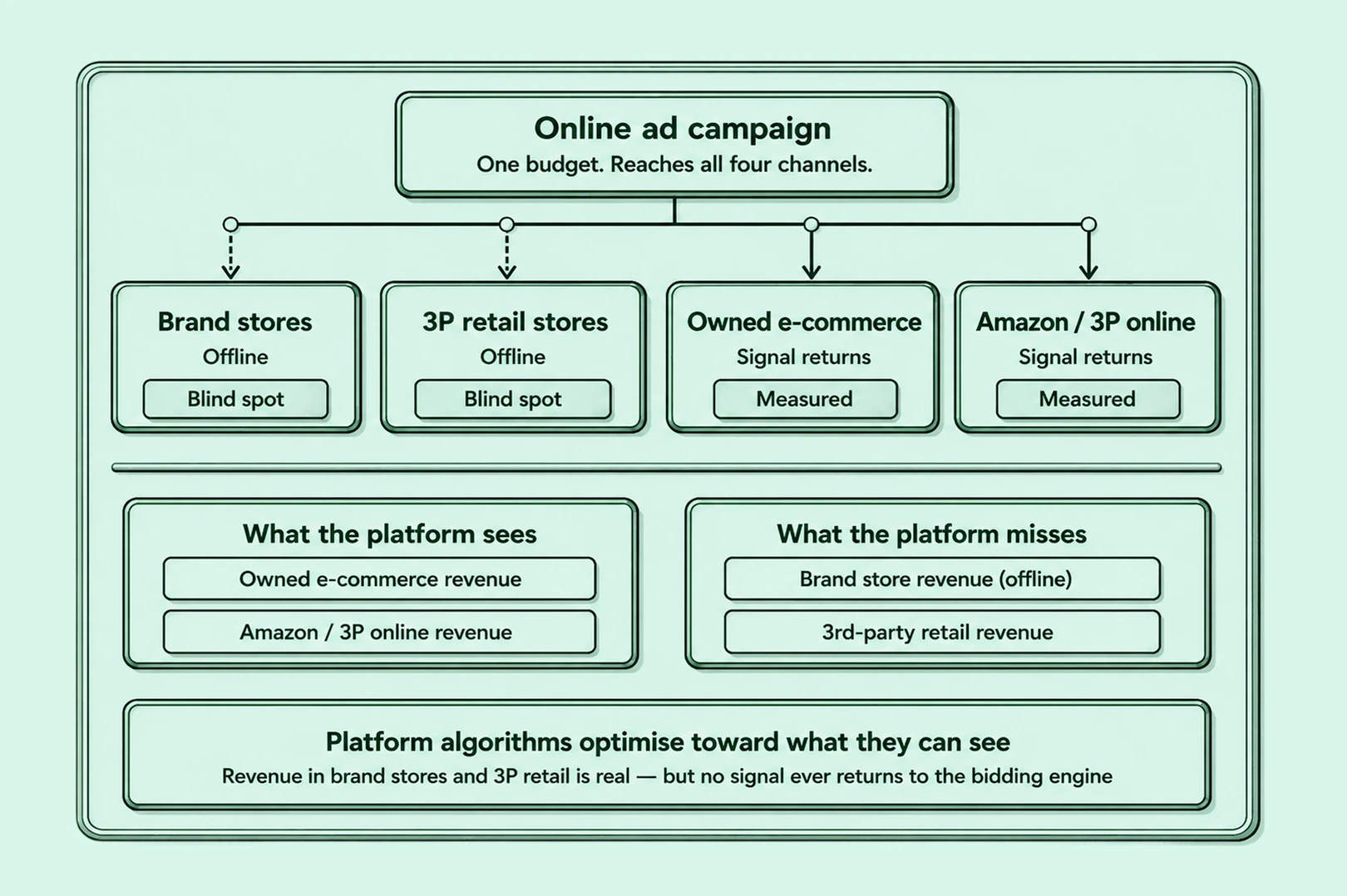
This structural blind spot, where online advertising influences all four sales channels but only one provides feedback to the platform, is what LiftLab, and PMG call the Omnichannel Measurement Trap. This is not a data quality issue; it results from how the system was designed.
Why Platforms Can’t See What Happens Next
Platform-reported ROAS is often only a partial read on performance and once you understand how platforms are built, the blind spot is not only evident, but also unavoidable from inside the platform. Let’s understand why:
The Signal Loop Platforms Operate On
Digital advertising platforms are closed-signal systems. They optimize based on conversion data fed back to them. What gets fed back: online direct sales, app purchases, on-platform conversions. What doesn’t: in-store purchases, third-party retailer transactions, Amazon orders placed by a user who saw your Meta ad last Tuesday.
Think about what that means in practice. A consumer who saw your Instagram Story on Monday, searched your brand on Thursday, and purchased in Target on Saturday? The platform credited Thursday’s click and learned nothing about Monday or Saturday. The most important part of that journey is invisible to the system governing your next bid.
The platform’s algorithm isn’t failing. It’s succeeding at optimizing a fraction of your actual business, while ignoring the rest.
The Four-Channel Problem
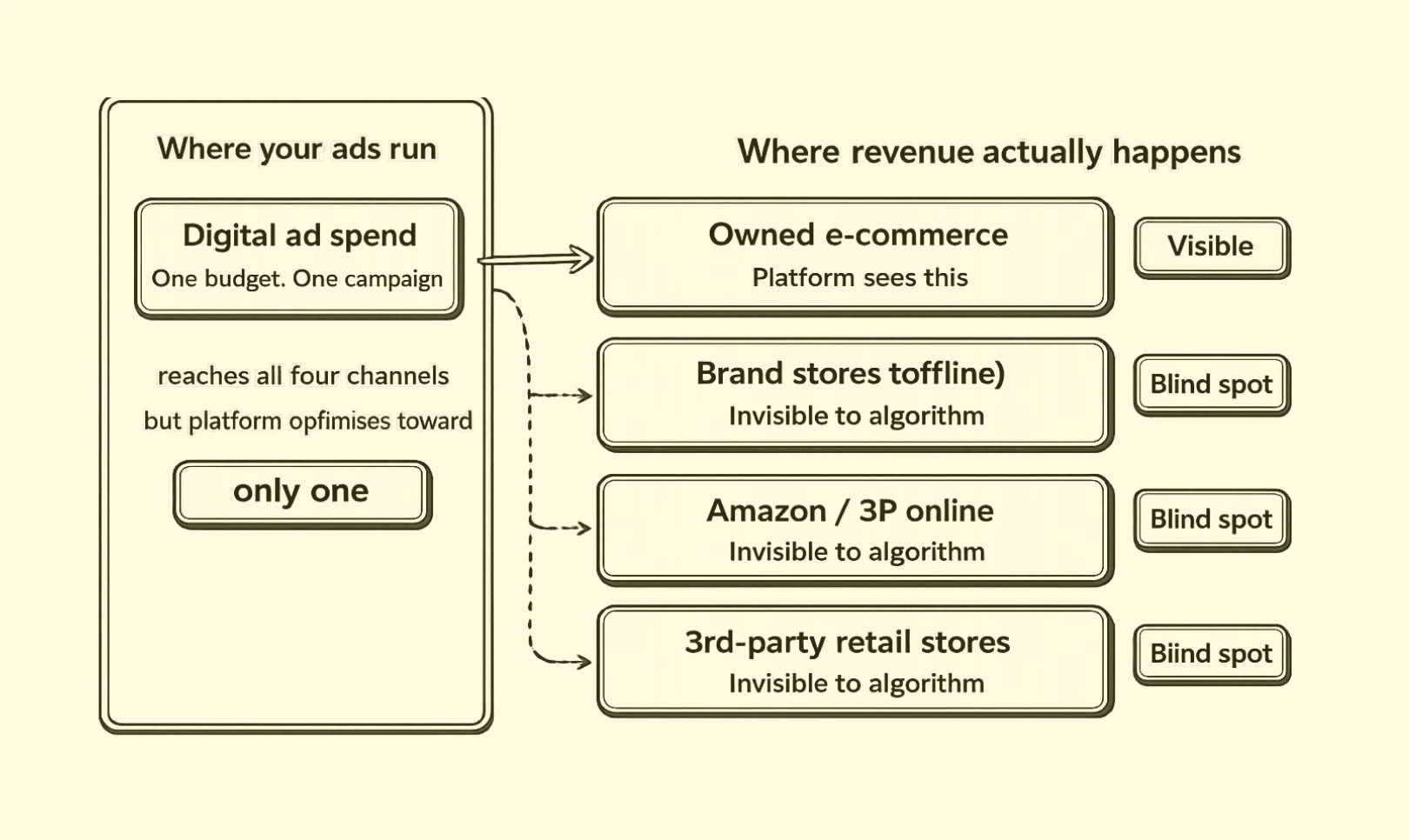
Advertising spend is incurred once, however revenue is realized across four channels simultaneously: owned e-commerce, brand stores, Amazon and third-party online, and third-party retail. Platforms can see one. Yet every omnichannel budget decision gets made as if the other three channels do not exist.
This is not just a measurement gap. This is measurement leading you in the wrong direction.
What the Bid Algorithm Does with an Incomplete Signal
When ad impact on offline sales is absent from the signal loop, the algorithm over-indexes toward users who convert online, typically high-intent, already-decided buyers. At the same time, it under-indexes toward audiences who respond by walking into a store or purchasing through a retail partner, often higher-LTV segments representing a larger share of total revenue.
It optimizes toward what it has been told, but the real problem lies in everything it has NOT been told. Over time, the platform gets measurably better at finding online converters while systematically downweighing the audiences that are driving actual business growth.
The Compounding Cost: What This Does to Every Budget Cycle
Here is what makes the online to offline attribution gap genuinely dangerous. It does not produce a single wrong answer. It compounds across every budget cycle, each one building on the misread from the one before, quietly eroding the effectiveness of every dollar spent.
Cycle 1: The Misread
A digital campaign runs nationally. The platform reports a ROAS of 2.5. In the same period, offline sales spike 18% in the markets where the campaign ran. The digital advertising offline impact measurement system credits the campaign with none of that lift. Finance sees 2.5x and approves a similar budget next quarter. Here’s where the compounding has already been initiated.
Cycle 2: The Underinvestment
Budget stays flat or gets shifted toward channels with stronger platform signals. The channels driving offline lift receive no recognition and no budget increase. Over-investment in demand-harvesting channels, branded search and retargeting, continues unchallenged. Upper-funnel channels that created the offline spike in Cycle 1 get quietly squeezed.
LiftLab and PMG’s 2026 research across enterprise omnichannel brands confirms what this costs: branded search’s true causal contribution is 30–70% lower than last-click reports, because the channel is intercepting demand built by the very upper-funnel channels now being defunded.
Cycle 3: The Erosion
Without sustained investment in demand-building channels, the baseline erodes. CAC creeps upward. Platform ROAS declines. The attribution model cannot explain why, because the real cause is structurally invisible to it. The instinctive response is to increase performance spend to compensate, which further starves the channels that have the potential to reverse the problem.
The compounding cost of incomplete measurement shows up over time: not one bad quarter, rather a vicious cycle of redirecting budget away from channels creating demand and toward channels consuming it, until the baseline disappears.
Why Attribution Cannot Fix This, and Why Adding More Will Not Either
At this point a reasonable CMO will push back: “We use MTA, not last-click. Does this still apply?”
Yes. Here’s why.
Multi-touch attribution (MTA) limitations persist even at its best. MTA meaningfully improves credit distribution across the digital journey. But it still cannot answer the question: Would this sale have happened without the ad? It measures correlation across touchpoints. It does not measure causation. More critically, MTA has no mechanism to connect to a TV exposure, a store visit, or an out-of-home impression to a downstream conversion. They are invisible by design, not by accident.
On the other hand, server-to-server (S2S) integrations improve signal quality within the digital ecosystem and raise the floor on data accuracy. But they cannot see offline. S2S raises the floor but does nothing to the ceiling. For a full breakdown of why each measurement method fails and where testing-informed MMM outperforms the rest, download the LiftLab and PMG framework: Escaping the Omnichannel Measurement Trap
Upgrading your attribution stack is like adding a better camera to a submarine periscope. You will certainly see the surface more clearly but still won’t be able to see beneath the waterline.
The core problem is not signal quality inside the digital ecosystem. It is that the demand system extends well beyond it. And no attribution upgrade changes that structural fact. For a broader look at the five forces driving this problem, read The Measurement Waterline
The Only Method That Captures the 84% and How It Works
The underlying logic of the problem points toward one solution, not because it’s the most convenient one, but because it’s the only one that answers the causal question.
What Geo Holdout Incrementality Testing Actually Measures
If the question is ‘what did this campaign actually cause across retail and digital?’, you need an experimental anchor. That’s where geo holdout testing earns its place.
Geo holdout testing is a controlled experiment. Advertising runs normally in treatment markets and is deliberately withheld from matched control markets. Matched markets are selected through stratified random sampling of DMAs to ensure the comparison is structurally valid before a single dollar of test budget is committed. Offline sales outcomes, including in-store and third-party retail, are then compared across treatment and control simultaneously. The difference is the true incremental lift, including what happened in stores, on Amazon, and through retail partners your platform ignores.
How MMM Turns One Experiment Into a Scalable System
A single geo holdout gives you a causal anchor for one channel at one moment in time. The compounding value comes when that result is fed back into a Marketing Mix Model that recalibrates its response curves across all channels simultaneously. The MMM then identifies which channels carry the highest response uncertainty and prioritizes those for the next experiment.
This is a closed loop reflected in LiftLab’s Trust Engine™: the model guides the experiments, and the experiments refine the model. Over time, the offline revenue tracking estimates the model produces become finance-auditable, grounded in causal evidence rather than mere correlation.
LiftLab’s PlatformSense layer directly addresses the responsiveness gap. Instead of waiting for the next model refresh to detect platform shifts, PlatformSense ingests daily signals such as CPM changes, conversion rate fluctuations, and auction dynamics, applying them as real-time effectiveness modifiers to long-term response curves. When Google Performance Max reallocates budget overnight, or Meta’s algorithm targets a new audience segment, PlatformSense identifies these changes the same day. The model remains rigorous, and decisions remain current.
What Changes When Platforms Receive the Full Signal
Once you know which channels are driving undercounted demand, you can stop judging them by platform ROAS alone. When an integrated MMM confirms that a channel is, let’s say, driving 3X the offline lift that platform ROAS is reporting, that insight changes everything. Right from how you set budgets, how you value upper-funnel media, to how aggressively you push spend into channels that create business value outside what the platform sees.
What marketing teams need is a measurement system that can see the full demand system and feed those insights back into platform strategy continuously, not quarterly.
What the Math Looks Like in Practice
A case study in LiftLab and PMG’s 2026 report, Escaping the Omnichannel Measurement Trap, illustrates this challenge. A growth-stage CPG brand increased its retail and digital spending but could not demonstrate an incremental impact, making retail media investment difficult to justify to Finance. Although platform ROAS appeared satisfactory, a measurement blind spot remained the core issue.
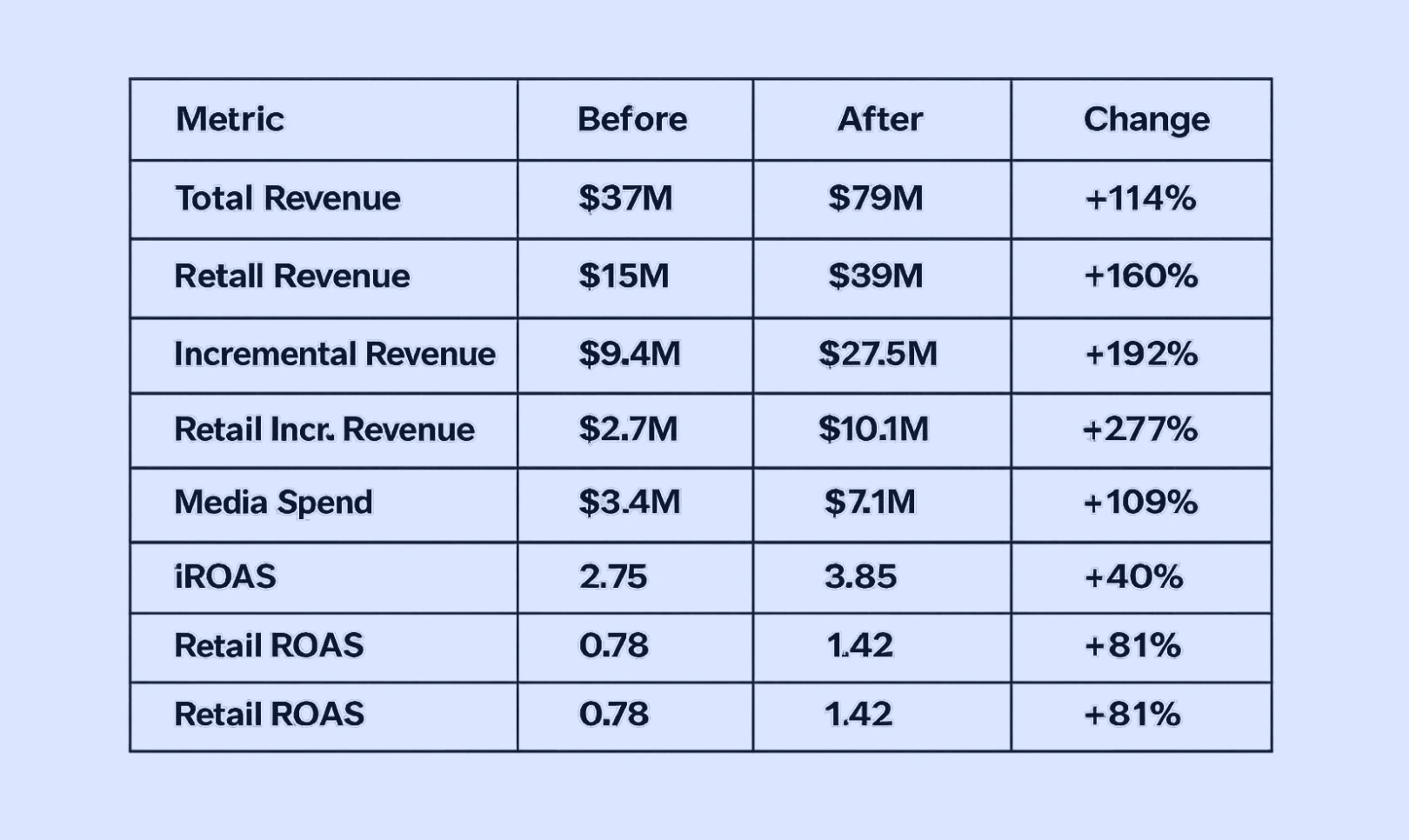
Business and marketing investments doubled year over year, while incremental revenue tripled. Retail’s incremental revenue increased nearly fourfold. Finance now has visibility into the impact of paid media across online and offline channels and can identify optimal investment levels to maximize growth.
The ads weren’t new. The measurement was. This doubled the spend and tripled the returns.
The brand didn’t become a better advertiser suddenly, instead they measured the same advertising more completely, with offline sales attribution and digital spend in the same model, across all four channels, for the first time.
Three Signs Your Budget Is Being Built on Invisible Math
Your digital ROAS looks stable, but CAC is creeping up quarter over quarter
Healthy efficiency metrics alongside rising acquisition costs typically mean over-investment in demand-harvesting channels and chronic under-investment in the one’s building the baseline. The problem isn’t your media team. It’s your measurement.
Your digital campaign data and your retail/POS data live in separate reports
If your offline conversions data and media performance data never sit in the same model, you cannot know whether your digital campaigns are driving offline sales or by how much. You are running two ledgers for one business.
Your platform ranks branded search or retargeting as your top-performing channel
Last-click attribution systematically over-credits bottom-funnel channels that intercept audiences with an intent to buy. If branded search is consistently first, you are measuring demand harvesting, not demand creation. The channels that built that demand are invisible in your attribution model and underfunded in your budget.
Stop Waiting for the Platform to Fix It. Here’s Where to Start.
A full measurement overhaul isn’t the starting point. A single geo holdout test is.
Pick your highest-spend digital channel. Find a market where you have meaningful offline retail presence. Run the test. That experiment will give you the first causal anchor that tells you with genuine statistical confidence, how much offline revenue your digital advertising is actually generating. That’s your baseline for everything that follows.
When that result is fed into an integrated MMM platform, the improvement in model accuracy improves. Each subsequent budget cycle is built on more complete evidence. Each reallocation decision is closer to the true return on the investment. The brands that close this online to offline attribution gap first don’t just measure better. They build a spend flywheel, each budget cycle more accurate, each reallocation generating higher compounding returns than the last.
Key Takeaways
84% of online ad impact occurs offline, invisible to dashboards
Platforms optimize on a closed signal loop that excludes in-store and third-party retail sales
Incomplete signals compound across budget cycles, defunding demand-building channels
MTA and server-to-server integrations improve digital coverage but cannot see offline
MMM calibrated by incrementality experiments turns a one-time test into a scalable system
The brands closing this gap first build a compounding measurement advantage
84% of your ad impact is happening somewhere your platform will never report, which means your budget strategy is being built on a fraction of the truth. The brands closing this gap aren’t waiting for platforms to fix it; they’re building the measurement architecture that sees all of it.
Download the full framework: Escaping the Omnichannel Measurement Trap – A practitioner’s guide to building measurement that sees the full demand system, co-authored by LiftLab’s CPO, Chief Data Scientist, and VP of Product Marketing alongside PMG’s analytics leadership team.
LiftLab helps brands measure incremental impact across channels and turns that learning into better capital allocation decisions. Uncover the 84% impact your platform can’t see:
FAQs about Online-to-offline Attribution
Why do online ads drive offline sales?
Online advertising builds awareness and purchase intent across the full consumer journey, not just at the digital point of conversion. A consumer who sees a digital ad may research online and then buy in-store, through a retailer, or on Amazon days later. A single exposure can generate revenue across multiple channels simultaneously, most of which standard offline sales attribution never captures.
What does it mean that 84% of online ad impact occurs offline?
A field experiment in the <a href=”https://www.informs.org/News-Room/INFORMS-Releases/News-Releases/Over-80-of-online-ad-effect-is-on-offline-sales” target=”_blank” rel=”nofollow noopener noreferrer”>INFORMS Journal of Marketing Science</a> tracked 3 million users alongside a national apparel retailer. It found that 84% of the campaign’s sales increase came from offline purchases. The retailer’s online-only attribution system was capturing just 16% of the true impact, a misread that nearly resulted in the campaign being cut.
Why can’t digital advertising platforms measure offline sales?
Digital advertising platforms are closed-signal systems that optimize on conversions fed back from within the digital ecosystem. In-store and third-party retailer purchases return no signal to the platform. This is not a technical failure. It is a fundamental architectural limitation of digital advertising offline impact measurement that no platform update can solve.
What is geo holdout testing and how does it measure offline sales?
Geo holdout testing is a controlled experiment that withholds advertising in selected geographic control markets while maintaining normal advertising in treatment markets. Markets are chosen for their structural similarity, including historical sales patterns, demographic composition, and retail distribution, to ensure a valid comparison before allocating any test budget. Sales outcomes are then compared across offline and digital channels in both groups. The resulting difference reveals the true incremental lift, including in-store and third-party retail, which attribution dashboards cannot measure.
What is the difference between attribution and incrementality?
Attribution assigns credit for a sale across the touchpoints in a consumer’s path answering the question “Which channels did this buyer interact with?” Incrementality measurement answers: “Would this sale have happened without advertising?” Attribution measures correlation. Incrementality measures causation. For omnichannel attribution where most ad impact occurs offline, incrementality is the only method that captures what a campaign actually caused.
How do you fix the online-to-offline attribution gap?
The most rigorous fix combines geo holdout incrementality testing with a Marketing Mix Model. The geo holdout test measures true causal lift across all sales channels, including offline. That result calibrates the MMM’s response curves with causal evidence. Over time, the MMM guides which channels to test next, converting a blind spot into a continuously improving, finance-auditable measurement system.