
Executive Summary
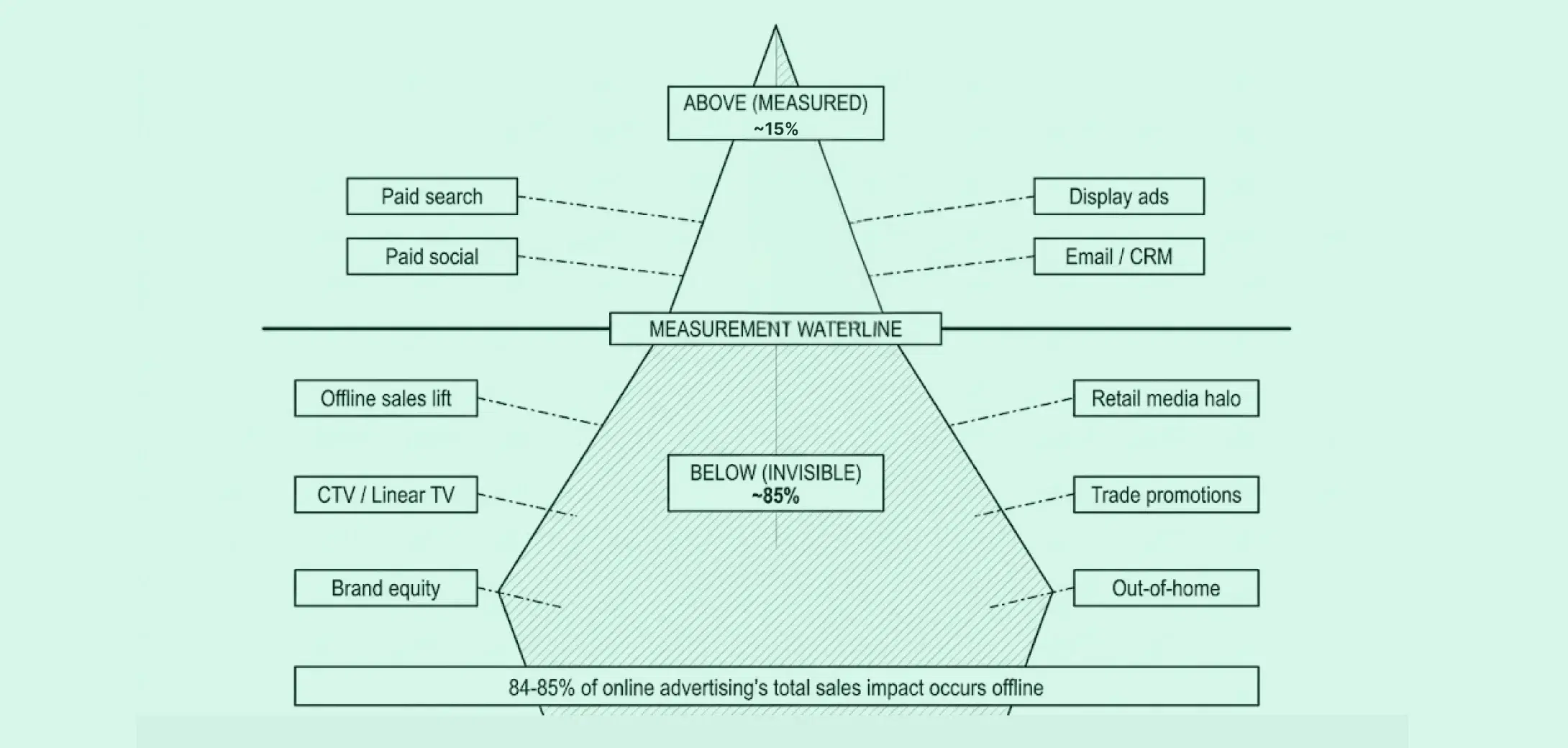
Your marketing measurement system is showing you 15% of what’s actually happening. The other 85%, offline sales lift, brand equity accumulation, retail media halo effects, and trade promotion distortion, sits invisible beneath what we call the measurement waterline. And every budget decision you made this quarter was built on that partial picture.
This isn’t a data quality problem. It’s an architectural one. And until brands fix the structure of how they measure, every budget decision they make is being built on an incomplete picture of reality.
What follows is a diagnostic of why the other 85% stays invisible, what it has been costing your channel budgets, and the measurement architecture that finally closes the gap.
What you will learn
Why omnichannel measurement requires a fundamentally different architecture than what most attribution tools were built for
What the measurement waterline is, what sits above it, and why the 85% of impact below it is structurally invisible to platform dashboards
The five forces actively pulling more advertising impact below the line: offline sales, retail media opacity, CTV causation gaps, trade promotion contamination, and brand compounding
What the marketing measurement blind spots in your current stack are costing you
How LiftLab’s three-layer architecture closes the omnichannel marketing measurement gap
Three diagnostic questions to pressure-test your current measurement stack before the next planning cycle
What Is Omnichannel Measurement?
Omnichannel measurement is the practice of tracking and attributing marketing performance across every channel a consumer interacts with, such as paid search, social, CTV, in-store, retail media, and third-party retail, within a single unified model. Unlike single-channel or platform-native reporting, omnichannel measurement accounts for the full demand system.
Why 85% of Ad Impact Goes Unmeasured?
| Force | The Blind Spot It Creates |
|---|---|
| Online ads drive offline sales | 84-85% of campaign sales lift occurs in stores. Platforms only see what converts online |
| Retail media is self-attributing | RMNs measure only what converts on their own platform. Cross-channel lift never enters the model |
| CTV links exposure to outcome, not causation | A streaming impression cannot be connected to a downstream sale without an incrementality experiment |
| Trade promotions contaminate media signals | When promotions and media run simultaneously, attribution credits the ad for the discount’s lift |
| Brand investment compounds invisibly | Brand effects build over 6 to 52 weeks. Short measurement windows miss all of it |
The Iceberg Your Dashboard Shows You, and What it Doesn’t
Imagine your marketing dashboard as an iceberg. Everything you see above the surface, paid search clicks, social conversions, display impressions, email opens, represents roughly 15% of your advertising’s actual impact on the business. The other 85% is underwater, representing offline sales lift, brand equity compounding over time, retail media’s halo across channels it can’t track, and trade promotion effects bleeding into media attribution. All of it real; all of it invisible to your current measurement systems.
INFORMS research confirms it: 84-85% of the total sales impact from online advertising occurs offline. A number that could be so detrimental, that it simply cannot be ignored.
But here’s the harder truth; the tools aren’t broken. They’re working exactly as designed, for a world that no longer exists. A world where consumers bought online after clicking on one ad, where channels were distinct, and where “measuring marketing” meant counting digital fingerprints. That world is gone. The omnichannel measurement architecture hasn’t caught up.
What ‘Above the Waterline’ Actually Measures
What lies above the waterline is real data. The signals your measurement system captures are real. Paid search clicks convert. Paid social drives traffic. Display and email generate measurable response. The problem is that these signals represent only the fraction of the demand system that happens to leave a digital footprint. And the distortion starts before you even reach the invisible 85%.
What is last-click attribution actually measuring? It awards full credit to the final touchpoint before purchase, systematically intercepting users already on the verge of converting, people already influenced by TV, a store visit, or brand awareness, and handing the trophy to whichever channel happened to be last in line.
Incrementality tests consistently show that branded search’s true causal contribution is 30-70% lower than what last-click reports. Brands running on last-click are over-funding channels that harvest demand and starve the ones that actually build it.
Multi-touch attribution (MTA) limitations are equally real. MTA improves coverage but still can’t answer the fundamental question: Would this sale have happened without the ad? That’s not an attribution question; that’s an incrementality question. Running MTA without incrementality is analogous to measuring how many people entered the store without asking what made them leave their house in the first place. Marketing attribution blind spots persist as long as the measurement architecture can’t answer it.
This is the ceiling of what above-the-waterline measurement can see. The five forces below are what’s actively pulling more impact out of view.
The Five Forces Pulling More Impact Below the Line
The omnichannel measurement challenges facing brands today aren’t new, but they’re accelerating. Five structural forces are actively pulling more true advertising impact below the measurement waterline, and none of them are going away.
- 01
Online ads drive offline sales, but platforms only see one:
A landmark INFORMS field experiment tracked 3 million users alongside a national apparel retailer. Result: 84% of the sales lift from the online campaign came from offline purchases. The retailer, using online-only attribution, was close to cutting its digital budget as the measurement system had inverted reality. This isn’t a one-off case, rather the structural norm in any omnichannel brand. If you sell through any combination of e-commerce, retail, and brand stores, this reflects your business.
- 02
Retail media is worth billions and largely self-attributing:
As per eMarketer’s Retail Media Ad Spending Forecast H2 2025, Retail Media Networks (RMNs) hit $53.7 billion in 2024 and are projected to reach $69.3 billion in US by 2026. Nearly 80% of major retailers now operate their own network. Yet RMNs are fundamentally trapped within their own walled gardens. The result is systematic underreporting of true omnichannel marketing measurement impact, and underinvestment in tactics whose real ROI is invisible.
- 03
CTV links exposure to outcome, but not causation:
IAB projects CTV will capture nearly 60% of all TV and video ad spend by 2026. However, connecting a streaming impression to a downstream conversion is just the first step.
Without incrementality, the CTV attribution problem is simply
last-touch attribution on a bigger screen.The question isn’t whether the purchase happened after the CTV exposure. The question is whether it happened because of it.
- 04
Trade promotions contaminate media performance signals:
In CPG, upto 70% of total volume sells during promotional periods. When a price reduction and a media campaign run together, attribution models conflate the two. The ad gets credited for the lift the promotion drove. Globally, nearly 35-40% of CPG trade promotion spend is wasted, partly because trade and media remain completely opaque. You cannot optimize what you cannot isolate.
- 05
Brand investment compounds invisibly:
A $100K brand campaign with a short-term ROAS of 1.0 may be dramatically understated. If the investment lifts branded search, improves organic conversion, and reduces future media requirements over 6-52 weeks, its true return is multiples of what the dashboard shows. Brand-building effects compound slowly; the measurement system doesn’t see the carryover, eroding the baseline quietly over time. Without a measurement architecture that captures carryover effects, you’re not just undervaluing brand; you’re systematically eroding the baseline that makes your performance spend work harder.
This is LiftLab’s Omnichannel Measurement Trap: Brands invest in cross-channel marketing but assess performance through a dangerously narrow lens. Want the full framework behind this?
What Its Costing Every Budget Decision You Make
Understanding the waterline is one thing. Understanding what this costs you in real budget decisions, quarter after quarter is another.
The consequences aren’t abstract. Gartner research finds fragmented measurement costs enterprises $12.9 million annually in missed opportunities and wasted investment. Up to 60% of digital marketing spend is misattributed or outright wasted. You’re not funding just one measurement gap; you’re funding thousands of incorrect budget decisions that compound it.
- 01
Underinvestment in channels that build demand :
When upper-funnel and offline marketing attribution yields no measurable credit, budgets migrate relentlessly toward last-click channels. Those channels harvest demand rather than create it. Over time, CAC creeps upward as the demand baseline erodes because the brand stopped funding the channels that built it.
- 02
Platforms over-optimized on incomplete signals:
When only online direct sales are fed back to digital platforms, platforms optimize toward a narrow slice of reality. They find online converters efficiently, but receive zero signal about offline sales, brand lift, or retail halo.
The algorithm isn’t broken. It’s optimizing exactly what it’s been told to value.
The problem is what it hasn’t been told. This is the omnichannel measurement framework failure hiding in plain sight.
- 03
The 53-point confidence gap:
Nielsen’s 2025 Marketing ROI Blueprint found 85% of marketers confident to measure holistic ROI, but only 32% actually do so. That 53-point gap means most CMOs are presenting confidence to their boards that their measurement system cannot actually support. It’s not a skills problem. It’s a structural one built into the architecture. It persists because the measurement architecture most brands rely on was never designed to see the full demand system.
The problem is not that you lack data. It’s that your measurement architecture was built to see only the visible portion of the demand system, and it rewards accordingly.
The Architecture That Sees the Full Demand System
Overcoming the omnichannel measurement trap isn’t a matter of adding another attribution platform or running a one-off incrementality test. It requires a fundamental architectural shift.
Each demand layer needs to be modeled with the appropriate approach, and the outputs need to be unified into a single portfolio. As LiftLab’s framework puts it: accuracy requires separation; decision-making requires integration.
The architecture has the following three layers:
- 01
Data Foundation:
This is a unified input layer spanning POS data, trade calendars, retail media spend, CTV/linear, real-time platform signals, and macroeconomic indicators. Not siloed by channel team or managed by separate vendors. One layer, one version of the truth. Retail media on-site placements and off-site programmatic behave differently and should be modeled separately.
- 02
Model Engine:
A well-architected marketing mix modeling platform separates auction dynamics (how budget becomes impressions) from consumer response dynamics (how impressions become revenue). Conflating the two, as traditional MMM does, produces elasticity estimates that capture neither accurately.
Paired with a closed-loop incrementality testing and MMM program such as LiftLab’s Incrementality Testing Suite: the model flags which channels need causal validation; experiments recalibrate the model. This is what makes measurement smarter over time. LiftLab’s Trust Engine powers this closed loop, while PlatformSense delivers daily budget signals without the 90-day lag of traditional MMM.
- 03
Decision Layer:
Weekly investment optimization, monthly learning, quarterly forecast and planning – all from one model, not three vendor dashboards. LiftLab’s Scenario Planner operationalizes exactly this: pressure-testing growth plans before committing spend.
The Real-World Evidence
The results of making this shift are groundbreaking: A growth-stage CPG brand scaling through both direct e-commerce and national retail distribution replaced last-click attribution with integrated iROAS measurement.
160% growth in retail revenue
192% growth in incremental revenue
3.85 iROAS, improved from 2.75
2X spend
3X Incremental Returns
The improved visibility didn’t just close a measurement gap. It turned budget decisions into a compounding growth advantage.
Three Questions to Pressure-Test Your Stack
Run your current marketing measurement architecture through these three diagnostic questions:
Does your measurement system include all four sales channels, owned e-commerce, owned stores, Amazon, and third-party retail, in the same model? If different channels live in different models, you’re measuring partial ROI and calling it total.
Can you separate media-driven lift from trade promotion effects in the same view? If the answer is no, you’re not optimizing media. You’re optimizing noise.
Does your budget optimization account for the next 6-52 weeks of brand equity carryover or only last quarter’s ROAS? If the answer is the latter, you’re systematically underfunding the investments that build the baseline everything else depends on.
Stop Measuring the Tip of the Iceberg
The waterline isn’t moving anywhere. But your architecture can.
The brands winning in omnichannel aren’t the ones with the most dashboards. They’re the ones who know what those dashboards can’t see and build a measurement system around the full picture. Start making budget decisions from a position of actual evidence rather than confident ignorance.
Read the full framework: Escaping the Omnichannel Measurement Trap – the complete guide to building integrated measurement that sees the full demand system.
See what’s below your measurement waterline:
Key Takeaways
85% of ad impact occurs offline and remains invisible.
Last-click overvalues bottom-funnel channels by 30-70%.
Retail media networks claim credit for what they drive to themselves. Cross-channel lift is invisible and uncompensated.
Every budget cycle run on incomplete measurement defunds your best-performing channels.
The fix is architecture, not more tools.
Omnichannel Measurement FAQs
What is the omnichannel measurement trap?
The omnichannel measurement trap is a structural condition where brands invest across channels but measure performance through a lens that only captures trackable digital outcomes. It systematically overvalues visible channels and penalizes the ones driving the most impact, distorting every budget decision that follows.
Why does last-click attribution undervalue offline marketing?
Last-click attribution only captures the final digital touchpoint before a purchase. It has no mechanism to connect TV exposure, out-of-home, in-store activations, or brand investment to downstream conversions.
What is incrementality testing and why does it matter for omnichannel brands?
Incrementality testing answers the question attribution never could: would this sale have happened without the ad? It uses controlled experiments such as geo-holdouts, switchback tests, audience holdouts, to isolate the causal lift a marketing investment generates. For omnichannel brands , incrementality testing confirms whether media spend is actually driving growth or simply taking credit for it.
How do retail media networks create measurement blind spots?
Retail media networks are walled gardens, they can measure sales impact within their own platform but have no visibility into lift they drive across other retail channels, owned e-commerce, or brick-and-mortar stores. This means brands routinely underestimate true omnichannel ROI and make allocation decisions based on a fraction of the actual return.
What is Marketing Mix Modeling (MMM) and how is it different from attribution?
Marketing Mix Modeling is an econometric technique that measures the contribution of each marketing investment to total sales. Unlike attribution, which traces individual user paths, MMM operates at an aggregate level and can measure both online and offline channel effects, including brand equity accumulation.
What is the omnichannel measurement waterline?
The measurement waterline is LiftLab’s term for the boundary between what your current marketing measurement architecture can see and what it cannot. Above it: trackable digital signals. Below it: offline sales lift, brand equity, retail media halo, and trade promotion effects. Research from INFORMS confirms that 84-85% of online advertising’s true sales impact falls below this line, invisible to the attribution tools most brands rely on for budget decisions.
How do you measure the offline impact of online advertising?
The most rigorous method is geo-holdout incrementality testing which involves running a controlled experiment where advertising runs in treatment markets and is withheld from matched control markets, to get the causal evidence of offline lift. When integrated with Marketing Mix Modeling, these experiments calibrate the model’s response curves, producing offline attribution estimates that can withstand CFO scrutiny.