

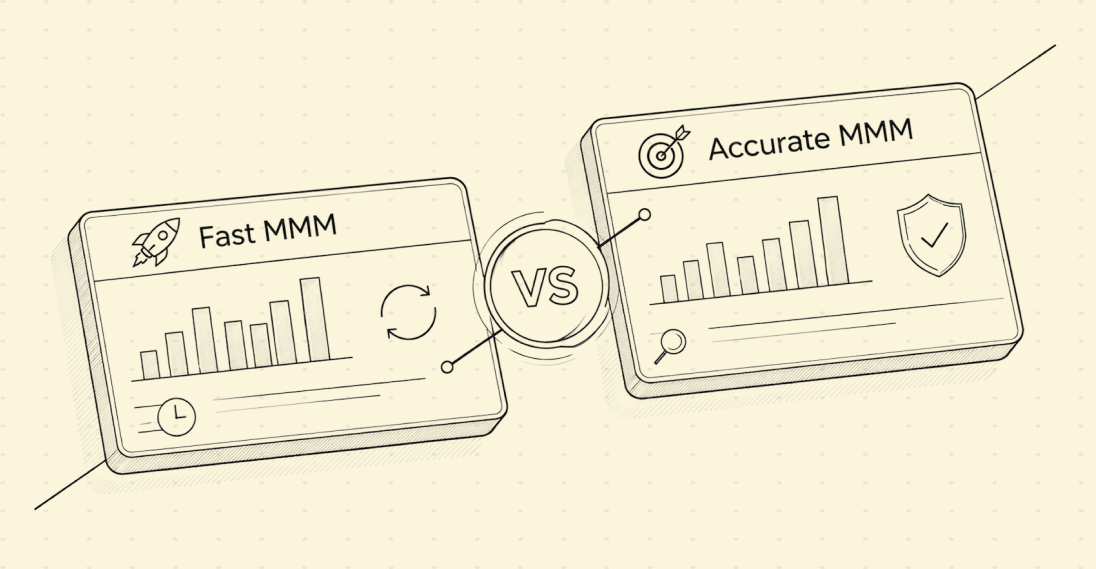
MMM accuracy comes from predictions that hold up in the real world. Regular refreshes, paired with controlled experiments, let marketers to test those predictions and improve the model over time. In-sample fit shows how well a model explains the past, while out-of-sample validation tests it on unseen periods. A real-world prediction track record shows whether its recommendations work in practice. This article shows how experiments and faster refreshes strengthen MMM accuracy.
Executive Summary
The debate between fast and accurate marketing mix modeling is framed as a trade-off, but the real distinction is between validated and unvalidated predictions. This article explains the three tiers of model validation, why controlled geo experiments act as the neutral referee, how experiment results create a calibration loop, and why frequent validated refreshes build a stronger prediction track record. It also examines how quarterly models handle market shifts and provides six questions for evaluating any marketing mix modeling platform.
What You Will Learn
Why historical model fit does not establish marketing mix modeling accuracy
What each of the three model validation tiers actually proves
How controlled geo experiments test model predictions against real-world outcomes
How experiment results become part of a calibration loop rather than a one-time report
Why validated monthly forecasts can build a stronger prediction track record than validated annual forecasts
What to ask a marketing mix modeling platform before trusting its speed or accuracy claims
What Makes an MMM Accurate?
Marketing mix modeling accuracy comes from forecasts that are repeatedly confirmed by real-world outcomes, not from the best historical fit. Controlled experiments provide causal reads that validate and recalibrate the model. Frequent experiment-calibrated refreshes accumulate validated predictions faster. Here is how to evaluate both failure modes and judge the architecture behind the cadence. The sections below show what that requires in practice.
The Real Question Is Not Speed or Cadence. It Is Whether Reality Agreed
A marketer hears two pitches in the same week. One vendor says a model refreshed quarterly is disconnected from reality. Another says a model refreshed weekly is noise dressed up as insight. Both are half right, and both are selling the half that favors their architecture. The real question is neither speed nor cadence. It is this: when your model made a prediction, did reality agree?
That question changes how MMM accuracy should be evaluated. A model that fits historical data perfectly can still fail when market conditions shift. A model that refreshes quickly can still produce unreliable recommendations if those predictions are never tested against what actually happened. The answer is not choosing a faster model or a slower one. It is building a system where refreshes are validated, experiments recalibrate the model, and each new prediction adds a clear track record over time, rather than a single impressive model fit.
Fast MMM vs Accurate MMM at a Glance
| Evaluation Area | Fast MMM | Accurate MMM |
|---|---|---|
| Refresh cadence | Frequent updates without validation | Frequent updates paired with validation |
| Historical fit | Strong fit can still fail on future predictions | Historical fit supported by validated predictions |
| Out-of-sample validation | Does not establish predictive performance | Tests predictions against unseen periods |
| Experiments | Lift number becomes a one-off report | Results feed back into the model |
| Prediction track record | More outputs, limited evidence | More validated predictions over time |
| Market shifts | Quarterly refresh averages over regime changes it never detected | Daily signals catch shifts between refreshes |
| Core buyer question | “How often does it refresh?” | “How does it prove its predictions are right?” |
Where the Speed Versus Accuracy Debate Came From
The speed-versus-accuracy debate emerged as MMM adoption grew and marketers looked for faster ways to understand how marketing drives value. As MMM adoption has grown, the limitations of the traditional approach have become harder to ignore. Annual enterprise MMM rebuilds created a timing problem. By the time a model was rebuilt and ready to inform decisions, the market conditions behind those decisions could already have changed. The model could describe what had happened, but its usefulness for current decisions was limited by the time required to rebuild it.
The agile wave responded to that problem with faster modeling cadences. Instead of waiting for an annual rebuild, marketers could refresh their models more frequently and bring newer information into the decision-making process. The appeal was straightforward: a model that updates more often has a better chance of reflecting current market conditions.
That created a second criticism. Faster does not automatically mean more accurate. A model that refreshes quickly but has not been properly validated can produce faster noise. More frequent outputs do not make a model reliable if its predictions have not been tested against what actually happened.
Both critiques are legitimate.
Annual rebuilds can arrive too late to support the decisions marketers need to make today. Faster models can become noise when speed comes without sufficient validation. Both realities point to the same problem: treating speed and accuracy as opposing choices. The better approach is to build a modeling system where frequent refreshes and rigorous validation reinforce each other.
The relevant question is what happens between model refreshes and how the model establishes that its predictions are accurate. A model should not be judged by cadence alone. It should be judged by whether its predictions are repeatedly tested against real-world outcomes and whether those results strengthen the model over time.
That changes the choice. The goal is not to find the fastest model or accept a slower model in the name of accuracy. It is to build a modeling system where frequent refreshes and rigorous validation reinforce each other.
What Accuracy Actually Means (and What R-Squared Cannot Tell You)
Accuracy in MMM is not the same as historical fit. A model can describe the past extremely well and still fail to predict what happens next. That is why MMM validation needs to be viewed in three tiers, each answering a different question about performance.
The three tiers of MMM validation
Tier 1: In-sample fit
In-sample fit uses measures such as R-squared and MAPE-class metrics to show how well the model describes the historical data used to build it. A good fit means the model explains the history well. It does not prove that the model can predict an unseen period or that its recommendations will produce the outcomes it forecasts.
Tier 2: Out-of-sample holdout
Out-of-sample holdout tests the model against a holdout period that was not used to build it. The model makes predictions for that unseen period, and those predictions are compared with what actually happened. This tests whether the model can generalize beyond the data it already knows.
Tier 3: Real-world prediction track record
The strongest tier asks whether acting on the model’s recommendations produced the outcomes it forecast. This moves validation from describing or predicting history to demonstrating performance in decisions. A model earns a track record when its recommendations are repeatedly confirmed by real-world outcomes.
Consider a model that fits historical data perfectly. Its R-squared is strong, and its predictions look reliable within the period used to build it. Then a platform changes its auction dynamics and CPMs move sharply. The model continues to apply relationships learned from the earlier period and misses the shift. Its historical fit remains strong, but its prediction has failed.
That is what R-squared cannot tell you. Fit statistics describe how well a model explains the data it was given. They do not manufacture evidence that its future predictions will hold. Out-of-sample validation provides a stronger test, while a real-world prediction track record provides the strongest evidence that recommendations work in practice.
Only tier 3 earns a CFO’s trust because it connects model predictions to actual outcomes. It is also the tier that no fit statistic can manufacture.
Why Experiments Are the Only Referee
Controlled geo experiments are the only neutral referee because they test marketing’s causal impact independently of both the model and platform-reported numbers. Platform-reported ROAS has the same limitation: it shows attributed outcomes, not necessarily incremental impact. They create a causal read by deliberately changing marketing exposure in one set of comparable markets while holding another set steady. The difference between treatment and control becomes evidence that is independent of the model and independent of platform-reported numbers.
That independence makes them the only neutral referee between a fast MMM and an accurate MMM.
A fast marketing mix modeling system can refresh every month. An annual model can produce a stronger historical fit. Neither wins by default. Both have to answer the same question: did the predicted outcome happen when the recommendation was put into practice?
Experiments answer that question because they do not ask the model to validate itself. They test whether reality agrees with the prediction. That is the standard that matters for marketing measurement, because budget decisions need evidence that survives outside the modeling process itself.
From one-off tests to a calibration loop
A single experiment settles a single argument. It can answer whether increasing spend in one channel produced incremental lift in a specific market during a specific period.
That is valuable, but it is not enough.
The stronger system is a calibration loop, where every experiment result feeds back into the model and permanently tightens its response curves. Validation stops being a one-time event and becomes an ongoing system that improves the next decision instead of simply documenting the last one.
That is different from simply backtesting a model against its own historical predictions. Backtesting can show how well a model performed against data it did not use during development. Experiment-fed calibration adds an independent check: controlled experiments test the model’s predictions against real-world outcomes, and those results are used to recalibrate the model.
The model should also help determine where the next experiment belongs. Instead of testing channels at random, it should identify which channel carries the highest uncertainty. That channel becomes the next candidate for experimentation, so each new test reduces uncertainty where it matters most.
The anti-pattern is treating an experiment as a reporting exercise. A lift number appears in a report, gets discussed in a presentation, and disappears before the next planning cycle. A calibration loop does the opposite. Every completed experiment changes the model itself, permanently tightening its response curves, so each result becomes evidence that shapes the next allocation decision instead of a statistic that expires after the readout.
This is the principle behind LiftLab’s Trust Engine, where geo experiment results feed back into Agile MMM, permanently tightening response curves while the model prioritizes the next experiment based on uncertainty. The Incrementality Testing Suite provides the controlled experimentation layer that supplies this evidence.
Why Speed Compounds Accuracy Instead of Eroding It
Speed compounds accuracy when each model refresh is paired with validation, because every validated refresh adds evidence to the model’s prediction track record. Accuracy is built by repeatedly testing predictions against real-world outcomes, not by waiting longer between updates. That is why fast MMM and accurate MMM do not have to pull in opposite directions.
The important distinction is not how frequently a marketing mix modeling platform refreshes. It is whether each refresh earns its place in the track record by being tested against reality. Here is why that gap compounds: a model that validates its forecast every month has confirmed twelve predictions by the end of the year. A model that validates once, at the close of an annual cycle, has confirmed one. That difference alone is what makes frequency worth caring about, provided every one of those refreshes is actually checked against what happened, not just produced on schedule.
A faster cadence without validation does not close that gap. It just produces more forecasts nobody has tested. A slower cadence closes it too slowly, even when the underlying model is sound, because the evidence needed to trust it takes a full year to arrive. Neither extreme gets marketers what they need, which is a growing, confirmed record they can act on now.
The volatility problem a quarterly model cannot see
When CPMs, auction dynamics, or platform algorithms shift between refreshes, the model may not incorporate those changes until the next modeling cycle. That leaves marketers making decisions from evidence that no longer reflects current conditions.
LiftLab’s PlatformSense captures daily signals across ad platforms that catch shifts between Agile MMM refreshes, so reallocation decisions do not wait for the next modeling cycle.
The Buyer’s Checklist: Six Questions That Expose Both Failure Modes
A marketing mix modeling platform should be evaluated with questions that expose both sides of the speed versus accuracy debate. Some models refresh quickly without earning trust. Others become too slow to keep pace with changing market conditions. These six questions work for any vendor, including LiftLab, because they test MMM validation, marketing mix modeling accuracy, and the quality of the evidence behind every recommendation.
Fast but flimsy
Show me your out-of-sample performance.
Historical fit is not enough. Ask how the model performs against a holdout period it did not use during development. That is the first test of out-of-sample validation MMM.
Show me a prediction that was acted on and confirmed.
The strongest evidence is a prediction that was put into practice and produced the outcome of the model forecast. That is what begins a real-world prediction track record.
This question is worth pressing harder than it usually gets pressed, because vendors tend to answer it in one of two ways. Some will point to strong performance against a holdout period, data the model did not see while it was built. That is a real test, and it is worth asking for. But it still only tells you the model can explain data that already happened. A prediction earns a different kind of trust when it is tested against something the model had no part in generating at all, like a controlled experiment run after the forecast was made, with the result fed back to recalibrate the model. That is the difference between a model that predicts well and a model that has been proven right.
What changes the coefficient between refreshes?
A fast MMM should refresh because new evidence changed the model, not because time passed. Ask what evidence triggers those changes and how it becomes part of the next model.
Slow but stale
When did the model last detect a platform shift?
A model should be able to show when it detected a platform shift and what changed afterward. That reveals whether changing market conditions become part of decision-making in time.
How long does it take to move from data to decision?
Marketing measurement only creates value when new evidence reaches planning before the opportunity has passed. Ask how quickly fresh evidence becomes a budget decision.
What happened to accuracy during the last volatile quarter?
Stable periods reveal less than volatile ones. Ask how accurate MMM performance held up when CPMs, auction dynamics, or platform algorithms changed, and what evidence supports that answer.
These questions shift the evaluation away from refresh cadence alone and toward whether a model repeatedly earns trust when its predictions meet reality, which is the standard that ultimately matters for marketing effectiveness measurement.
Accuracy Is an Architecture, Not a Cadence
The honest answer to fast versus accurate is that marketers should not have to choose. The stronger system is designed so that speed generates validation instead of outrunning it. Each refresh brings current information into the model, while experiments test those predictions against real-world outcomes. The resulting evidence strengthens the next prediction.
That is what turns marketing mix modeling accuracy into a track record instead of a claim. It also makes marketing measurement finance-auditable by construction: each recommendation can be traced from the prediction to the evidence that tested it, the resulting recalibration, and the decision that followed.
What matters is whether each refresh earns trust by showing that the model’s predictions hold up when tested against reality.
Want to see how real-time MMM can combine speed with econometric rigor?
Download the PlatformSense whitepaper to see how daily marketing intelligence can support faster decisions without sacrificing validation.
Key Takeaways
R-squared cannot tell you whether a model’s recommendations will work in the real world.
Out-of-sample validation is stronger than historical fit, but a real-world prediction track record is the strongest test.
Experiments matter because they test predictions independently of both the model and platform-reported numbers.
A calibration loop turns individual experiments into a system that continuously strengthens response curves.
Speed only compounds accuracy when each refresh is validated against reality.
The right buyer question is not simply how fast a model refreshes, but how it proves its predictions.
Frequently Asked Questions About Marketing Mix Modeling
How often should a marketing mix model be refreshed?
A marketing mix model should be refreshed at the cadence of the decisions it informs, provided each refresh is validated. The right cadence depends on how quickly the business needs new evidence to make decisions. Frequent refreshes without validation are the failure mode. Updating a model more often does not make it more accurate if its predictions are not tested against real-world outcomes. The priority is a cadence that supports decisions while maintaining a validated prediction track record.
What is out-of-sample validation in MMM?
Out-of-sample validation tests a model against a holdout period that was not used to build the model. The model makes predictions for that unseen period, and those predictions are compared with what actually happened. This tests whether the model can generalize beyond the data it already knows. It provides stronger evidence of predictive performance than in-sample fit because the model is being tested against data it did not use during development.
Can MMM be accurate without incrementality experiments?
An MMM can be well-fit without incrementality experiments, but experiments are what confirm causal accuracy. A model can explain historical data well without proving that marketing caused the outcomes it predicts. Controlled experiments provide an independent causal read by comparing treatment and control groups. Their results can then validate and recalibrate the model. The distinction is between being well-fit to historical data and having evidence that the model’s predictions reflect real-world causal outcomes.
How does LiftLab combine speed and accuracy?
LiftLab combines an Agile MMM cadence with a Trust Engine calibration loop, where geo experiment results feed back into the model and tighten response curves. PlatformSense provides daily signals across ad platforms between refreshes, so reallocation decisions do not wait for the next modeling cycle. Confidence intervals are communicated on every read, providing transparency around model outputs and supporting finance-auditable decisions.