


Executive Summary
The conversation around marketing mix modeling platforms has changed dramatically. Privacy changes, signal loss, and rising scrutiny from Finance have pushed enterprise teams to revisit marketing measurement platforms that can do more than summarize channel performance. IAB’s 2026 State of Data states that between 60 -75% of marketers say advanced measurement approaches fall short on rigor, timeliness, trust, and efficiency needed to assess ROI and justify spending.
The modern measurement problem is not a lack of data. It is a lack of trust in the data. What matters is a more transparent, trusted view of performance that both marketing and finance teams can act on.
In 2026, the question is no longer whether MMM is needed, rather it is which platform fits your operating model, internal team, and decision cadence.
This guide is for buyers already in decision mode. It provides a structured MMM platform comparison between LiftLab, Measured, Recast, and Haus, each representing a distinct philosophy in modern marketing measurement. It assesses them across seven dimensions and includes a comparison table, decision framework, and vendor checklist to support a final decision.
What you will learn
Why the MMM platform comparison landscape has changed in 2026 and which buyer profile each platform is actually built for
How LiftLab, Measured, Recast, and Haus differ across seven dimensions: methodology, full-funnel coverage, cadence, planning, AI automation, integrations, and ideal fit
What the full-funnel gap is, why it is the most expensive blind spot in modern marketing mix modeling software, and which platforms address it
A decision framework that maps your specific situation to the right platform without requiring a three-month evaluation process
Ten questions to bring into any vendor demo to surface architectural gaps before they show up in planning cycles
What Are the Best MMM Platforms in 2026?
The best MMM platforms in 2026 are LiftLab, Measured, Recast, and Haus. Measured is strongest for enterprise triangulation and managed incrementality, Recast stands out for Bayesian rigor and transparency, Haus is best for experiment-first teams, and LiftLab is built for full-funnel measurement tied to capital allocation.
Known For
Liftlab
Full-funnel MMM with experiment calibration and optimization
Measured
Triangulated MMM plus incrementality testing
Recast
Bayesian MMM with lift-test calibration
Haus
Experiments first, with MMM as a complementary layer
Best MMM Platforms in 2026: At a Glance
| Platform | Best For | Core Strength | Watch Out For |
|---|---|---|---|
| LiftLab | Growth and enterprise brands running brand and performance simultaneously | Trust Engine closing the loop between experiments, daily signals, and constraint-aware planning | Not the obvious fit for standalone geo-experiment design |
| Measured | Large enterprise brands with complex channel mixes needing audit-ready measurement | Experiment infrastructure, 300+ integrations, managed strategic layer | Services-heavy; lighter on long-term brand equity quantification |
| Recast | Mid-market brands with strong internal analytics wanting model transparency | Bayesian uncertainty ranges, live accuracy dashboards, weekly out-of-sample validation | More analyst-friendly than executive-friendly; GeoLift is a separate product |
| Haus | Teams building a marketing science function or experiment-first culture | Causal inference rigor, synthetic control methodology, academic-backed measurement | Less documented on continuous budget reallocation and planning depth |
Why the MMM Platform Comparison Matters Now
The MMM Renaissance Is Real, but the Platform Choices Are Overwhelming
MMM made a resurgence because the old stack stopped answering the questions that mattered. Walled-garden opacity, unreliable user-level tracking following iOS/ATT, retail media complexity, and platform self-attribution have made measurement increasingly hard to trust, pushing teams back toward more durable measurement. This is why the market for marketing mix modeling platforms has expanded considerably in 2026.
What Kind of Buyer Is This Guide For?
This is an MMM tools comparison for bottom-of-funnel buyers, not early-stage researchers. If you are a VP of Marketing, CMO, growth leader, or marketing operations team, this guide is designed to help you choose based on business model, team maturity, spend mix, and measurement goals.
How We Evaluated These Platforms: Our MMM Tools Comparison Framework
The best comparisons are NOT built around vendor claims. They are built around buyer needs. To make this a practical marketing measurement framework, we evaluated all vendors across the same dimensions.
The 7 Dimensions We Compared
Measurement Methodology: MMM-only, incrementality-first, or blended
Full-Funnel Coverage: Whether the system handles brand and performance in one model
Model Cadence & Freshness: Daily signals, weekly validation, or slower model cycles
Budget Optimization & Scenario Planning: Whether the platform supports action, not just analysis
AI Automation vs. Human Expert Oversight: Self-serve, managed, or hybrid
Integrations & Data Infrastructure: Connectors, onboarding complexity, and data readiness
Ideal Fit: Company stage, industry and team maturity
These dimensions map directly to the gaps identified in IAB’s 2026 research – rigor, cadence, planning integration, and Finance-ready outputs.
Platform-by-Platform Breakdown
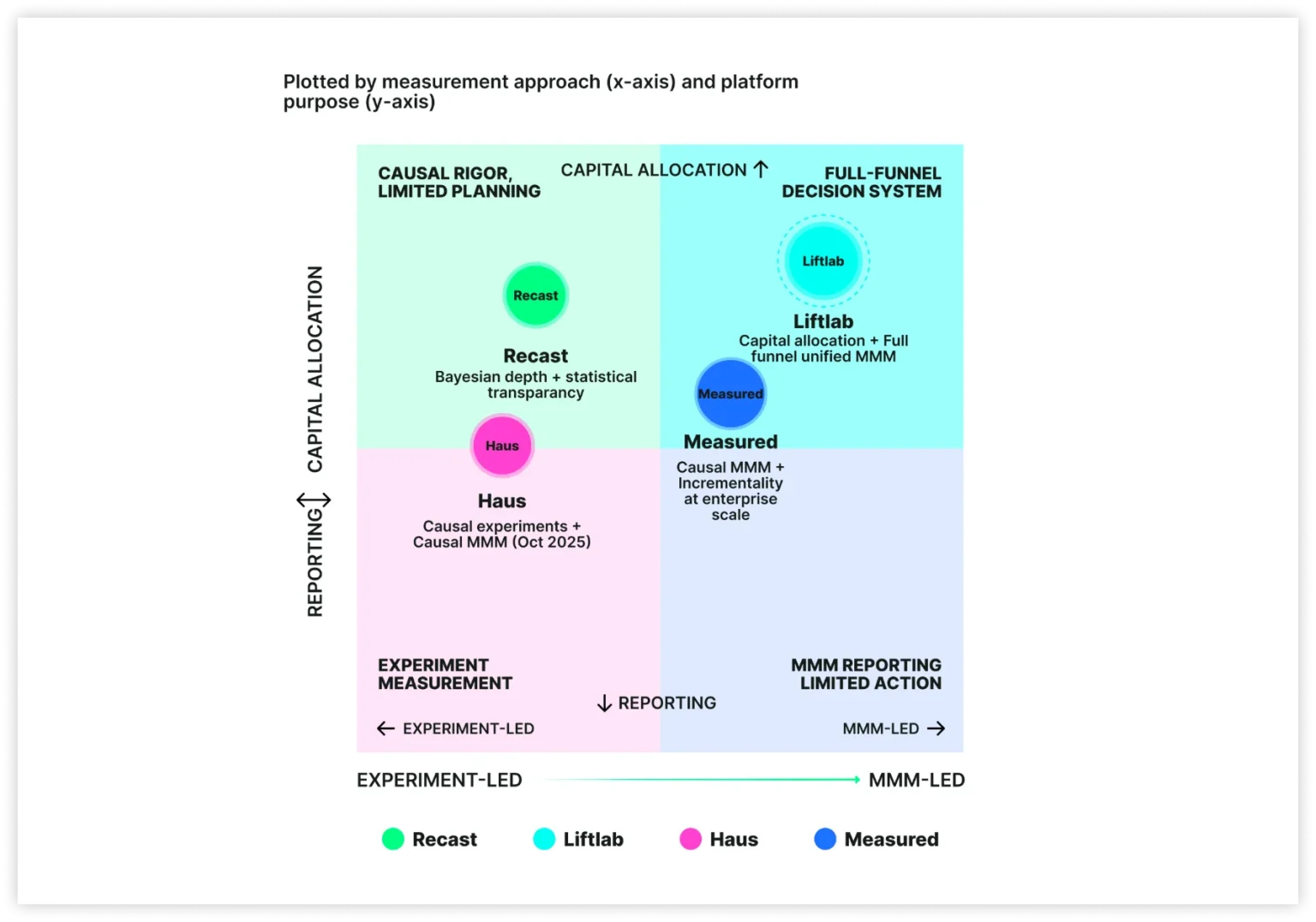
Measured: Enterprise-Grade Triangulated Measurement at Scale
Measured is an enterprise system built around triangulation, combining MMM, incrementality testing, and optimization in one workflow.
Strengths: Its clearest advantages are incrementality depth, broad integrations, and a managed services layer that helps large organizations to turn fragmented data into a consistent measurement process. Its planning layer is calibrated by incrementality experiments, grounding what-if simulations in causal evidence rather than correlational estimates.
Ideal for: Larger brands with complex channel mixes, multiple data environments, and stakeholders who expect measurement to be audit-ready.
Considerations for buyers: This is NOT a lightweight, self-serve choice. Buyers should expect a more managed, services-heavy experience and a deeper onboarding process. Buyers looking for unified brand equity quantification over a 52-week horizon may find its incrementality-calibrated orientation a mismatch.
Best-fit use case: If your primary challenge is proving marketing’s P&L impact with experiment-backed evidence, Measured is a good fit.
Recast: Accuracy-First Bayesian MMM with Radical Transparency
Recast is an accuracy-first, Bayesian MMM platform aimed at buyers who want to see the model, not just the performance summary.
Strengths: Recast’s clearest advantage is transparency. It makes model validation visible, with live accuracy dashboards, published methodology, and weekly out-of-sample forecast accuracy checks. It is also strong on marginal ROI, diminishing returns, and confidence ranges around channel estimates, helping analytically mature teams judge budget movement and confidence in the recommendation
Ideal for: Growth-stage and mid-market brands with strong analytics instincts, especially teams that want measurement rigor without defaulting into a consultancy-heavy engagement.
Considerations for buyers: Recast is more analytically oriented than executive oriented. Teams without internal data or performance sophistication may find its statistical depth requires more interpretation than they want from an MMM tool. GeoLift, Recast’s standalone incrementality testing product, launched in September 2025. Buyers wanting both MMM and integrated incrementality testing should confirm whether the products share a calibration loop or operate independently.
Best-fit use case: If your team values statistical transparency and wants model accuracy validated week by week without a heavy managed-services wrapper, Recast is one of the most credible options in the market.
Haus: Experiment-Led Incrementality with a Marketing Science Lens
Haus approaches MMM from a marketing science perspective, putting causal experiments first and treating MMM as strongest when grounded in experimental truth.
Strengths: Haus is strongest where rigor in experiment design matters most. It has a clear strength in causal inference, incrementality, and is for teams who want measurement built on experimental evidence rather than correlation alone. Haus’ scientific advisory includes academic economists focused on causal inference, giving its methodology credentials that few MMM platforms can match. Its causal MMM, launched in October 2025, extends into scenario simulation, saturation analysis, and weekly model refreshes.
Ideal for: Brands building a marketing science function and buyers who want causal evidence to anchor budget conversations early.
Considerations for buyers: Haus is fundamentally experiment-led, not planning-led. Buyers who need continuous full-funnel budget reallocation should examine specifically how Causal MMM outputs feed into an executable budget planning workflow, since this is where its experiment-first architecture has the least documented capability
Best-fit use case: If you are building a test-and-learn culture from the ground up and want causal experiments at the center of your measurement stack, Haus is a strong partner.
LiftLab: Full-Funnel MMM That Turns Measurement Into Capital Allocation
LiftLab is built around the idea that measurement should function as a capital allocation system, not just a reporting system. Its focus is full funnel marketing measurement across brand and performance in one framework.
Strengths: Its architecture connects four integrated layers: Agile MMM for two-stage modeling that separates auction dynamics from consumer response; the Trust EngineTM for experiment calibration that closes the loop between incrementality tests and model coefficients; PlatformSense for daily platform intelligence applied to stable long-term response curves; and a constraint-aware Scenario Planner that produces plans Marketing can execute and Finance can approve. Measurement only becomes strategic when it tells you what to do with the next dollar.
Ideal for: Growth-oriented brands and scaling enterprises running brand and performance together and needing measurement to support continuous reallocation, not just periodic reporting.
Considerations for buyers: LiftLab is not the obvious fit for teams whose primary use case is standalone geo-experiment design. Its value shows when the buyer wants measurement, planning, and optimization to operate as one system.
Best-fit use case: If you’re running brand and performance spend simultaneously, need a model that responds to ad platform shifts within 24 hours, and want measurement that compounds into better capital allocation over time, not just a quarterly snapshot; LiftLab is the clearest fit in 2026.
See how LiftLab models your brand and performance mix in one capital-allocation workflow and reveals the optimization gap in your current measurement approach.
Head-to-Head MMM Platform Comparison Table
This MMM platform comparison table summarizes the most important differences in methodology, planning orientation, and buyer fit.
| Dimension | LiftLab | Measured | Recast | Haus |
|---|---|---|---|---|
| Primary Measurement Methodology | Full-funnel MMM with experiment calibration and optimization | Triangulated MMM plus incrementality testing | Bayesian MMM with lift-test calibration | Experiments first, with MMM as a complementary layer |
| Full-Funnel Coverage | Unified brand and performance measurement | Broad omnichannel coverage | Unified Bayesian model across upper and lower funnel with explicit cross-channel hierarchy | Experiment-led coverage, expanding through Causal MMM |
| Model Cadence & Freshness | Daily platform signals applied to stable response curves without re-estimating the full model. | On-demand model refresh with user-selectable inputs | Weekly validated refreshes with visible accuracy checks. Note: Recast re-estimates 40,000+ parameters weekly | Weekly Causal MMM refreshes |
| Budget Optimization & Scenario Planning | Capital-allocation workflow with scenario planning | AI-assisted optimizer with what-if planning | Forecasting and planning tools with scenario support | Scenario modeling within Causal MMM (launched October 2025); planning depth still maturing |
| AI Automation vs. Human Expert Oversight | AI-powered optimization with embedded human expert oversight. (neither fully automated nor fully managed) | AI-enhanced platform with paired analytics expert support | Product-led with analyst support and technical transparency | Marketing science-led model with strong experimental guidance |
| Integrations & Data Infrastructure | Built for ongoing full-funnel data inputs and planning workflows | 300+ managed integrations | Lighter operational footprint. Suited to analytically-capable teams | Built around experiment and measurement workflows |
| Ideal Fit | Growth-oriented brands needing full-funnel measurement and capital allocation | Large enterprise brands with complex stacks | Growth-stage and mid-market brands with strong analytics capacity | Teams building a marketing science function or experiment-first culture |
Decision Framework: Which Platform Fits Which Buyer?
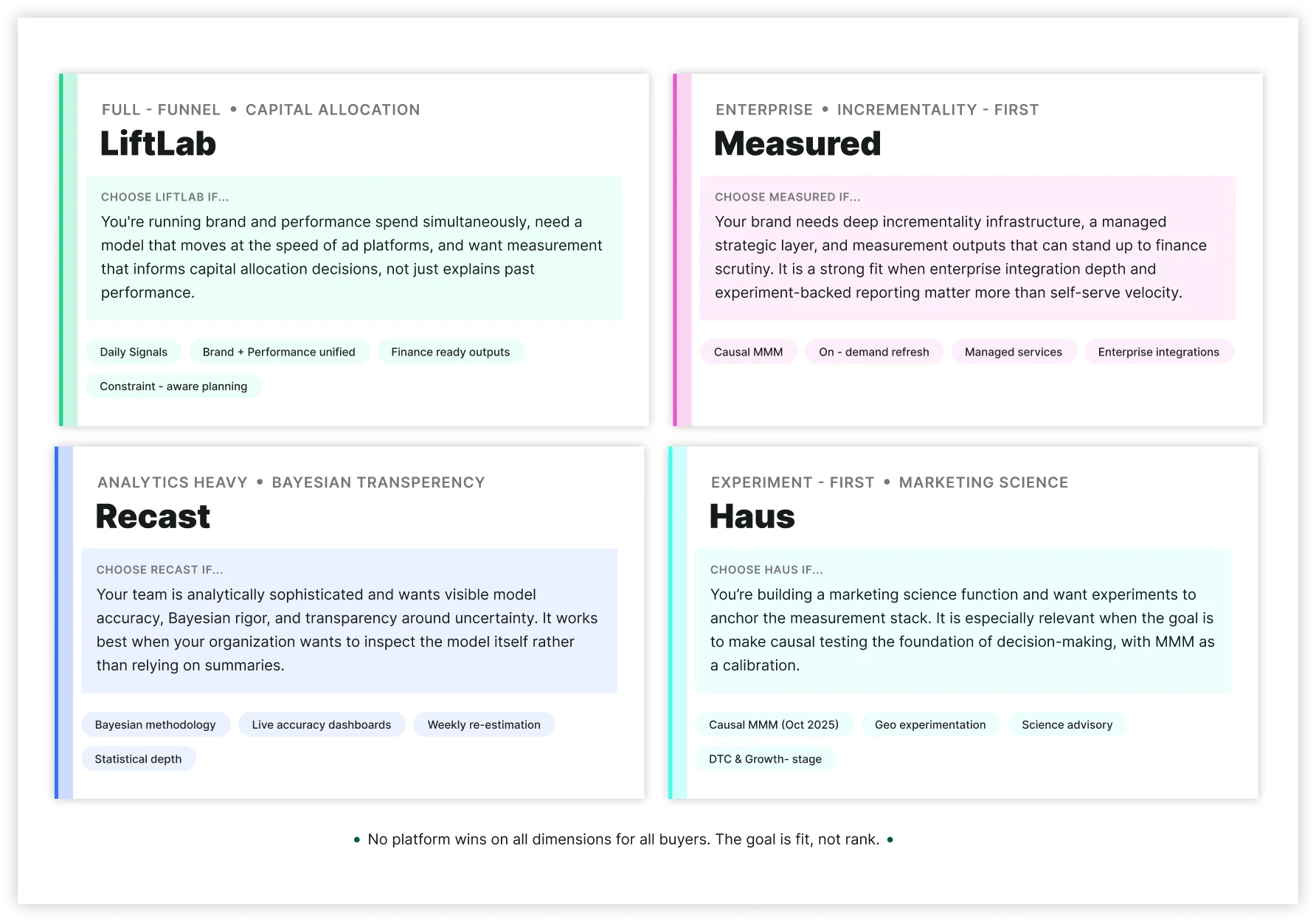
Choose Measured If
Your brand needs deep incrementality infrastructure, a managed strategic layer, and measurement outputs that can stand up to finance scrutiny. It is a strong fit when enterprise integration depth and experiment-backed reporting matter more than self-serve velocity.
Choose Recast If
Your team is analytically sophisticated and wants visible model accuracy, Bayesian rigor, and transparency around uncertainty. It works best when your organization wants to inspect the model itself rather than relying on summaries.
Choose Haus If
You’re building a marketing science function and want experiments to anchor the measurement stack. It is especially relevant when the goal is to make causal testing the foundation of decision-making, with MMM as a calibration.
Choose LiftLab If
You’re running brand and performance spend simultaneously, need a model that moves at the speed of ad platforms, and want measurement that informs capital allocation decisions, not just explains past performance.
10 Questions Every Marketing Leader Should Ask Before Choosing an MMM Platform
Use this as a practical MMM vendor checklist for teams comparing marketing mix modeling software.
How frequently does the model update, and can it catch channel-level shifts in near real-time?
Does it model long-term brand effects separately from performance spend?
How is incrementality testing integrated, as calibration or separate workflow?
What does the budget optimization output look like, and how actionable is it day-to-day?
Is the expert or analyst layer embedded in the product or sold separately?
How does the platform handle walled-garden data – Meta, Google, TikTok etc.?
How long does onboarding take before first meaningful insight?
How are seasonality, macro shocks, and saturation modeled?
Can it map spend to CAC, payback, or LTV, not just ROAS?
What does model accuracy validation look like, and how is it surfaced to users?
Notice which questions a vendor struggles to answer specifically. The architecture failure patterns are predictable; platforms that can’t answer Q1 precisely rarely handle Q3 or Q7 well either.
Why the Full-Funnel Gap Is the Most Expensive Blind Spot in Modern Marketing
Most MMM Platforms Were Built for a Performance-First World
Many marketing mix modeling platforms are still structurally better at measuring demand capture than demand creation. They explain lower-funnel efficiency well, but often struggle to show how brand investment improves future demand, conversion efficiency, and growth quality.
But Brand Investment Doesn’t Show Up in Next-Quarter ROAS
This is where the blind spot becomes expensive fast. Brand effects often don’t show up until much later through stronger direct traffic, higher conversion rates, lower future CAC, and better payback. When those effects are under-modeled, brand becomes harder to defend and easier to cut.
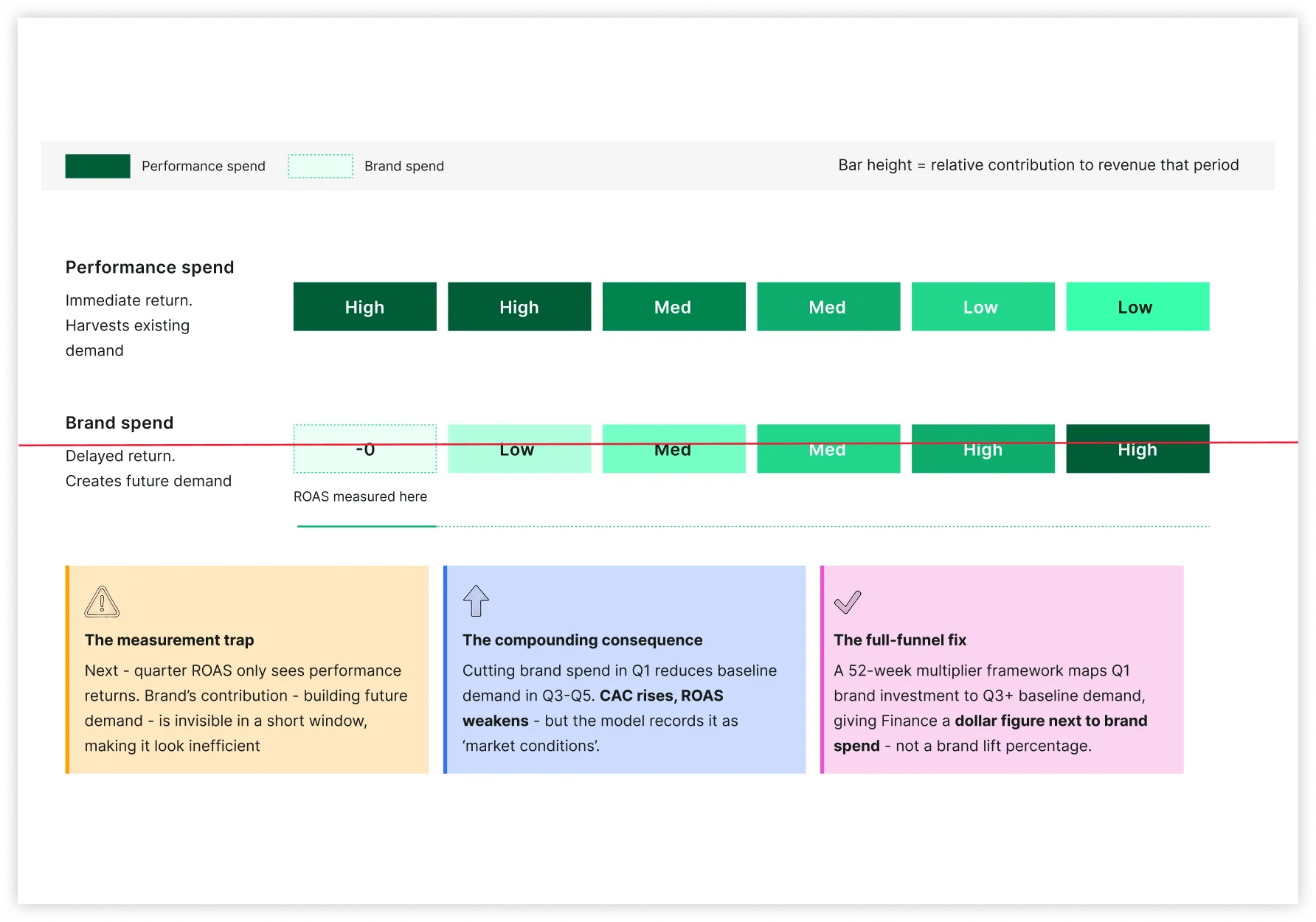
The Real Requirement Is Capital Governance
This is precisely what IAB’s 2026 research captures: the measurement tools exist, but 60–75% of users say they still fall short. The gap is not tool coverage; rather the absence of a governance layer that translates measurement into decisions Finance will act on.
LiftLab’s View: The Compounding Advantage of Unified Full-Funnel Measurement
This is where LiftLab stands apart. When brand and performance sit inside the same framework, better allocation in one period can reduce the cost of growth in the next. LiftLab’s view is that unified full funnel marketing measurement improves not just visibility, but future allocation across CAC, payback, marginal ROI, and planning decisions. The most valuable measurement system is the one that makes future growth cheaper, not just past spend easier to explain.
LiftLab describes this as compounding economic value; each better allocation decision in one period reduces the cost of growth in the next, lowering CAC, strengthening ROAS, and accelerating payback over time. That logic shows up in real-world budget reallocation and experimentation examples such as the Pandora case study and SKIMS case study.
Final Verdict: There Is No Universal Winner in MMM Tools Comparison, Only the Right Fit
Measured is a strong fit for enterprise triangulation and managed incrementality. Recast stands out for rigor and transparency. Haus is compelling for experiment-first organizations. LiftLab is the most distinctive choice for teams that need full-funnel measurement to function as a capital allocation system, one that operates across brand and performance spend in a single, continuously refreshed model.
The best MMM platform in 2026 is the one your team can trust enough to move money with confidence.
Ready to See How LiftLab Handles Your Specific Spend Mix?
LiftLab can show how your spend mix, planning constraints, and reallocation logic behave inside a capital-allocation workflow built for ongoing decision-making. We’ll model your brand and performance channels in the same framework and show you where the optimization gap lives in your current measurement approach.
Key Takeaways
The MMM platform comparison in 2026 is no longer about which platform has the most feature, rather which architecture matches your operating model, team maturity, and decision cadence
60 to 75% of marketers say advanced marketing measurement platforms fall short on rigor, timeliness, trust, and efficiency. The problem is not tool coverage but the absence of a governance layer that translates measurement into decisions Finance can act on
The strongest marketing mix modeling platforms in 2026 integrate both MMM and incrementality testing in a closed loop where experiments calibrate the model and the model surfaces the next experiment worth running
The full-funnel gap is the most expensive blind spot in modern media mix modeling: platforms that model demand capture well but sideline demand creation systematically inflate future CAC
Each platform in this guide fits a distinct buyer. Measured for enterprise triangulation. Recast for statistical transparency. Haus for experiment-first teams. LiftLab for full-funnel capital allocation.
Frequently Asked Questions About Best MMM Platforms in 2026
How should teams evaluate marketing mix modeling platforms?
The best way to evaluate MMM platforms is to compare methodology, cadence, planning output, integration depth, and team fit. A platform can be statistically strong and still be wrong for your operating model if it does not match your decision rhythm or internal capabilities.
What should be included in an MMM vendor checklist?
A practical MMM vendor checklist should include update frequency, brand and performance coverage, experiment integration, planning outputs, onboarding complexity, walled-garden data handling, and model validation transparency.
How do the best marketing measurement tools help measure brand ROI?
The strongest measurement architectures do not force brand and performance into separate worlds. They use long-term effects, carryover logic, and unified response curves to help teams measure brand ROI in a way that feeds actual planning rather than treating brand as unmeasurable.
Is LiftLab significantly more expensive than Recast or Haus?
Each platform in this comparison is positioned at enterprise or growth-enterprise pricing. The relevant comparison is not cost per seat but cost per allocation decision, a model that produces higher-confidence budget recommendations faster than quarterly has a different ROI calculation than one that delivers insights after the planning window closes.