


Introduction
Marketing leaders often find themselves in a difficult position: they see efficient Return on Ad Spend (ROAS) in their campaign results, yet top-line revenue growth is stagnant. This is rarely an issue of inefficient ad spend or poor campaign creativity; instead, it is usually a fundamental problem with how the budget is allocated and allocated financially, known as the “short-term measurement tax.” This is where budgeting is based on last-touch attribution and often reacts slowly to changing market conditions.
To overcome this, advanced marketing teams are using a more advanced form of budgeting known as full-funnel budget planning, allocating funds based on the entire customer journey rather than channel-specific metrics. This is a fundamental shift in how the budget is allocated and is critical for long-term growth and scaling. Having managed more than $38B in revenue through models designed to identify these exact measurement traps, we at LiftLab have found that brands that are optimizing for immediate ROI are sacrificing 20-30% of their total long-term growth opportunities.
Executive Summary
When efficient ROAS and stagnant revenue growth coexist, poor creative or bad campaign execution is almost never the cause. It is a short-term marketing measurement problem disguised as a media problem. Brands that optimize purely for immediate returns end up harvesting existing demand rather than building future demand, and the dashboard keeps reporting efficiency right up until the customer pipeline runs dry.
LiftLab has measured this pattern across more than $38B in revenue: brands over-optimizing for immediate ROI sacrifice 20 to 30% of their total long-term growth opportunities in the process. This post explains how full-funnel budget planning i.e. allocating budget across the entire customer journey rather than to whichever channel produced the last click, is the structural fix and why it is essential to treat marketing spend as a portfolio with distinct budget maturity cycles rather than a single pool to be efficiency-ranked.
What you will learn
Why efficient ROAS and stagnant revenue growth can coexist, and what the short-term marketing measurement trap actually costs in compounding growth terms
How full-funnel budget planning differs from conventional channel-based allocation and why the distinction changes budget conversations with Finance
Why Marketing Mix Modeling updated weekly cannot keep pace with ad platforms that change intra-day, and what that gap costs in diminishing returns you never see coming
How LiftLab’s single econometric model simultaneously estimates brand vs performance marketing effects so brand spend can be defended with the same financial discipline as performance
A five-step implementation framework for moving from negotiation-based budgeting to science-based deployment
What Is Full-Funnel Budget Planning?
Full-funnel budget planning is a marketing budget optimization approach that allocates spend across the entire customer journey, from brand awareness through consideration to conversion, rather than by channel-specific performance metrics. Instead of asking which platform delivered the best ROAS last month, it asks which stage of the funnel needs investment to sustain future demand. In practice, this means treating the marketing budget as a portfolio with distinct budget maturity cycles: performance spend expected to deliver returns within 0 to 30 days, and brand spend expected to compound over 3 to 6 months or longer.
Short-Term Measurement Approach vs. Full-Funnel Budget Planning
| Short-Term Measurement Approach | Full-Funnel Budget Planning | |
|---|---|---|
| What drives allocation | Past performance of a specific platform or channel | Purpose of spend across the customer journey |
| Budget maturity expectation | Immediate returns, 0 to 30 days | Performance: 0 to 30 days. Brand: 3 to 6 months or longer |
| How brand spend is treated | Hard to measure, first to be cut | Modeled in the same econometric framework as performance |
| Demand pool management | Harvests existing in-market demand | Replenishes future demand through upper-funnel investment |
| Optimization basis | Average ROI of the last period | Marginal ROI of the next dollar invested |
| Causality validation | Deterministic attribution, no causal proof | MMM combined with geo-lift experiments to confirm causality |
Full-funnel budget planning is an approach in which the budget is allocated across the entire customer journey, from brand awareness through consideration to conversion. It differs from conventional budget planning, in which budgets are allocated based on past performance of a particular platform or channel, such as Facebook or Google. In a full-funnel budget planning approach, the budget is allocated based on the purpose of the spend.
In a full-funnel budget-planning approach, the budget is treated as an investment with varying maturity periods. In this approach, the performance of the budget is expected to deliver results within 0-30 days, whereas the brand budget is expected to deliver results within 3-6 months or longer.
The “Short-Term Measurement Tax”: A Hidden Barrier to Growth
The Appeal of Immediate ROAS – Defining the Tax
The “short-term measurement tax” is the revenue lost when a brand prioritizes immediate budget efficiency over incremental revenue growth. It is the revenue lost when budget allocation is dictated by deterministic attribution models like Google Analytics and platform pixels, which are ill-equipped to measure the ROI of touchpoints that occur days or weeks before conversion.
However, when costs are heavily optimized to achieve the highest ROAS possible, the upper-funnel strategies that reach the most people at the lowest frequency and drive the greatest number of new customer acquisitions are often cut. This leads to a ‘hollowed-out’ funnel, where the dashboard metrics are extremely favorable because the budget is optimized to acquire and convert the highest-intent users, who are more likely to convert regardless of ad exposure. While this maximizes ROI in the short term, it also exhausts the pool of future customers. Industry data shows that companies stuck in this efficiency cycle can see a 40-50% year-over-year increase in customer acquisition costs as in-market demand runs out and is not replenished.
How Short-Sighted Budgeting Blocks Growth
The way short-sighted budgeting blocks growth is often technical. Today’s ad platforms (Meta, Google, TikTok) are all algorithmically driven and change intra-day based on user behavior. However, many marketing teams are still relying on traditional marketing mix models (MMM), where data is updated only weekly or monthly, at best.
This creates a critical blind spot in the marketing organization, where the traditional model fails to recognize that baseline sales are decreasing because there are not enough users supporting the brand, until the issue has been ongoing for weeks. The lack of a feedback loop between the daily ad platform and the traditional model leads to a failure to respond to diminishing returns in performance marketing channels. Budgets continue to be spent on bottom-funnel tactics, where competitors can take advantage of the lack of upper-funnel investments resulting from the more modern measurement approach.
Mastering Full-Funnel Budget Planning: A Strategic Approach
Allocating Resources Across Awareness, Consideration, and Conversion
To optimize resource allocation, we can divide the budget by function rather than by channel. This is because some channels can serve multiple functions, such as the YouTube campaign, which can fulfill both awareness and conversion objectives.
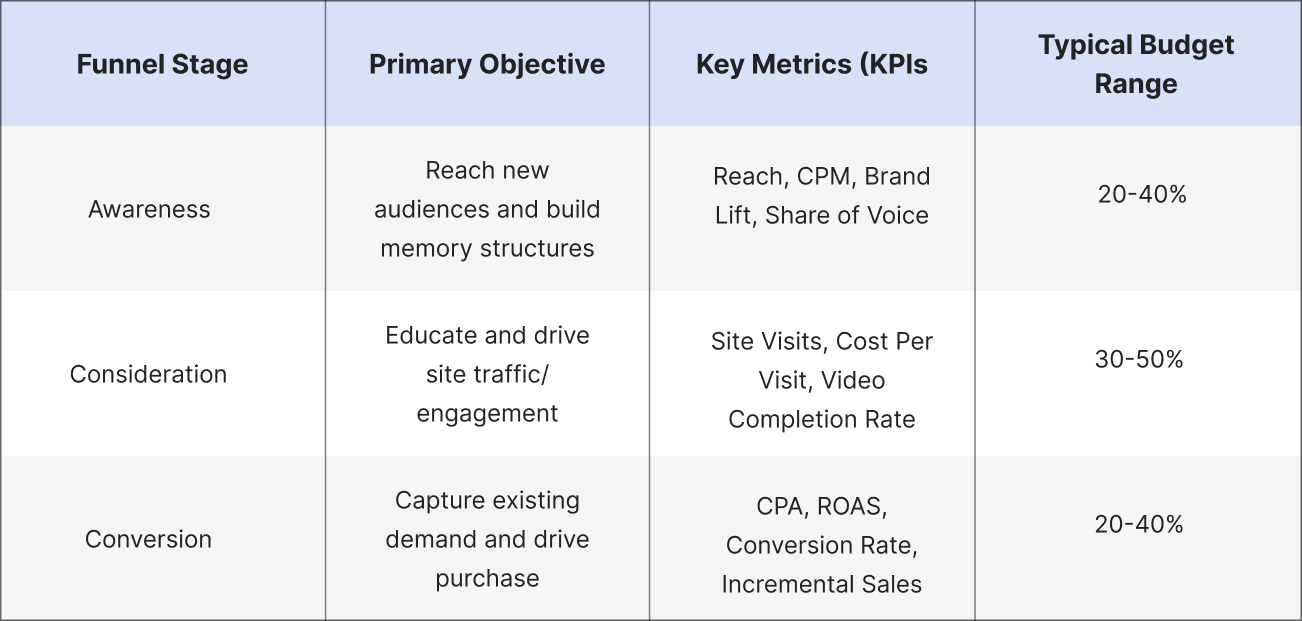
Note that these budget ranges are illustrative and that the optimal budget allocation will depend on marginal returns analysis.
Balancing Brand-Building and Performance Marketing Investments
The debate between brand and performance marketing is a false dichotomy; they’re interdependent variables in the same equation. The problem is that they’re difficult to measure. Performance marketing is easy to measure through clicks and conversions, while brand equity is difficult to measure and affects the “base” volume, the volume not directly affected by advertising pressure.
To solve this, LiftLab has developed a single econometric model that simultaneously estimates both brand equity and performance effects. This model breaks revenue into a base driven by brand, seasonality, and product fit, and incremental lift driven by media. By understanding the incremental impact of upper-funnel spend on the base over time, you can defend brand spend with the same financial discipline as performance spend. This prevents cuts to “hard-to-measure” channels, silently undermining long-run pricing power and organic demand.
Using Data for Dynamic Budget Optimization
While static budgets are planned for on a yearly or quarterly basis, these are no longer sufficient in today’s dynamic media landscape. To effectively optimize your entire funnel budget, dynamic optimization is key: optimizing budgets by the marginal ROI of the next dollar invested rather than by the average ROI of the last month.
However, it’s also important to realize that data without context is meaningless. High correlation does not equal causality. LiftLab’s Trust Engine uses Marketing Mix Modeling in conjunction with experimentation, such as geo-lift, to ensure causality rather than correlation. Essentially, this is to ensure that their data is accurate and to validate their model’s prediction. If their data shows that $1M in revenue is generated by Social Media, it should also show that this revenue disappears when spending in this channel is halted.
Implementing Your Full-Funnel Budget Plan
Implementing your full-funnel budget plan effectively requires a structured workflow between data science and media execution.
Data Unification and Hygiene:
Aggregate data from all available sources, such as ad platforms, CRM systems, e-commerce platforms, and economic data. Make sure data naming conventions are standardized to facilitate in-depth analysis.
Baseline Establishment:
Use econometrics to determine your “base” in sales. What you sell when you spend zero dollars in advertising is key to determining marketing incrementality.
Diminishing Returns Analysis:
Channel saturation curves should be plotted to determine when the next dollar invested in “Search” generates less revenue than the first dollar invested in “Connected TV.”
Scenario Planning:
Design ‘what if’ scenarios. For example, ‘If we shift 10% of the budget from Conversion to Awareness, what is the projected impact on revenue in six months?’
Execution and Calibration:
Use the budget and begin executing experiments immediately to validate the results. If the model indicates a 5% increase from the new channel, conduct a geo test to validate the results.
This methodology changes the way the company approaches budgeting, shifting from a negotiation-based approach to a science-based deployment approach
Conclusion: Unlocking Sustainable Growth with Strategic Budgeting
The ‘short-term measurement tax’ is the unseen force holding back the company’s growth. It causes marketers to ‘over-harvest’ the existing demand while ignoring the long-term growth potential of the customer pipeline. Full-funnel budget planning balances the equation by providing value to every step of the customer journey, from awareness to consideration.
However, changing the approach requires not only a shift in the company’s mindset but also the appropriate level of technical support. LiftLab’s approach is designed to help marketers avoid the short-term measurement tax by providing daily updates on media spend performance and blending it with experimentation. This allows the company to invest with the agility of a performance marketer and the foresight of a brand builder.
Key Takeaways
The “short-term measurement tax” results in brands missing 20-30% of their total long-term growth opportunities through over-optimization of immediate ROI and draining of long-term customer pools.
Full-funnel budget planning is a process in which the budget is allocated based on the customer journey rather than channel-specific caps, treating it as a portfolio with distinct budget maturity cycles.
MMM is updated weekly, whereas ad platforms change daily, leading to a lack of visibility into timely reactions to diminishing returns in performance channels.
Using dynamic optimization and unified econometric models that combine MMM and experimentation can rigorously demonstrate causality and defend brand investments financially, on par with performance spend.
FAQs about Short-term marketing measurement
What is the short-term measurement tax in marketing?
The short-term marketing measurement tax is the compounding revenue cost of optimizing purely for immediate ROAS. When budgets follow last-touch attribution, upper-funnel investment gets cut because its contribution is invisible to short observation windows. The funnel hollows out wherein high-intent users convert efficiently, but the pool of future customers is never replenished. LiftLab’s data across $38B in measured revenue shows brands in this cycle sacrifice 20 to 30% of total long-term growth opportunity.
What is full-funnel budget planning and how does it work?
Full-funnel budget planning allocates marketing spend based on the customer journey stage rather than channel-specific performance metrics. It treats the budget as a portfolio: performance spend with a 0 to 30-day return horizon and brand spend with a 3 to 6-month compounding horizon. Allocation is driven by marginal returns analysis across both stages simultaneously, using a unified Marketing Mix Modeling framework that captures both effects in the same model rather than treating them as separate budget conversations.
Why does Marketing Mix Modeling struggle to capture short-term platform changes?
Most Marketing Mix Modeling platforms refresh weekly or monthly. Ad platforms on Meta, Google, and TikTok update intra-day based on user behavior and algorithmic shifts. The lag between model refresh and platform reality creates a critical blind spot where diminishing returns in performance channels go undetected until the budget has already overspent. This is one of the core reasons short-term marketing measurement approaches fail to respond to changing market conditions in time to protect performance.
How do you defend brand spend with the same rigor as performance spend?
LiftLab’s econometric model estimates brand equity effects and performance effects simultaneously within the same framework. It separates revenue into a base driven by brand, seasonality, and product fit, and incremental lift driven by media. By quantifying upper-funnel spend’s impact on the base over time, brand vs performance marketing investment can be compared on the same financial metric: incremental revenue per dollar. This is what makes brand defensible in a CFO review without falling back on awareness metrics that Finance cannot interrogate.
What is dynamic budget optimization?
Dynamic budget optimization means allocating the next dollar based on its marginal return rather than the average return of the prior period. Saturation curves built into the Marketing Measurement Platform show exactly where each channel’s next dollar generates less than its last, enabling reallocation before overspending becomes visible in performance data. Combined with geo-validated experimentation, it ensures budget moves are grounded in causal evidence rather than correlation.