


Executive Summary
A familiar scene plays out every week for a DTC brand: Meta says performance is strong, Google says efficiency is holding, and TikTok is reporting healthy returns. But when the numbers reach the P&L, blended CAC is up again, and growth seems stalled.
For DTC brands, the core measurement problem is not too little data but too many disconnected systems claiming credit for the same sale, with no causation. At the same time, customer acquisition costs have risen sharply across e-commerce categories, straining margins at every revenue tier. Platform dashboards report efficiency in their own terms, and legacy marketing mix modeling for e-commerce often arrives too slowly or in the wrong language to guide real budget decisions.
Whether you are a founder making budget calls directly or a CMO defending allocation to a board, the measurement gap looks the same from either side of the table. This article explains why most MMM for DTC brands still fail in practice, defines the four requirements of a DTC-ready architecture, and names the evaluation mistakes to avoid.
What You Will Learn
Why each level of MMM, from consultancy to Bayesian SaaS, consistently fails DTC brands in specific and predictable ways.
The four requirements a measurement architecture must meet to effectively manage CAC and payback at the pace required by DTC brands.
The three evaluation errors that lead DTC brands to choose a reporting tool rather than a capital allocation engine.
What is MMM for DTC Brands?
MMM for DTC brands is a measurement framework that estimates each marketing channel’s contribution to revenue, blended CAC, and payback, without relying on user-level tracking or platform attribution.
Instead of assigning credit to individual clicks, MMM identifies which channels generate demand and models how budget changes impact future performance across the entire acquisition system.
For DTC brands experiencing rising blended CAC while platform dashboards report stable ROAS, this distinction is critical. It highlights the gap between the model’s outputs and the actual P&L results.
This post explains why standard MMM architectures fall short for DTC brands, outlines the requirements for a DTC-ready system, and provides guidance on evaluating vendors.
How Do Standard DTC Marketing Metrics Fall Short?
| What It Is | What It Measures | Why It Falls Short for DTC | What to Measure Instead |
|---|---|---|---|
| Platform ROAS | Attributed revenue per ad dollar on that platform | Over-credits demand harvesters; invisible to blended CAC pressure | Incremental ROAS (iROAS) per channel |
| Last-click attribution | Total acquisition cost across all channels | Shows rising cost, but cannot identify the causal source | CAC trajectory by channel from MMM outputs |
| Blended CAC (unmodeled) | Total acquisition cost across all channels | Shows rising cost, but cannot identify the causal source | CAC trajectory by channel from MMM outputs |
| Channel ROAS leaderboard | Relative efficiency ranking across digital channels | Rankings change when incrementality evidence is applied | Marginal ROI by channel at current spend level |
Why ROAS Fails DTC Brands
ROAS is not useless; it is just too narrow for a DTC business making capital allocation decisions. Here’s why:
ROAS ignores blended CAC pressure. A channel may appear efficient even as overall acquisition costs increase, since channel-level efficiency and portfolio-level cost of growth are measured differently.
ROAS over-credits demand capture. Branded search and retargeting consistently achieve the highest ROAS because they capture buyers who already intend to purchase. This demand is generated by brand, creator, and prospecting channels that the model does not track.
ROAS is weak in boardroom decisions. Leadership cares about payback, capital recovery, and sustainable CAC, not just channel efficiency.
ROAS breaks when channels interact. Brand, creator, retargeting, search, and social work together, but ROAS scores them in isolation.
What Does MMM Measure for DTC Brands?
A DTC-ready MMM goes beyond ROAS to produce outputs the board can actually use:
Incremental revenue by channel
Channel contribution to blended CAC
Diminishing returns curves per channel
Blended CAC and payback period projections
Budget allocation trade-offs across the full mix
Unified brand and performance effects in one model
The DTC Measurement Problem Nobody Talks About
Here’s a scenario that DTC brands are all too familiar with: every platform dashboard is green, your team is showing stable ROAS, and blended CAC is still climbing. The CFO asks why acquisition is getting harder if Meta, Google, and TikTok all claim efficiency is steady. The uncomfortable truth is that the stack was built inside the very platforms that need to justify its spend. Each system reports success on its own terms.
That is the core DTC marketing measurement problem. It is not a lack of data. It is a collection of tools designed for another era, another media mix, and another business model.
Every platform in your stack was designed to claim credit for your revenue. None of them were designed to tell you which ones actually caused it.
E-commerce CAC has risen exponentially in recent times, with average acquisition costs as high as $91 for some industries. Measurement failure is no longer just a reporting issue. It is a margin issue. A founder running $20M in revenue on Tuesday’s Shopify data does not need another dashboard. They need a system that can explain why growth is stalling even as efficiency appears fine before the next planning cycle closes.

Why Every MMM Tier Fails DTC Brands in a Specific Way
Tier 1 – The Consultancy Model: Right Methodology, Wrong Operating Rhythm
When MMM was built as a discipline, they got the causality question right long before the rest of the market caught up. However, MMMs were built for quarterly planning cycles, TV-heavy mixes, and teams with the time to wait.
DTC brands do NOT operate on that rhythm. The planning window for next month’s Meta spend can open and close before the insight arrives. IAB’s modernization guidance makes it clear: marketers now need frequent refreshes, modular updates, and outputs tied directly to planning decisions to keep up.
Tier 2 – The First-wave SaaS Platforms: Faster Delivery, Same Language Problem
The first generation of SaaS MMM solved access and improved speed, but it spoke the wrong output language. Many tools still translate results in ROAS and media efficiency, whereas DTC brands manage the business through CAC, LTV: CAC, contribution margin, and payback.
If a model tells you Search is more efficient than Meta but cannot show what happens to blended CAC at the next growth target, it has not solved planning. It has just moved the same old reporting problem into a different UI. In a market where CAC has surged 40% in two years, and an LTV: CAC below 3:1 is considered structurally weak by most DTC investors and operators, this language mismatch cannot be dismissed as a cosmetic problem; it means the results cannot actually be used in a budget room where capital allocation happens.
Tier 3 – The Modern Bayesian Platforms: Strong Methodology, Incomplete DTC Architecture
New-age Bayesian platforms brought real rigor, transparency, and a major improvement over the earlier click-based attribution. However, most still refresh on weekly re-estimation cycles, keep experiments adjacent to the model rather than inside it, and struggle to unify brand and performance. That is a problem for DTC brands running prospecting, creator, retargeting, and branded search simultaneously. The evidence for this blind spot has been visible for years. In Dropbox’s recent blackout-experiments work, applying incrementality-adjusted profitability findings led the company to reallocate approximately $25M in spend, showing how budget decisions can change once attributed performance is separated from true causal lift. That is what demand harvesting looks like in practice when a model credits a channel for demand it did not create.
None of these three tiers was designed to operate at the speed of the channels it models or speak the language of the P&L it serves. This is the DTC measurement gap that needs to be bridged.
What DTC brands need is not a slightly better version of the same architecture. It is a system designed around the realities those architectures still miss.
The DTC MMM Framework: The Four Requirements of a DTC-Ready MMM
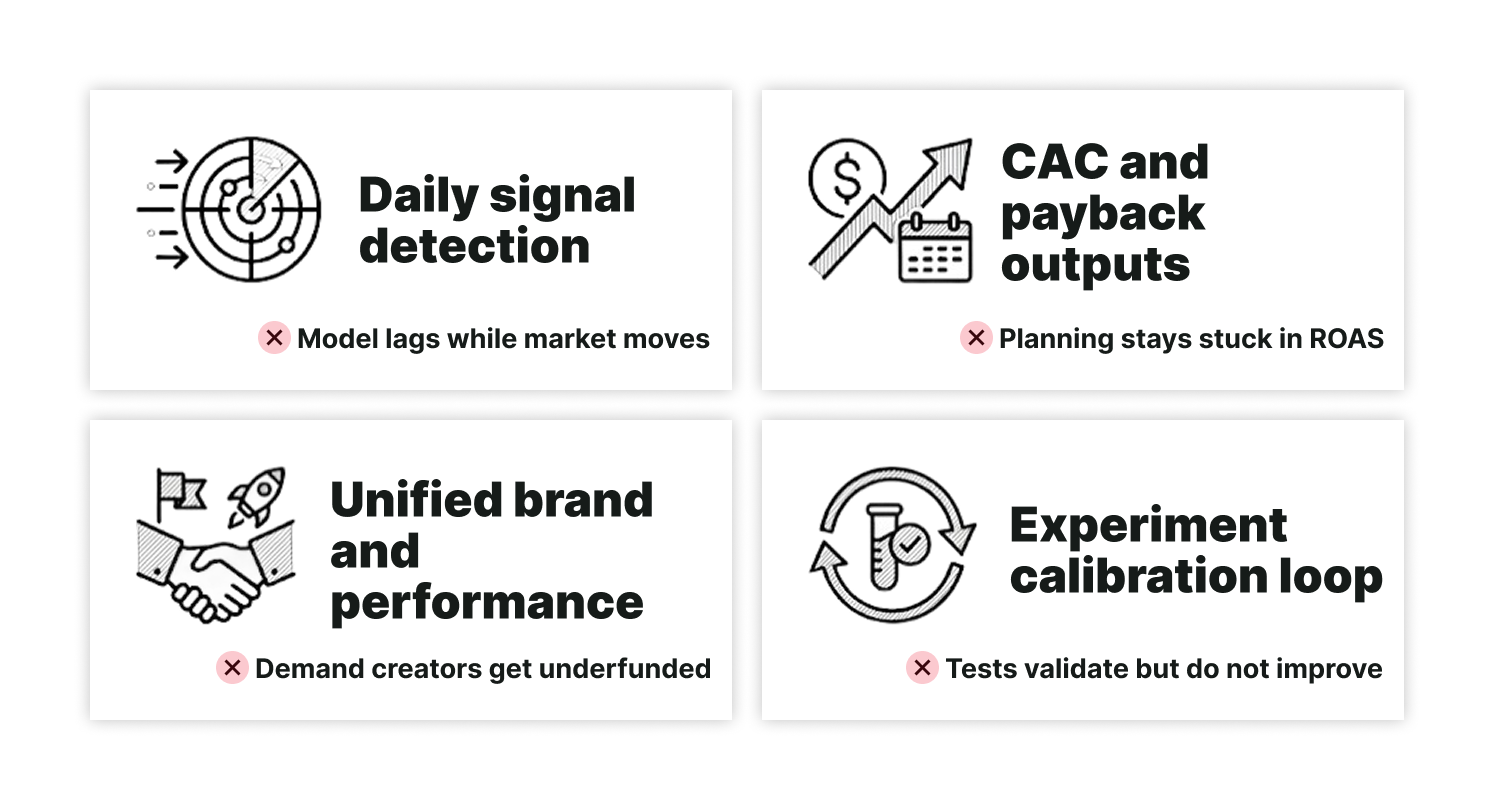
Requirement 1: Daily signal detection without model instability
A DTC-ready model must detect shifts in CPM, CTR, auction pressure, and creative fatigue within 24 hours without rebuilding the full structural model. A weekly refresh using sliding time windows still doesn’t reflect daily signal shifts, as the very efficiency change that needs to be captured drowns in historical data. Re-estimating everything daily is also not an option, as it creates noise, whereas ignoring daily shifts can make the model lag behind.
The right architecture separates stable long-run response curves from fast-moving effectiveness signals. That is what MMM for DTC brands should look like in practice.
Requirement 2: CAC and payback as primary planning outputs
The model must answer the question the board actually asks: if we shift spend from one channel to another, what happens to blended CAC and payback period, not just the ROAS? If the model cannot look beyond channel ROAS, this is a major red flag. In a market where e-commerce CAC is up 40 to 60%, scenario planning has to speak the language of capital allocation, not just media scorekeeping. For DTC brands that need to defend budget decisions to the board, CAC and payback are the outputs that make the model useful.
Requirement 3: Brand and performance in the same model
A DTC brand can run brand awareness and retargeting on the same platform at the same time. A measurement system that treats both as one undifferentiated performance bucket will over-credit demand harvesters and underfund demand creators. Over-optimizing for short-term activation can weaken long-term growth. The strongest business outcomes come from balancing brand and activation rather than forcing one to cannibalize the other, making it crucial to capture both brand and performance in a unified measurement system.
Requirement 4: Experiment calibration as a loop, not a module
A good measurement system cannot keep experiments in one tab and MMM in another. Incrementality testing in e-commerce only becomes strategically valuable when test results feed back into response curves, saturation estimates, and planning ranges. IAB explicitly recommends triangulating MMM, experiments, and attribution into one coherent measurement system, not three disconnected reports.
These four requirements are a must and make all the difference between using a measurement platform and a capital allocation engine.
What LiftLab’s Architecture Actually Does for DTC Brands
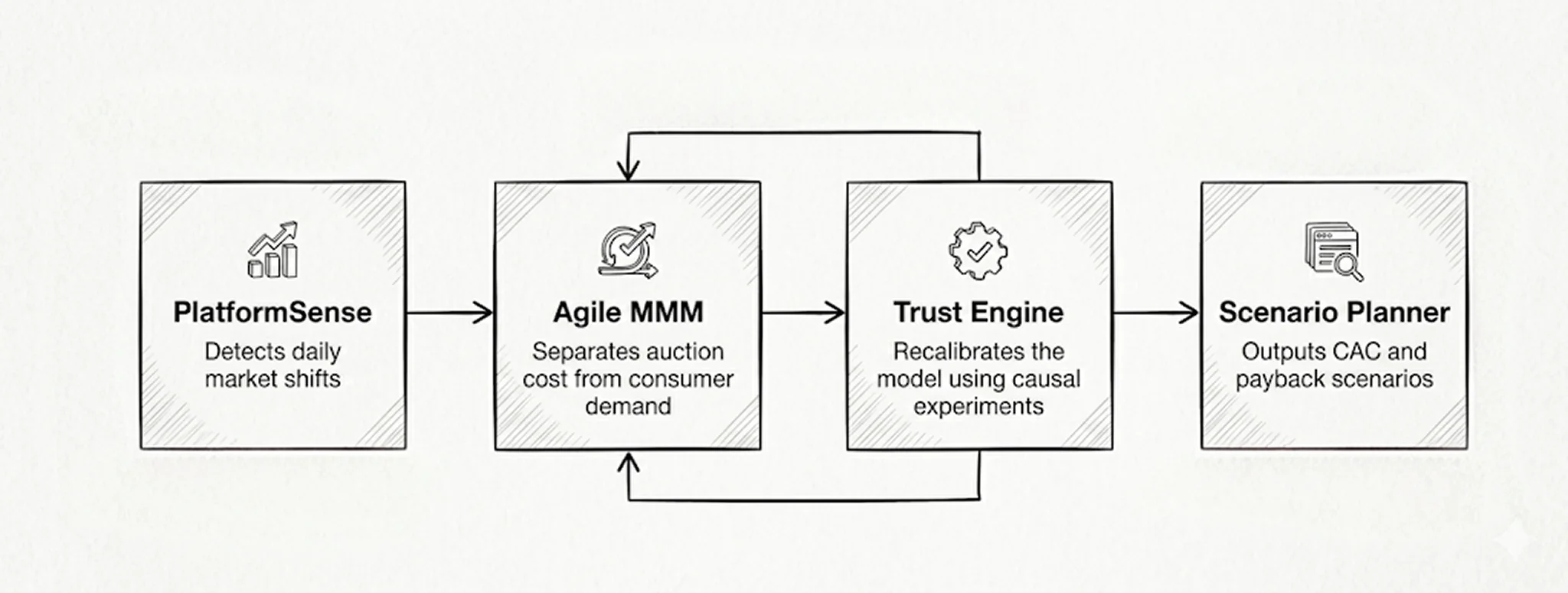
LiftLab is built as a capital allocation engine, not a reporting platform, and its architecture reflects that design requirement in four connected layers.
PlatformSense: Daily MMM Intelligence Without Instability
PlatformSense delivers DTC teams daily MMM intelligence without structural instability. It captures CPM changes, CTR shifts, conversion-rate movements, and auction pressure in near real time, then applies those changes as time-varying effectiveness modifiers on top of stable long-term response curves. That means the model detects the signals within 24 hours without forcing a full re-estimation cycle every time Meta or TikTok moves. For a DTC brand looking at flash sales or peak season, it can make all the difference between reacting to today’s market while the window is still open and explaining last quarter’s performance after the opportunity has closed.
Agile MMM + Trust Engine™: Experiment-Calibrated Planning
LiftLab’s two-stage Agile MMM separates auction dynamics from underlying consumer response so platform-level fluctuations are not mistaken for demand changes. The Trust Engine™ closes the loop: geo holdouts, lift tests, and other causal readouts feed directly back into the model, so that coefficients, saturation estimates, and planning ranges improve over time. This is the standard to use when it comes to marketing measurement for DTC brands: every experiment should make the next planning decision better.
Scenario Planner: Output in DTC Language
LiftLab’s Scenario Planner does not stop with achieving ‘better efficiency.’ It translates allocation changes into CAC and payback terms, with committed spend floors, constraints, and channel realities built into the scenario itself. For a DTC brand like SKIMS, LiftLab identified the spend level at which TikTok was generating maximum profit, enabling a 3.4x increase in recommended daily spend at the right moment, not before diminishing returns began.
Founders and CMOs of DTC brands do not defend ROAS in board meetings. They defend how quickly capital comes back and what acquisition cost the business can sustain. If you are asking how to measure marketing effectiveness for DTC brands, this is the operational answer: model the tradeoff in the same language the business is managed in.
Unified Measurement System: Brand + Performance
LiftLab solves the split that breaks many DTC brands. Its 52-week brand multiplier keeps brand investment in the same model as performance spend, so that future baseline demand generated is not wrongly credited to the last-click channel. For a DTC brand that uses Meta to build demand and Google to harvest it later, this architecture ensures the measurement system gives credit where credit is due. The criticality of unified measurement is not just theoretical, as demonstrated by Dropbox’s findings wherein the company reallocated $25M in spend, it shows how easy it is to overpay for demand already created elsewhere. Long-term profit depends on protecting brand investment across all channels
See how LiftLab models your DTC channel mix and delivers a unified measurement system
The Three Mistakes DTC Brands Make When Evaluating Marketing Mix Modeling for E-commerce Vendors
Mistake #1: Evaluating on methodology depth, not operating fit
The first question shouldn’t be which statistical school the model belongs to: Bayesian or frequentist. Rather, ask whether the platform’s refresh cadence matches the speed of your actual budget decisions. If insights arrive after spend has already been committed, the model may be sophisticated, but not useful in capital allocation.
A technically superior model that delivers insights after the planning window closes is still regressive.
Mistake #2: Accepting ROAS as the output language
Any vendor demo that stops at a ROAS leaderboard is a major red flag for DTC brands. Ask to see the blended CAC implication and payback period of the allocation. If the vendor cannot show that, the model was not built for a DTC operating model. That is the real test of how to replace ROAS with CAC and payback.
A strong model does not just tell you which channel looked better. It tells you what the next spend move does to the business’s bottom line.
Mistake #3: Treating the model and the experiment as separate workflows
If a vendor shows you the MMM model on one side and an experimentation product on the other, this is a clear indicator that you are not buying an integrated system. You need to determine whether new causal evidence actually changes the planning model.
Ask the harder question: when a geo holdout test finishes, does the system revise its assumptions, or update future recommendations? If there is no answer, that means you are not looking at a learning system. You are looking at two measurement products placed next to each other. The right model should treat experiments as truth serum.
What to Do Before Your Next Planning Cycle?
Before your next budget cycle, run a single diagnostic: chart six quarters of blended CAC alongside the reported ROAS of your two largest paid channels. If channel ROAS looks steady, or even stronger, while blended CAC continues to climb, you are likely looking at a measurement blind spot rather than a performance win.
If blended CAC has been quietly rising for six months while every dashboard stays green, it’s a telltale sign that your measurement is not where it should be. This usually points to a structural issue: channels are claiming credit for conversions without showing whether they are creating incremental demand. It can also signal overlap between channels or underinvestment in the brand. This is where MMM for DTC brands matters. It helps separate reported efficiency from the true cost of growth.
LiftLab benchmarks blended CAC against channel efficiency trends across DTC brands in your category. The 2025 Benchmark Report shows where the gap typically appears, and at what spend level it becomes material.
Get a full performance breakdown across 6 DTC categories for revenue, media spend, iROAS, funnel allocation, media mix composition, and CPM trends.
Find out how LiftLab fits your DTC stack
Key Takeaways
DTC marketing measurement is broken when dashboards stay green but blended CAC keeps rising.
Strong MMM for DTC brands must move at channel speed, without full model rebuilds.
ROAS is not enough. DTC planning needs CAC and payback outputs.
The right system should unify brand and performance in one model.
Real incrementality testing in e-Commerce matters only when tests improve the model, not sit beside it.
FAQs about Marketing Mix Modeling for Ecommerce
Is MMM worth it for a DTC brand under $50M revenue?
Yes, but if the system is built for decision-making rather than just showcasing a pretty dashboard. A sub-$50M brand does not need a six-month consulting engagement. Modern MMM designed for DTC brands improve CAC, payback, and allocation decisions quickly.
How is LiftLab different from the MMM my agency runs?
Compared to most agency MMM workflows that only produce periodic readouts, LiftLab is built as an always-on planning system with daily signal handling, integrated experiment calibration, and outputs in CAC and payback language.
How long until LiftLab produces planning-grade outputs for a DTC brand?
For a DTC brand, directional outputs arrive in weeks. Planning-grade confidence, sufficient for a material budget reallocation, typically matures after a quarter of calibration, once incrementality experiments have anchored the highest-uncertainty channels in causal evidence.
Can LiftLab handle influencer and creator spend for DTC brands?
Yes, it can. Creator and influencer channels are exactly where click-based attribution breaks down because links leak, codes get reused, and much of the effect shows up as lift in baseline demand rather than last-click conversions.
What data does LiftLab need from a DTC brand to get started?
For a DTC brand to get started with LiftLab, at minimum, clean spend by channel, outcome data such as revenue or orders, key business context like promotions and pricing, and enough history to estimate stable response patterns are required.