


Executive Summary
Most Marketing Mix Modeling platforms make a silent assumption that quietly corrupts every output they produce: ad spend directly causes sales. In reality, spend goes through two entirely separate mechanisms before it reaches revenue. First, it enters an ad auction where CPMs, competition, and inventory availability determine how much exposure your budget actually buys. Then, that exposure interacts with consumer psychology, brand equity, and creative relevance to determine how much of it converts into purchasing behavior. Conflating these two forces produces coefficients that are wrong by design.
LiftLab’s two-stage Agile MMM separates them, giving marketing and brand teams a more precise view on performance. This post provides an explorative read on the two-stage model, what is actually driving growth and what is just auction noise.
What you will learn
Why traditional Marketing Mix Modeling conflates auction dynamics with consumer response and why that single flaw corrupts every budget recommendation
What each stage actually measures and why the separation matters for diagnosing performance problems correctly
How three common performance scenarios look identical in aggregate but demand entirely different responses once the stages are separated
How LiftLab’s Agile Marketing Mix Modeling and Trust Engine turn this separation into a compounding decision advantage
What Is Auction Dynamics in Marketing Mix Modeling?
Auction dynamics in marketing refers to the supply-side forces that govern how ad budgets convert into media exposure: CPM fluctuation, competitive bidding pressure, inventory availability, dayparting effects, and platform-level algorithm changes. In Marketing Mix Modeling, these forces operate entirely separately from consumer response. When a single MMM coefficient absorbs both, declining ROAS becomes an undiagnosable issue. It could be due to an auction problem, a creative problem, or a demand problem; the model cannot tell which, making it crucial to separate auction dynamics from consumer response.
Auction Dynamics vs. Consumer Response: What Each One Actually Measures
| Auction Dynamics | Consumer Response | |
|---|---|---|
| What it measures | How ad spend converts to media exposure in a live auction market | How media exposure influences purchasing behavior and revenue |
| Key variables | CPM rates, competitive bidding pressure, inventory availability, dayparting effects | Short-term conversion lift, long-term brand carryover, creative effectiveness, saturation |
| What causes it to shift | Competitor budgets, platform algorithm changes, seasonal inventory constraints | Creative fatigue, audience saturation, brand equity changes, messaging relevance |
| What traditional MMM does with it | Blends it into a single spend-to-sales coefficient | Cannot separate from auction effects |
| What LiftLab’s two-stage AMM does | Models it explicitly in Stage 1 before passing exposure to Stage 2 | Models behavioral causality cleanly, free of auction cost noise |
Every Monday, performance marketing teams see Meta report a 15% lift in click-through rates, and Google Ads show CPCs dropping by 12%, yet the Marketing Mix Model (MMM) reveals almost no change in Meta’s incremental revenue or overall marketing efficiency.
Which signal should guide this week’s budget decisions?
This disconnect stems from a fundamental flaw in how traditional MMMs process advertising data. Most models treat marketing spend as a monolithic input that directly drives sales, conflating two distinct economic mechanisms that operate on entirely different timelines and principles: auction dynamics (how dollars translate into media exposure) and consumer response (how that exposure influences purchasing behavior). The result is a measurement that obscures rather than illuminates, leaving marketing leaders to optimize in the dark.
At LiftLab, we’ve pioneered a two-stage approach to Marketing Mix Modeling that separates these mechanisms, delivering the precision required for confident full-funnel investment decisions in today’s volatile advertising landscape. This isn’t merely a technical refinement; it represents a paradigm shift in how sophisticated marketing organizations measure and optimize media effectiveness.
The Conflation Problem: When Traditional MMMs Blur the Lines
Traditional MMMs assume sales come directly from ad spend, using formulas like: Sales = f(TV Spend, Digital Spend, Other Variables). This method assumes advertising costs stay about the same or average out over time. These assumptions no longer fit the fast-changing world of digital advertising in 2026.
Consider the realities modern marketers navigate daily:
Platform auction dynamics shift constantly.
CPMs fluctuate based on competitive pressure, inventory availability, seasonality, and time of day. A $10,000 Facebook investment might deliver 2 million impressions one week and 1.4 million the next, depending purely on auction conditions—with zero change in creative effectiveness or consumer receptivity.
CPC volatility compounds optimization complexity.
As paid search budgets scale, cost-per-click rises nonlinearly due to auction competition and diminishing returns from higher quality scores. A 20% budget increase might yield only a 12% lift in clicks, creating efficiency headwinds entirely separate from consumer saturation effects.
Day-of-week and timing effects influence auction pricing.
Monday morning CPMs for B2B audiences differ materially from Saturday evening rates, yet these cost fluctuations tell us nothing about whether the ads actually persuade customers to buy.
When MMMs blur the lines between auction dynamics and consumer response, coefficients average these two forces together. This muddying means marketing leaders can’t clearly tell whether declining ROAS is due to creative fatigue (a consumer response issue related to messaging changes), auction saturation (an auction issue related to bidding strategy), or true demand saturation (which suggests reallocating budget). Each scenario calls for a different intervention, but traditional models obscure these contrasts.
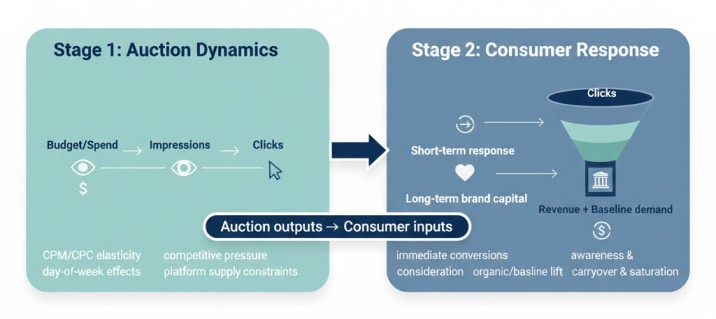
Stage 1: Auction Dynamics—Translating Budget Into Exposure
LiftLab’s Agile Marketing Mix Model (AMM) starts by focusing clearly on auctions: how ad spend turns into impressions and clicks in changing ad markets. Stage 1 measures:
CPM and CPC elasticity.
As spending increases within a platform or tactic, what happens to unit costs? Search campaigns exhibit rising CPCs due to competitive auction pressure, while programmatic display may show relatively stable CPMs until inventory constraints bind.
Competitive pressure and supply constraints.
When rivals increase budgets during peak retail seasons, your effective reach contracts even if spend holds constant. Stage 1 quantifies these competitive dynamics, isolating external auction forces from your brand’s consumer appeal.
Timing and context matter.
The day of the week, time, and platform each affect how well spend converts to exposure. By keeping these auction-level factors separate, AMM makes sure a single day’s price jump doesn’t distort the longer-term consumer response measured in Stage 2.
The output of Stage 1, impressions, clicks, or other engagement metrics, feeds directly into Stage 2. This separation clarifies that consumer response modeling now answers a different question: when auction dynamics are constant, to what extent does exposure drive incremental revenue? It separates the exposure obtained (auction) from its effect on consumers (response), making the distinction explicit.
Stage 2: Consumer Response—Translating Exposure Into Revenue
With auction dynamics cleanly separated, Stage 2 models how impressions and clicks influence purchasing behavior. This stage captures the marketing mechanisms performance leaders actually need to optimize:
Short-term performance effects.
Direct-response channels like paid search and retargeting drive immediate conversions, typically within hours or days. Stage 2 quantifies these rapid returns, enabling precise ROAS calculations uncontaminated by auction cost noise.
Long-term brand-building effects.
Upper-funnel investments in video, display, and social awareness campaigns generate impact that accrues slowly over weeks and months, building brand equity that manifests as elevated baseline demand and organic search volume. Traditional weekly or quarterly MMMs struggle to disentangle these persistent effects; LiftLab’s two-stage framework surfaces them explicitly, ensuring brand channels receive appropriate credit.
Carryover (adstock) and saturation.
Consumer response curves incorporate diminishing returns, the well-documented phenomenon in which each incremental dollar yields less incremental revenue as spending scales. Stage 2 also models adstock transformations, capturing how today’s advertising continues influencing behavior for weeks after exposure. These dynamics reflect genuine consumer psychology, distinct from the auction-layer efficiency curves in Stage 1.
By decoupling consumer response from auction dynamics, Stage 2 delivers response curves that reflect behavioral causality alone. If the model reveals saturation, marketers know it signals real demand constraints, not higher auction costs, which can be addressed through bidding or channel shifts. This separation avoids misdiagnosing problems and supports more precise optimization.
Why Separation Unlocks Precision: The Path to Confident Investment
LiftLab’s two-stage architecture transforms how marketing leaders diagnose performance shifts and allocate capital. Consider three scenarios that illustrate the value of separation:
Scenario 1: Declining efficiency in paid social.
Traditional MMM shows falling ROAS. The two-stage model reveals that Stage 1 auction costs rose 18% due to Q4 competitive pressure, while Stage 2 consumer response remained stable. Implication: Maintain spend to defend market share; efficiency will normalize post-holiday without creative or targeting changes.
Scenario 2: Flat performance despite budget increases.
Stage 1 shows impressions grew proportionally with spend (auction dynamics healthy), but Stage 2 response curves indicate saturation. Implication: Reallocate marginal dollars to undersaturated channels rather than continuing to scale the current tactic.
Scenario 3: Platform cost drops with no revenue lift.
Stage 1 captures the CPC decline, but Stage 2 reveals that click quality deteriorated (lower conversion rates per click). Implication: Revisit targeting and creative relevance; cheaper clicks aren’t valuable if they don’t convert.
Without the two-stage separation, these scenarios appear identical in aggregate metrics—each shows “efficiency problems.” The LiftLab AMM framework disambiguates root causes, enabling surgical interventions rather than blunt budget cuts or misguided creative pivots.
The LiftLab Advantage: Integration Through the Trust Engine
Separation drives accuracy, but decisions require integration. LiftLab’s Trust Engine™ unifies the two-stage AMM with a continuous experimentation framework, creating a closed-loop system where:
MMM guides experimentation.
The model flags channels with high measurement uncertainty or surprising saturation patterns, recommending targeted experiments (such as geo-holdout tests) to validate causal effects.
Experiments refine the MMM.
Real-world incrementality tests provide ground-truth data that recalibrates Stage 2 response curves, ensuring the model reflects actual consumer behavior rather than statistical artifacts.
Harness LiftLab’s two-stage model and Trust Engine™ today to unlock actionable, precise investment guidance. Take control of your marketing measurement, and contact LiftLab now to begin your transformation.
This architecture addresses the fundamental tension in modern MMM: the need for both stability (to detect true strategic trends) and agility (to capitalize on fast-moving platform dynamics). Traditional quarterly MMMs offer stability but miss opportunities; real-time dashboards react to every fluctuation but lack causal grounding. LiftLab’s two-stage approach, enhanced by PlatformSense, delivers both.
Implications for Performance Marketing Leaders
For Directors and VPs responsible for eight-figure media budgets, the two-stage truth in MMM translates to tangible competitive advantages:
Defend brand investments with causal clarity.
When CFOs question upper-funnel spending, Stage 2’s explicit modeling of long-term brand effects quantifies how awareness campaigns sustain baseline demand and reduce dependency on performance channels. LiftLab clients report an average 15% increase in upper-funnel investment after adopting the platform, driven by newfound confidence in long-term ROI measurement.
Optimize bidding strategies and budget pacing.
Stage 1 insights reveal exactly where auction saturation constrains growth, enabling tactical shifts—such as dayparting adjustments or competitive avoidance windows, that improve media efficiency without touching creative or messaging.
Eliminate false trade-offs between growth and efficiency.
By separating auction costs from consumer response, the AMM clarifies when “rising CAC” reflects temporary competitive dynamics (ride it out) versus true demand exhaustion (reallocate capital). This precision prevents premature abandonment of high-potential tactics and avoids over-investing in saturated channels.
Accelerate decision cycles from quarterly to weekly.
LiftLab’s Agile Marketing Mix refreshes weekly, incorporating the latest auction data and platform signals. Performance teams gain insights fast enough to inform the Monday morning budget call, not three months later when the opportunity has passed.
Embracing the Two-Stage Framework: From Measurement to Mastery
Marketing Mix Modeling evolved to answer a simple question: which marketing activities drive sales? For decades, the industry accepted models that treated advertising spend as a black box, assuming stable costs and direct sales effects. That approach sufficed in an era of annual TV upfronts and static print media buys.
Today’s digital advertising ecosystem, characterized by real-time auctions, algorithmic bidding, and minute-by-minute creative optimization, demands a more sophisticated framework. The two-stage truth recognizes that getting media (auction dynamics) and persuading customers (consumer response) are distinct challenges, governed by different dynamics, operating on different timelines, and requiring different optimization strategies.
LiftLab’s Agile Marketing Mix Model operationalizes this insight, providing enterprise marketing teams with a unified measurement system that separates for accuracy and integrates for decision-making. The result: marketing leaders who understand not just what happened, but why, and more importantly, what to do next.
When auction dynamics and consumer response are disentangled, full-funnel media planning transforms from educated guesswork into precision capital allocation. The path forward is clear: embrace the two-stage truth, and let data-driven confidence guide every investment decision.
Key Takeaways
Traditional Marketing Mix Modeling merges two forces that operate on different timelines: auction dynamics and consumer response
When both effects share one coefficient, a CPM spike and genuine consumer saturation look identical and the wrong fix gets applied every time
Stage 1 isolates supply-side noise. Stage 2 isolates behavioral signal. The separation is what makes the diagnosis reliable
Stage 2’s long-term adstock modeling is what makes upper-funnel brand investment defensible on the P&L. Brand channels finally get credit for the baseline demand they build
Marketing budget optimization built on a two-stage model stops treating every efficiency problem as one category. Each root cause gets its own correct answer
LiftLab’s Trust Engine closes the loop: the Agile MMM flags uncertainty, geo experiments reduce it, and consumer response curves get sharper every cycle
FAQs about Auction dynamics and consumer response
What is the difference between auction dynamics and consumer response in MMM?
Auction dynamics in marketing refers to the supply-side forces that determine how ad spend converts to media exposure: CPM fluctuation, competitive bidding, inventory availability, and timing effects. Consumer response modeling refers to how that exposure influences purchasing behavior: short-term conversion lift, brand equity accumulation, and saturation. Traditional Marketing Mix Modeling conflates the two into a single spend-to-sales coefficient. LiftLab’s two-stage AMM models each separately so the right lever gets pulled for the right problem.
Why does conflating auction dynamics and consumer response distort MMM outputs?
When a single MMM coefficient absorbs both auction dynamics and consumer response, declining ROAS can reflect a CPM spike, creative fatigue, or genuine demand saturation simultaneously, and the model cannot tell which. Each root cause calls for a different response: ride out the auction shift, refresh creative, or reallocate capital. A model that cannot separate them produces budget recommendations that are nothing more than an estimation.
What does Stage 1 of LiftLab’s two-stage model measure?
Stage 1 models how ad spend translates into media exposure under live auction conditions. It captures CPM and CPC elasticity as budgets scale, competitive pressure from rivals increasing spend simultaneously, inventory constraints that compress reach regardless of bid levels, and timing effects like dayparting that affect auction pricing without affecting consumer response. The output of Stage 1 is a clean exposure signal, impressions or clicks, that feeds Stage 2 without auction cost noise embedded in it.
What does Stage 2 of LiftLab’s two-stage model measure?
Stage 2 models how media exposure drives purchasing behavior. It captures short-term direct-response effects from performance channels, long-term brand equity accumulation from upper-funnel channels via adstock modeling, and genuine consumer saturation where incremental impressions stop generating incremental revenue. Because auction dynamics have already been removed in Stage 1, Stage 2 response curves reflect actual consumer psychology rather than a blend of behavioral and supply-side forces.
How does the two-stage model improve marketing budget optimization?
By separating the two stages, marketing budget optimization decisions become diagnostically precise. A budget increase that generates proportional impressions but flat revenue signals Stage 2 consumer saturation: reallocate. A budget held flat that generates fewer impressions signals Stage 1 auction pressure: adjust bidding strategy or timing. A CPM drop with no conversion improvement signals Stage 2 click quality deterioration: revisit targeting. Each scenario has a different correct answer that aggregate spend-to-sales coefficients cannot surface.
How does LiftLab’s two-stage AMM support full-funnel marketing measurement?
Full-funnel marketing measurement requires that both brand and performance channels receive accurate credit for their distinct contributions. Long-term adstock modeling ensures upper-funnel brand investments are credited for the baseline demand they build over weeks and months, not just the direct conversions they touch. Performance channels are credited for their short-term lift only, separate from the brand equity that made those conversions more likely. The result is a marketing measurement platform that gives CMOs and CFOs a single, causally grounded view of return across the entire funnel.