
- Platform
- Solutions
- Resources
- About
Move beyond theoretical, single-number forecasts. Build constraint-aware budget scenarios that predict accurate outcome ranges, set strict financial guardrails, and align Marketing and Finance before spending is ever committed.

Most marketing forecasts fail because they treat uncertainty as if it doesn't exist and ignore real-world business constraints.
"Optimal" models built in a vacuum might tell you to cut brand spend entirely to hit a short-term ROAS goal. Meanwhile, single-number forecasts create false precision, leading to finger-pointing when market conditions shift mid-quarter. You need a planning suite that accounts for uncertainty and respects your actual business limits.

When results are missing, teams argue rather than learn.

Minimum brand spend, channel caps, locked commitments, and promo weeks make “optimal” plans infeasible.

CPM spikes, conversion rate breaks, competitive moves, and promo changes can invalidate a plan mid-quarter.
Net result: the plan becomes reactive, budgets get reworked under pressure, and stakeholders lose trust.
Don't plan in a vacuum. Input your target KPI (growth, efficiency, or profit) alongside strict commercial realities, like minimum brand investments, channel caps, and locked TV commitments.
Generate practical Conserve, Maintain, or Accelerate budget scenarios. Forecast outcomes as dynamic ranges to visually highlight the exact trade-offs between short-term efficiency and long-term growth.
Publish your chosen plan with explicit guardrails (e.g., maximum move percentages) and monitoring triggers (like CAC spikes or conversion rate drops), so your team knows exactly when a plan is breaking and when to pivot.
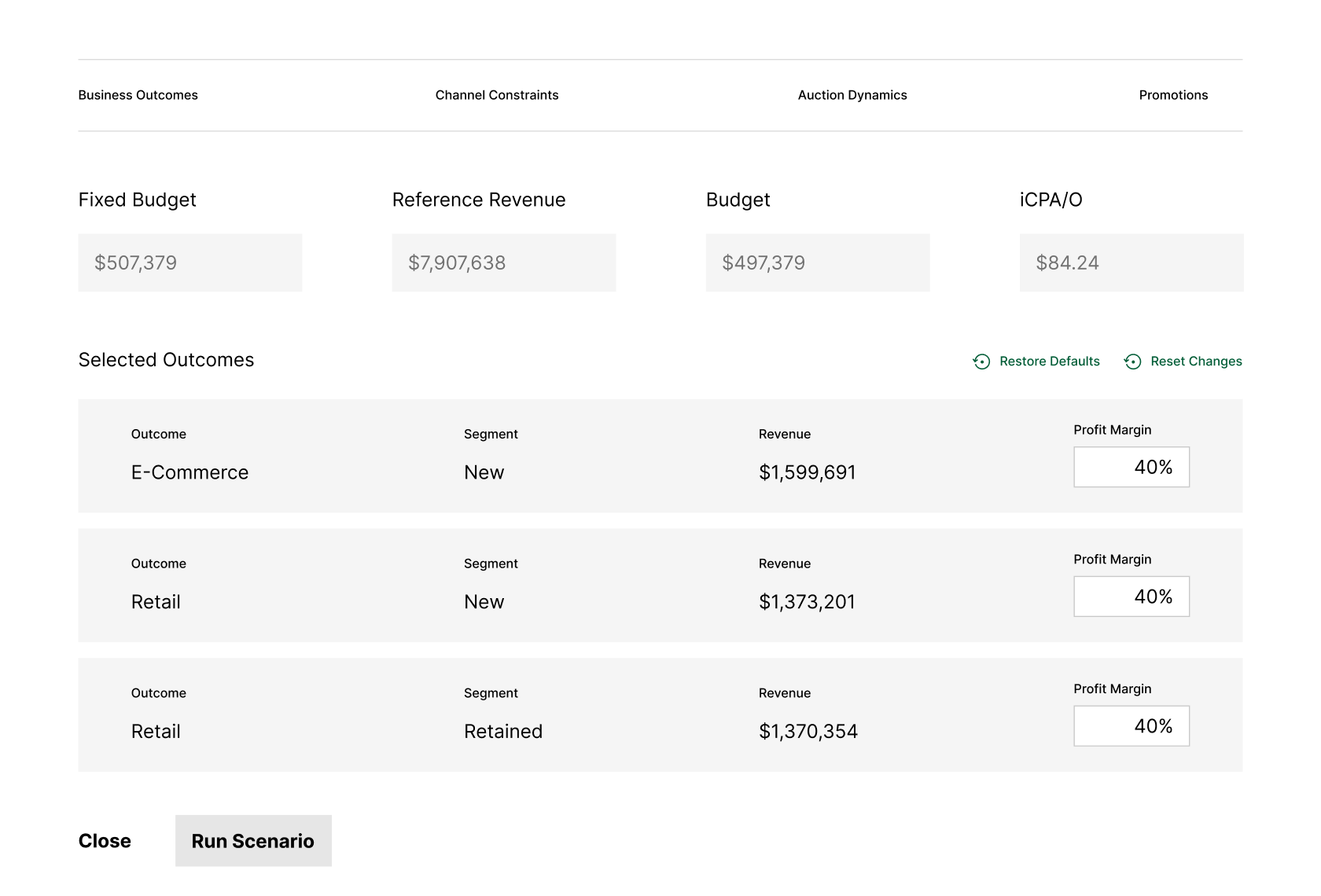
Run a Scenario
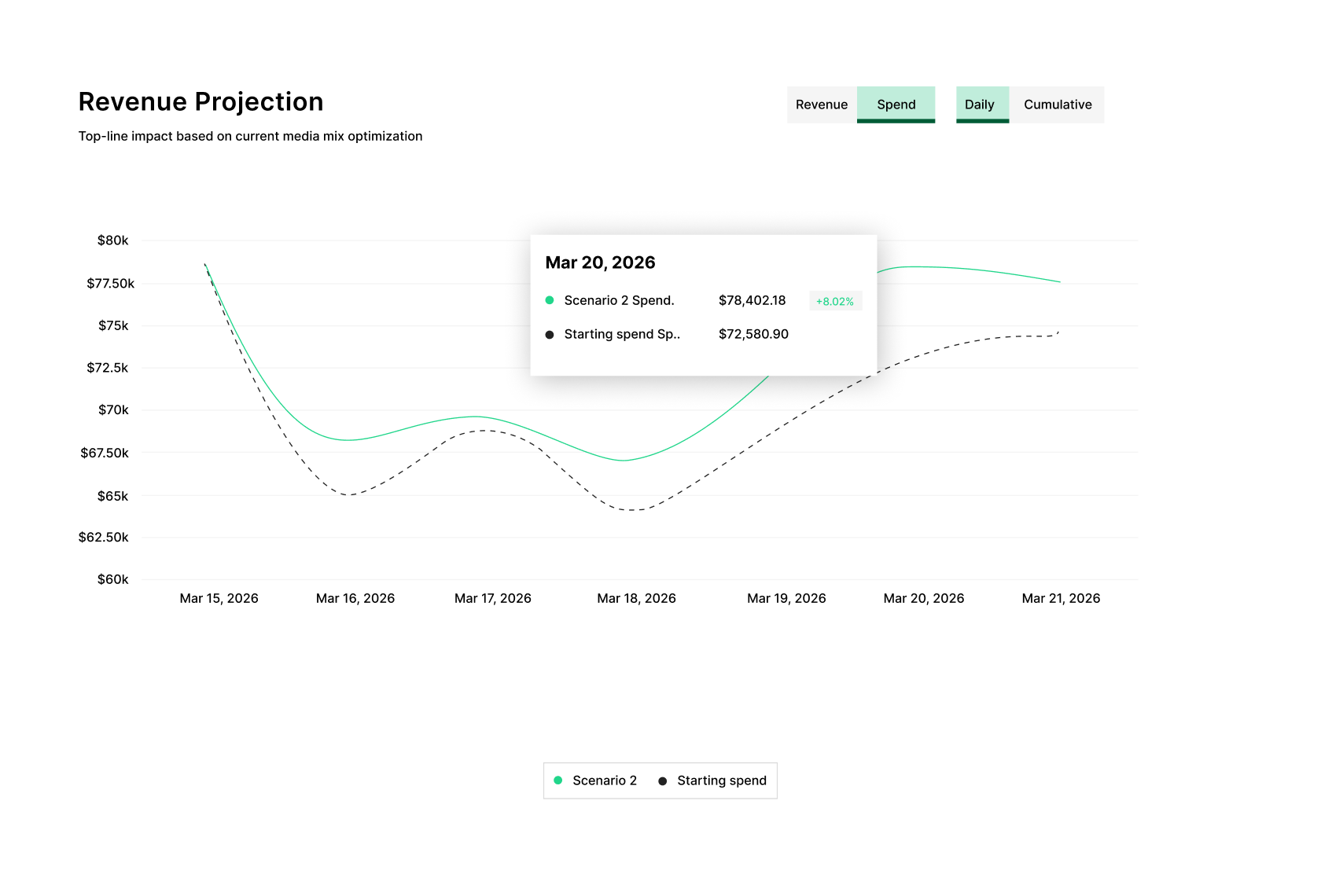
Forecast Ranges and Trade-offs
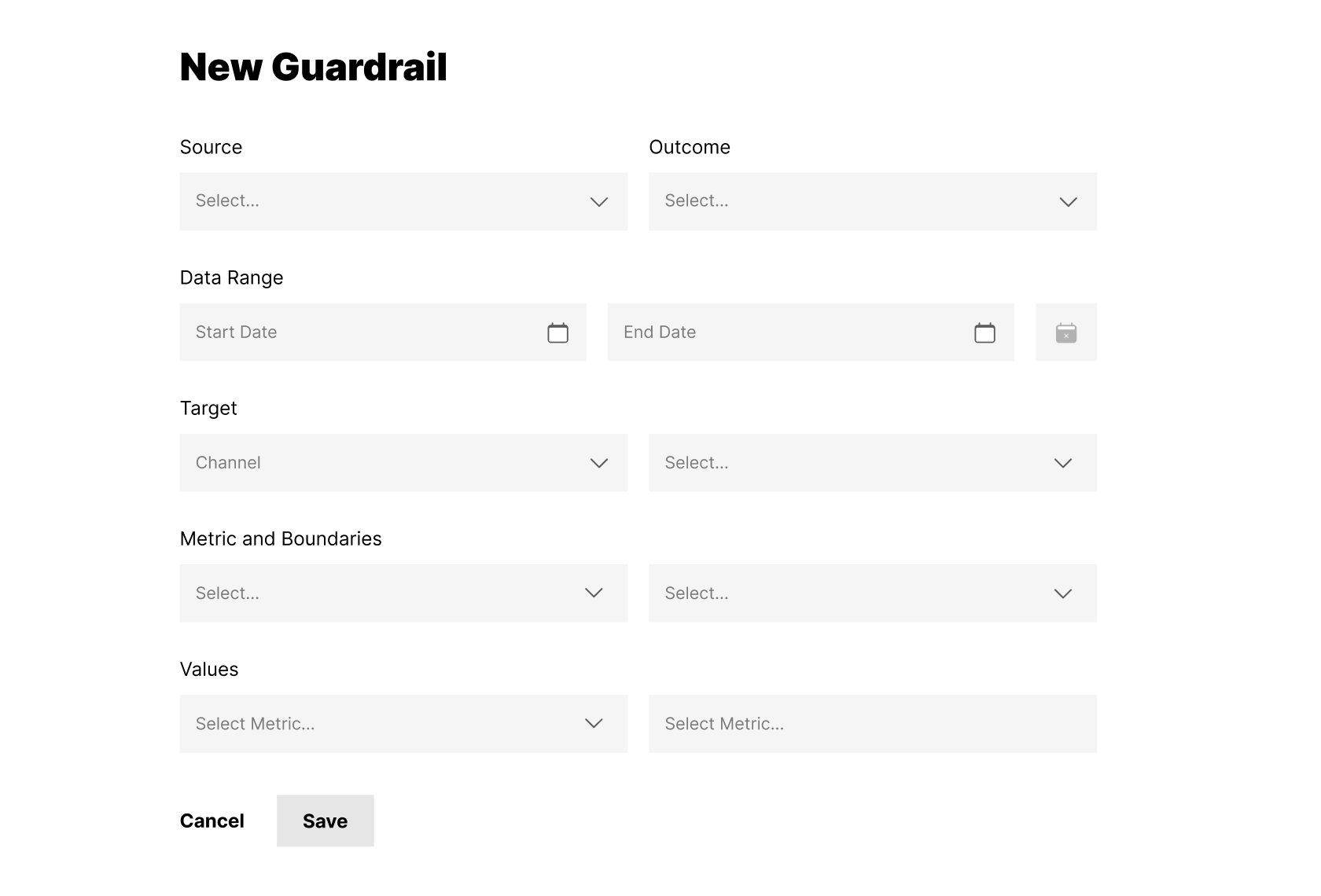
Setting up New Guardrails